Showing posts with label Food. Show all posts

Wednesday, March 5, 2014

Strict Lent - How to Make it Work!

Today, Taylor Marshall (whose blog I recommend) shared a story of how he ruined his Easter one year by trying to go too hard on himself at Lent -How My Strict Lent Once Ruined Easter – A Lesson on Lenten Crash and Burn.  Excellent post - go and read it!

I wrote the following as a response on how I moderate my Lenten penance.

1. Talk to Your Priest


I tend to "go hard" (this year, for example, I'm giving up meat, coffee and Facebook) but I moderate this in several ways. One is I take the advice of my priest; if he says something is too much, I believe him. Dr. Marshall mentions this point and it's very important; most priests have seen enough crash and burn stories that they can see it coming if you're being too hung up on going all out. I have done this since I first joined the Catholic Church (this is only my 3rd Lent) and priests are very helpful in giving direction like this.
 
2. No Penance on Sunday!
 
We must remember that Sundays are not days of penance; it's not that penance is "optional" but, from what I understand, it is actually incorrect, since every Sunday is like a mini Paschal feast, we are to celebrate on Sundays. Every Sunday I will be enjoying my meat and coffee (I'll stay off FB, though, since that could lead to a habit, and it's not really "festive" to go on FB in any way); this way it's only 6 days at a time, and these urges don't build up so much. I enjoy it thoroughly and in moderation. We're usually at my parents' house for lunch on Sundays, and they inevitably make a nice roast. My mom has coffee with the desert, and I wait till it's served (rather than gorging into the coffee the minute Mass ends), enjoy two cups with cake, maybe one more later in the day and leave it at that. (Basically, what I would do on a normal Sunday.)
 
Make sure the festiveness of Sundays is a celebrating Christ, not just gorging in the things you abstained from; we eat meat and cake, drink wine and coffee and spend our Sundays with family to celebrate the Resurrection. If you find yourself going crazy for meat (or whatever you gave up) on Sundays, it's probably a good early indication that you may need to make adjustments and you should talk to your priest to guide you through those adjustments, especially if you haven't yet!

3. Rededicate Penance to Christ

Even with the 6 day waits, it can be disastrous to start thinking about our penance day in and day out, and even more disastrous to become frustrated that you can't stop thinking about it. Meat isn't really an issue for me (my family eats meat only 2 or 3 times a week as it is), and I usually feel the break from FB is a relief; coffee could be a killer for me. But if I find myself thinking about coffee, instead of fighting it (which just turns into a frustrating battle with yourself over something silly), I let myself enjoy looking to forward to coffee, and then I pray a decade of the rosary or something like that, thanking the Lord for the coffee I'm going to enjoy on Sunday and rededicating what I have given up to Him.

4. Make the Penance a Gift

When I want coffee in the morning, I make a cup for my wife instead, who doesn't give it up. This seems like it would be counter-productive, bringing the temptation too close, but for me it works. I feel a certain satisfaction that someone else has enjoyed it and that I have made my sacrifice a gift. If you give up meat, buy a roast for the old widow next door (who in all likelihood hasn't given up meat.) We did that last year. If the temptation is too much, then find another kind of gift to give instead.

5. Don't Isolate Yourself

Try penances that other people around you are doing. Support helps. In the old days, besides being holier (as Dr. Marshall pointed out), people had the support of EVERYONE around them doing the same penance. Some Catholic and especially Eastern Christian communities still have that. We as North American Christians don't. Meat isn't hard at home for us, but my parents (who we visit often) rarely have a meal without meat. My wife and I support each other, and my parents are very understanding, so we get by. As for coffee, my wife doesn't give it up, but she also never makes coffee for herself at home (that's my job!) So, I don't have to smell coffee brewing from the kitchen, unless I'm the one who did it as a gift for my wife.

If you know that people bring cookies to work every day and you love them, or there's a bakery you walk by every morning, it could be torture to give up sweets. Don't choose penances to torture yourself. I give things up that are important, but not things that will be wafting in my face all the time.

6. Leave Yourself Some Pleasures

I love beer and wine. Having given up coffee, I can still sit down in the evening and enjoy a glass of wine with other people. I also enjoy my pipe. If I tried to give up alcohol and tobacco too, it would be torture since I wouldn't have that little pleasure to fall back on - and I can enjoy the pipe even on Ash Wednesday or Good Friday when I'm otherwise fasting as per the rule! Don't try to eliminate every one of the most pleasurable items, but rather specifically choose a couple that you WON'T give up.

7. Build Up Little by Little

In my three Lents I've progressed from giving up one thing to three. I don't expect to increase this by one item every year, but I hope that in 20 years I can handle more than I can now. Disciplines are developed with time, not over night. I will also not feel bad if one year I have to go easier on myself for some reason or another.

So, it's possible to go hard for Lent, but it's not by any means necessary or even helpful to torture yourself.  I think these little guidelines I've created for myself have been a big help.

Thursday, May 23, 2013

May is Time to Start Another Garden!

For my family, gardening has progressed from accidental tomato and papaya plants, to our beautiful bougainvilleas and mini rose bush in Playa del Carmen,
to last year's sunflowers here in Canada, and this year to a shared garden and a more complete house-side garden (instead of the usual flower gardens.)

Our elderly neighbour, who can no longer plant her garden alone, as asked me to help her plant and care for her garden, and has offered us the share the vegetables.  Her garden includes:
  • tomatoes
  • green, red and yellow peppers
  • potatoes
  • onions
  • radishes
 and a few other items I can't remember right now.  Here are some pictures:


In the same flower garden where we planted the sunflowers last year, I planted various items since they all have space between them:
  • tomatoes
  • sunflowers (which will be tall and rise above the rest)
  • string beans (between the tomato plants)
  • marigolds (in a well-spaced line right in front)
  • cilantro (between the marigolds)
  • more potatoes (around the more shaded side of the house)
I don't know if I've crowded too much in, but we'll see.  It's our first experiment.  Weeding won't be a problem since it's all accessible from the front of the flower garden.  The kids helped to plant it again, and were very excited.

Unfortunately, I didn't get pictures of the kids helping, but I'll get pictures of them at harvest time.  Here are some pictures I took of the visible plants later in the evening:


These are the packages from the cilantro and string bean seeds:


I'm looking forward to enjoying fresh vegetables in August and September!

Monday, October 8, 2012

Thanksgiving in Canada

Unfortunately, I wasn't in Canada to celebrate Thanksgiving this year; fortunately, my wife "shared" the dinner with me by means of pictures.  Looks delicious:

Table set

Some of the Family
(By the look of these first two pictures - looks like bacon and eggs - I'm not sure if it was breakfast, or the first part of the dinner.  In any case, I wish I were there ...)

Main course


If this is what I think it is, it's a "cooked salad" - some of the veggies are cooked, others are raw, with peanuts and grapes; I'm not sure if this a Mexican thing or my wife's creation, but it ends being pretty good.


Happy Thanksgiving to all!

Saturday, October 6, 2012

Another Beer, with a Mexican Snack ...

Tonight's Mix:

Leon Beer
The dark "Munich-style" beer I mentioned in yesterday's post. (see Mexican Beers - 2 of My Favorites.)

Chicharron
This is fried pork skin, that is dry kind of like chips.  As unappetizing as the description usually sounds, it's delicious.  Not the healthiest thing in the world, but tasty.

Valentina Sauce
This is a favourite Mexican sauce, good for just about everything from eggs to popcorn, french fries to pizza (if you're Mexican, that is.)  Tonight it's going on the chicharron.

Not a bad Mexican snack.  The beer is my favorite part.

The unusual part of the mix is Leonard Cohen.  Not very Mexican.

By the way, I go the chip for my camera (well, actually for my wife's camera; I don't own cameras.  If I do, she expropriates them.)  So, today I have a better picture.  Tomorrow I'll have more pictures of the city and other stuff, once again.

Friday, October 5, 2012

Mexican Beers - 2 of My Favorites

I don't have a whole to do on weekend evenings these days.  I'm in Mexico, without my family.  I've forgotten what it's like to be alone and go out and do stuff.  I feel like I should be changing a diaper, or doing the laundry. (Come to think of it, I do need to do the laundry.  Funny how I forget about that when I'm alone.)

In order to save money, I've limited myself to visiting some old acquaintances here (who also seem to stay at home with nothing to do), or, in the case of this evening, buy some beer to take home and drink it while reading (and writing) blogs.

Today, while reading some good pages, I've been enjoying two of my favourties: Leon, and - probably tied as my favourite Mexican beer - Negra Modelo.  The other favourite is Noche Buena, which is a special Bock beer sold only at Christmas time; the name means "Christmas Eve" and "Poinsettia," which is the logo of the brand.  Unfortunately, it's still much too early to find Noche Buena.

All of these are dark beers, which tend to be my preference.  However, a good Mexican light-coloured beer is Pacifico, which was originally a contribution from German (or more correctly, German Bohemian) immigrants in the north-west of the country (specifically Mazatlan) who also gave Mexico it's famous Banda music; this music - even in it's countryfied, popified versions - still carries the tradition of the triple beat (ump-pa-pa), the accordion and bass which are so characteristic of the famous Polka brought by the unMexican immigrants.

For most of us, it's rather strange to make any connection between German and Mexican cultures; the seem to be rather polar opposites in so many ways; but there it is, real and unmistakeable - both in the beer and the music.  (Incidentally, my own Germanic roots have come through Mexico.)

The German taste for strength, flavour and distinction combine well with the Mexican taste for easy smoothness and a happy life. (Yes, that's my description of Noche Buena, and applies to Pacifico as well; it could also be a description of parts of my life.)

Cheers!  Prost! and Salud!

(P.S. Still no memory card for the camera; but I remembered that my laptop can take pictures too!  The only problem is it's not convenient for taking pictures in the street.  The memory card will come tomorrow.)

Wednesday, August 22, 2012

Mexican Mole Sauce, Nuns, Archbishops and Holy Grail

Next to Mescal, I would say mole ("mole-lay") is Mexico's best kept food/drink secret.  But the word is spreading.  Mole is now sold in my local supermarket here in Canada.  Here's a nice post from Mexico Today, all about mole and religion (or, at least why some people get so religious about mole!):


Mole: The Delicious Quest

I love mole. I think it’s heavenly. In fact my plan was to use the title, “Holy Mole,” for this story, but Chef Rick Bayless, the renown American chef of Mexican cuisine, beat me to it. I suspect he feels the same way I do about mole. It’s an appropriate title for a number of reasons, but before I get into that I should probably start with first things first.

One of the great mysteries of the world is why a dish so common and beloved in Mexico should be so little known in the United States.  By any measurement Mexican food is a smashing success in the U.S. Ask any American about tacos, enchiladas, tostadas and he can tell you about them.  But mole’s fate up to now has been less certain.

What is Mole? (Moe Lay)

Part of the reason mole hasn’t made the same impact in the US as other Mexican foods is it’s a little hard to define, although you certainly know it when you see it.  It always includes chiles. Most folks, though not all, agree it’s a sauce. I’ve never been served a bowl of mole by itself, it always enhances something. Many exotic locales in Mexico claim its origin and mole can be vastly different, especially from region to region. In fact mole isn’t just one thing, there are many moles.

The most famous moles come from Puebla and Oaxaca.  In Puebla, mole poblano, as it is known, is a rich, dark, spicy, sweet, sour, nutty, and savory sauce that can be made from upwards of 30 ingredients like onions, tomatoes, and chiles, but also raisins, almonds, fennel seeds, tortillas, and chocolate to name a few.  Traditionally it is served with turkey, but commonly it’s served over chicken or even vegetables.  Certain mole types are served with fish.  In Oaxaca, at least six distinct types of mole are identified mostly by their colors-such as colorado or red and verde or green-which reflect differences in ingredients.

Another likely reason moles are rarer in the US is they are difficult to make and even more to perfect.  Just the number of ingredients makes mole a labor of love. But in addition, getting the ingredients right isn’t enough, the proper roasting, frying, straining, simmering, and cooking of the ingredients is critical to a successful mole, so just adding them all to the pot won’t work.

I suspect another reason moles have been slow to spread in the States is it may have been difficult, until very recently, to simply find each and every ingredient folks needed to make mole the way their mamas did back home.

So Why Holy Mole?

Well, first it’s just so divinely yummy, and the best moles give the same type of pleasure the complexity of well-aged wines do!  Then there’s the legend.  Growing up in Mexico, popular legend had it that the poor nuns at the Convent of Santa Rosa in Puebla prayed for help in providing a meal to the visiting archbishop. After praying about it they basically threw everything at the problem, save for the kitchen sink-spices, fruit, nuts, chiles, vegetables, chocolate- and it was a hit.

Lastly, and more to the point, the best moles, with their complexity, depth, richness, and exotic, roasted flavors are just heavenly, which means searching far and wide throughout Mexico for my favorite is like the quest for the Holy Grail. It’s all about the delicious journey.

¡Buen Provecho!

If you would like to see or even test your culinary chops on a yummy, traditional mole recipe from Puebla, here’s a link to a post by one of my Mexico Today colleagues, Brad Johnson, who shares his favourite mole recipe from a restaurant in Puebla.
Most importantly, here are some mole festivals; if you happen to be in any of these areas, do go and explore the wonderful world of mole:

And here are a few leads in your quest for Mole, both in the US and Mexico:

  • In Puebla, The International Mole Festival is aimed at foodies, tourists, cooking professionals, and students from the more than 20 culinary schools in Puebla. English and Spanish simultaneous translation will be available. Look for it near May 5th each year.
  • In San Pedro Atocpan, the National Mole Festival (Feria Nacional del Mole) in October, from the community where reportedly 60% of the mole consumed in Mexico is now made.
  • In Los Angeles, CA, La Feria de los Moles (The Festival of Moles) takes place on Olvera Street and continues growing each year.  This year is the 5th annual event and takes place on October 7th, 2012.  Check out www.feriadelosmoles.com for more details.
  • In Querétaro, the Feria del Mole y Tortilla (The Mole and Tortilla Festival) occurs in July.
  • In Coatepec de Morelos, Zitácuaro, Michoacán, Feria de Mole (Mole Festival) in April.
  • In Chicago, the 4th annual mole cook-off and street festival entitled Mole de Mayo took place on May 26th-27th and takes place in May each year.

 (Thanks to the Mexico Report for the link!)

Thursday, August 9, 2012

A Different (and Wonderful) Kind of Gift for Families with Newborns!

For parents of newborns a meal they don't have to cook is a great help!
3 weeks ago, my twins were born!  Since then, we've had many visits from family, friends and neighbours.  Besides the pleasure of seeing people and the joy on their faces when they held our babies, almost everyone also brought gifts. We are very thankful for all the gifts and - most importantly - the love and support so many people have shown us!

Yet, there's something different that happened this time.  Anglo Canadians, like Mexicans, bring gifts of clothes, toys, bottles, diapers, soothers, etc.  All very helpful and useful items, and all received with gratitude! However, something new for both me and my wife was the kind of gift that the our Old-Colony Mennonite (also known as Mexican Mennonites or Low-German Mennonites) friends, neighbours and relatives have been bringing us; they bring meals! (Sometimes in addition to the other kind of gifts.)

The first (Mennonite) family that visited us - some new friends who we've been getting to know this summer - called us one day shortly after the twins were born and asked if they could bring supper over around 5 pm.  All of us being over tired and not in the mood for cooking, we were delighted with the idea.  My mother-in-law (who has flown in from Mexico City, just to help out) and I hurried around to see if we could find enough dishes for the guests.  When they arrived, they passed dinner to us, and we asked them to come in.

"No, it's OK," they answered, "we just wanted to bring supper.  We'll be on our way and come to see the babies in a couple of days when you aren't so tired."

(They did come back in a couple of days, and we weren't so tired.)

At first we thought it was just a one-time idea that a friend had thought of; but as the weeks went on and neighbours we hardly know started bringing us dinner, we realized that this must be some sort of custom; we have no idea if all Old Colony Mennonites follow this custom or if it's just a local thing.  In any case, it really is a great idea.

(As a complete side note, I noticed that the meals all included [delicious] home-made chicken noodle soup; in Mexico, people believe that eating chicken soup is good for the mother of newborns.  Perhaps these people - most of whom spent most of their lives in Mexico - believe the same thing?  It was delicious - I hadn't had this kind of soup in a long time. The rest of the meal varied greatly, from Mexican-style stuffed peppers to fried chicken.  All very tasty!)

Over the next few weeks (in fact, right up to today) we've had neighbours bring us supper about 3 or 4 times a week.  It's incredible how much this has helped us.


Next time someone who lives nearby has a baby, we're going offer to cook a meal or two for them ... and "Thank You" to all of our friends, family and neighbours who cooked for us!

Thursday, May 3, 2012

Prosperity and Abundance

In a previous post, I wrote that I don’t believe that poverty in its truest sense exists in most places I’ve been to; even the poorest place I’ve been, where $500 dollars is a massive fortune, the people have never gone a day of their life without more than enough food, the clothing they need and a house to live in.  They have very little, but they are lacking nothing.

This doesn’t mean that true poverty doesn’t exist; it simply means that it in our comfortable world of prosperity and abundance, we have a skewed definition of poverty. Many of us have more than enough food every day of our lives, and money to spend on all sorts of extra items that are in now way necessary to live on, yet we consider ourselves poor or low income.

The village where we live in Canada has a large number of Mennonites arriving from Mexico; many live on incomes much lower than Canadians consider “necessary” with families much larger than Canadians consider sane.  Some church charities have noticed the situation and taken steps to help out.  For example, one day of the week, there is a sewing circle in a church basement here; one of the charities goes to a local grocery store and picks up all the fruit and vegetables that the store can no longer sell.  About 90% of these are still good, and only very few have gone bad.  The people who take these pick out some of the fruit, but leave pretty much all the vegetables and even some of the less popular fruit.  If there were anyone truly living in poverty, I’d suspect after everyone had picked out their favourites, they would pick it up the whole box and take it home to feed their needy family.  But no one does.

I am not complaining about or criticizing abundance, I’m only saying that we are so surrounded by abundance, that we don’t even realize it.  We begin to think that abundance is poverty.

Personally, I’m thankful for some of the benefits that overabundance brings.  Besides regular thrift shops which sell excellent used stuff for cheap prices, there’s a shop nearby called the “Twooney Barn.” It’s basically a thrift shop where you pay whatever you want for things.  You can also exchange furniture, clothing and a bunch of other items.  When you’re done with things, you simply take them back if they’re still good.  My wife went there for the first time today and completed the few things we still need for our new apartment here in Canada.  It helps keep the budget in check.  Places like that wouldn’t be possible without a culture of overabundance.  I’m thankful for and to the people who have too many things and are willing to give away some of those things, despite the fact that they are in perfectly good condition, so people like us can buy them at whatever price we see fit.

So, yes, I’m thankful that we live in a place of abundance and prosperity.  It only surprises me when people don’t realize how abundant and prosperous life really is.  Realizing this would help us do more for those who truly are poor.

Wednesday, February 29, 2012

Why I'm Not Vegetarian


First of all, I need to start of by saying this is not an anti-vegetarian rant. In many ways, I sympathize with and practice vegetarianism, (depending on how you define vegetarianism - I point I'll get to below.)  I eat very little meat.  My family buys and eats small portions of meat once a week, and we're happy with that.  We would probably be just as happy if we ate no meat at all.  For lent, we are eating no meat (except on Sundays if the occasion arises, which it usually does with our very carnivorous friends and family.)  Lent is hardly a change or challenge.  During normal weeks, we don't miss it or even think of it if we miss our weekly trip to the butcher.  So why don't I just take that easy step and make myself vegetarian?  Here are my reasons.

Vegetarianism is a means not an end.  In its proper context, practicing vegetarianism at times, most of the time or even all the time is a means to accomplish something else - health, religious devotion, saving money, economic improvement, protesting animal abuse, etc.  In their proper context, I consider all of these valid; I would definitely say some of these goals are more important than others, but all have some degree of validity.  But when we define vegetarianism as a practice which is a means to accomplish another goal, it means that there is no such thing as a "vegetarian."  Both a monk and an animal rights activist may practice vegetarianism, but it would absolutely incorrect to lump both together under the category of "vegetarian."  Their reasons have nothing to do with each other, and their manner of living and focus in life are entirely different.

Vegetarianism is something you can do sometimes, and not at others. This definition of vegetarianism (a means to accomplish other ends) is the definition I support. Depending on the purpose, I sympathize with and practice vegetarianism.  This definition allows someone to practice vegetarianism 95% of the time, then eat meat at the family Christmas dinner without feeling they've "lost their (meat) virginity," so to speak; it allows people to practice vegetarianism during religious fasting, and enjoy eating meat again when the feast day comes.

The label "vegetarian" makes vegetarianism an end rather than a means.  I would say most if not all vegetarians start off with something like I described above; they abstain from meat for a specific purpose which is an end more important than the practice itself.  Yet, I  feel that often once people make the leap and finally to call themselves "vegetarian," (note: this is not giving up meat altogether, but actually taking on the label) the relation of means vs. end gets turns on  its head.  Vegetarianism is now the end, and the purpose, and all the other ends (religion, health, animal rights, economy) suddenly become the means to justify being Vegetarian.  A vegetarian trying to convince someone else to become vegetarian (a situation that couldn't happen in the above definition) will give a long list of justifications - "Take your pick," is the message, "so long as you become vegetarian, it doesn't matter what your reason is."

Vegetarian purity. Once someone calls himself "vegetarian," he is committing himself to NOT eating meat pretty much at all costs.  I've seen vegetarians have a whole household running around trying to change the food so they can eat it. If a "vegetarian" eats meat once, they've committed a grave error on a moral level. They're left with the moral conflict of whether they will continue to be vegetarian or give in to their failure and abandon their cause.  Being vegetarian, if you're not careful, can become like a religion in itself.

I probably don't have to say that I'm not a fan of this kind of vegetarianism. Besides the fact that I still haven't heard a compelling reason to give up meat completely (to eat less or even little meat, yes, but to eat no meat, no,) I've never liked the idea of putting my hosts to all sorts of trouble to accommodate my preference.  The most important point is, I see vegetarianism as a means to accomplish more important goals.

I will continue to practice vegetarianism as often as it's necessary or reasonable to do so.  I'll continue practicing vegetarianism many days of my life because meat costs too much; I'll continue practicing vegetarianism during religious fasts to focus on God and give more to others.  On the other hand, for now, I'll continue eating meat when my family feels like it, to celebrate feast days and (usually) when I'm at another person's house and they offer me meat. But even if one day I stop eating meat altogether, I still won't be "vegetarian," because it will still be a means to accomplish another end, and not an end in itself.

Thursday, February 23, 2012

Good-bye, Meat!


A Torta Cubana (source: Prone to Wander Blog)
One folk etymology of  the word carnival is that it comes from the middle Latin "carne vale" which means "farewell to meat." So, while I didn't watch any brightly coloured dancers or have any big festivities during Carnival, on Shrove Tuesday, I said good-bye to meat. I ate a huge meat-filled "torta Cubana" (a sandwich like the one in the picture - see Vitamin T - The Mexican Special) and drank a litre of beer ("caguama" is the word they use here in Mexico - see Illegal Immigration - An Alternative Approach and the label "Beer.") and said good bye to both for the 40 days of Lent.

As a side note, this connects to a theme I've been meaning to write about for a while, namely vegetarianism, and my opinion that the proper place of vegetarianism is as means that leads to another end - first and foremost religious, and also health and economy as secondary reasons.  Interestingly enough, the "economics" of not eating meat is actually part of the religious reason; one reason to avoid eating meat (or abstaining from other items) is to save money to give to the poor.  The other part has to do with focusing on God rather than the flesh (the other meaning of "carne.")

Vegetarianism (as I see it) is misled and misleading when it becomes an end rather than the means. But more about that when I finally get around to writing that blog.

In the mean time, good-bye meat and good-bye beer.

[Note on the etymology of Carnival: the more philologically accepted etymology seems to be that it's from Italian "carne levare" which means "putting meat away."  It basically amounts to the same thing.  See - http://www.etymonline.com/index.php?term=Carnival.]

Tuesday, January 24, 2012

Roasting My Own Coffee

My home-roasted coffee
As of this weekend, I just discovered a very nice way to have very good, freshly roasted coffee at home all the time; roast your own coffee.  Especially in Playa del Carmen, where there are no coffee roasters (as in Cuernavaca, Mexico City or Toronto.)  The best I had found here so far was a coffee from Chiapas, but was pre-roasted and pre-ground; it was good, but, you know, there's nothing like coffee that was roasted this same day. (To be fair, there are excellent grocery store brands too, but I almost never go to the grocery store, so I don't feel it's worth the time walking through the whole store, going through the check-out line, etc.)

On Sunday, having found out that the coffee vendor had moved to a new spot inside the municipal market, I went through the market to find him.  On the way, however, stopping by a shop that sells bee propolis (the pollen that the bees collect from flowers, before they turn it into honey, which is good for sore throats and colds.)  Just out of curiosity, I asked if he happened to sell coffee; I felt that since my other coffee supplier moved his shop, I was justified in shopping around.

He didn't sell coffee, but he did sell the green coffee beans, he told me.  The coffee was also from Chiapas, and it was less expensive (about $10 CDN / kg or about $4.50 a pound.)  I remembered that my wife had bought a little coffee grinder (to grind grain for the baby.)  Roasting my own coffee would be fun, I thought.  So I bought a quarter kilo (about half a pound) and was happily on my way home to roast and grind my own beans.  The result has been amazingly good coffee!

Here are pictures of the process:
The shop where I bought the green coffee beans


Another view of the shop (with me on the other side)

The green coffee beans

Coffee beans roasting - about half-way done.


Me stirring the coffee beans (about halfway done)
 
When the coffee is almost done, it will fill your house with smoke.  Beautiful smell.  My wife wasn't impressed.

Cleaning some of the left over husks off the coffee beans; I'm not sure if this is necessary, or perhaps it should be done when they're still green?.
The ground beans, ready to brew
Brewing ...

The finished product - delicious, home-roasted coffee!

Saturday, September 17, 2011

The Great Canadian … Gut!

Man with gut - Cartoon

2 or 3 months after moving to Canada, my wife and I discovered a problem; our pants were getting too tight! We found a scale, weighed ourselves and discovered that we had each gained about 10-15 pounds!


While weight comes and goes depending on different factors in lifestyle, there was no question about it; we had both gained considerably more weight during 3 months in Canada than we had at any point during our 5 years together in Mexico!


We have a few theories, some of which can be discarded, and others more plausible. 


The discarded theories include:

  • Relatively recent childbirth: It’s a fact that most women gain weight during and after birth.  But there are two problems; this doesn’t offer me any excuse, and my wife had actually lost all of this extra weight before we moved to Canada, and she was down to her normal weight!  So this one’s out the window.


  • I started a second blog: More blogs means more sitting time. But this is no excuse for my wife.  Also, I cancelled this blog, and we found no difference for the two weeks when we were in Halifax, and I wrote no blogs whatsoever.


  • Canadians eat more fat and more carbs: True, Canadians seem to know no limits to these two nutrients; even “healthy” Canadians seem to think that eating fried steak with fried eggs and mayonnaise is a good low-carb diet. But Mexicans are at least as bad.  In fact typical Mexican food is probably worse.  Mexicans eat lots of bread loaded with sugar every day, plus tacos and tortas and tamales with grease dripping of them. See ().


We came to these more acceptable conclusions:


  • Canada is built for cars: In Mexico, if you don’t have a car, you end up walking a lot more and getting more exercise. I would say 3/4 of the country’s communities are designed to be walked in. In Canada, most people have a car; if you don’t have one, you simply don’t go anywhere.  Most communities are not designed to be walked in, and don’t have anywhere to walk to. (There are, of course, major exceptions.)  We live in a small village that takes 5 minutes to walk across, which hardly offers any exercise. We’ve been fortunate enough to have a car made available to us when we need it.  (We are really thankful for this!  But we’re also sure the guts are somehow related …) We started daily bike rides, but it’s one thing to have daily bike rides as an optional form of entertainment, and a completely different thing to have a couple of hours of biking or walking as a normal, non-optional part of your daily routine (= our life in Mexico.)


  • It’s easier to eat healthily in Mexico: While the typical Mexican diet is at least as bad as the Canadian one, it’s easier to be healthy in Mexico if you want to.  Fresh fruit and vegetables are cheap, as is freshly caught fish.  Someone pointed out how much oatmeal we eat for breakfast; in Mexico, we ate twice much oatmeal for breakfast, but we also ate twice as many fruit and vegetables, and we almost never ate desert or sweet things, since it’s so easy by cheap and good alternatives (fresh fruit.)  Red meat was a once a week meal, rather than the 2 or 3 times a day many Canadians seem to like. 


The difficult thing is that it’s really hard to eat differently in Canada; fruit and vegetables are expensive, often imported from the other side of the world, and rarely of good quality.  The fall is an exception here, since there is a good deal of local fruit available; yet if you are eating the fresh blueberries with Canadians, they like to mix them into ice cream!  Fish is outrageously expensive (compared to Mexico.)


I guess the bottom line is, even though most people in Mexico aren’t interested, it’s much easier to be active and eat healthy on a low budget than in Canada.  We’re hoping the guts will disappear when we get back to Mexico, and for our next time around in Canada, I think we’ll have to do more careful planning for exercise and healthy eating.

Friday, September 9, 2011

Made in Canada from Imported Ingredients

Peanut

A while back, my wife and I bought a bag of peanuts in their shells.  Nothing terribly exciting interesting.  However, out of habit, I like to read the list of ingredients even on the Peanuts - Bagsimplest products.  The bag reads:

Ingredient

Peanuts.

May contain tree nuts.

So far, so good. Then, out of sheer boredom, and something to do as I peeled and munched on peanuts, I read the other side of the bag.  This is how the first two lines read:

MADE IN CANADA FROM

IMPORTED INGREDIENTS


Peanuts - IngredientsI understand one part of this: the one ingredient (peanuts) is imported.

What I don’t understand is exactly which part of it was “made in Canada.”  Perhaps if it said “packaged in Canada” I could understand what they mean.  But “made in Canada??”


I didn’t think we as Canadians cared enough about whether a product was domestic or Peanuts - Made in Canadanot to make this kind of absurdity necessary.  Then again, I could be wrong.


I guess I could call that toll-free number to find out exactly how a peanut can be made in Canada from imported ingredients.

Wednesday, July 6, 2011

Another Odd Job; Butchering Chickens

Bleeding the ChickensDuring the past week, some of the Mennonites ladies who live in the community found a new way to generate some income.  They bought living chickens for 75 cents a piece, butchering them, removing feathers and gutting; then they sold the chickens for $3 a piece.

Recently, these ladies had been inviting my wife to join in their enterprises (including the garlic scrape cutting job I wrote about a while back.)  However, although my wife spent a few months every year of her childhood on her grandpa’s farm, she could not, for the life of her, get herself to kill, pluck or clean chickens.  What she could Steamed Chickensdo was take pictures – of everything but the beheading.

Enjoy the pictures.

P.S. – I would have expected this to be a part of my Mexico experience rather than my wife’s Canada experience, but in any case, here it is.
Butchering chickens - plucking feathers


Cleaning the chicken


Prepared, butchered chickens

Wednesday, June 22, 2011

Back to the Fields – Picking Garlic Scrapes

Garlic PlantI've always wondered what it is like for families coming from other countries that do temporary field work on top of their regular jobs to help get ahead in their new home; many Mexican immigrants, among others, have experienced this.  Here in Ontario, many "Mexican Mennonites" who have arrived from Mexico over the past decade participate in this kind of activity, bringing their whole family out to the fields.
Two days ago, my wife and I decided to try it out for ourselves (we don't bring the kids along.)  The job we found, through our neighbours, was picking the tops off garlic plants; after I finish my day's work on the computer, we drive out and start the field work.
The hardest part about this job is bending over.  You half to walk along the rows of garlic, snapping off the tops.  The second hardest part is that the juice from the plant burns, especially if it gets between your nails.  Today, the only pain I feel is in my thumb nails; or perhaps it's just that the pain is so sharp that I don't feel the rest of it.
Both evenings we've been there, we go with neighbours, and see other families show up.  The kids run along the rows breaking off the tops almost as fast as I do; it's easier in a way since they don't have to bend over.  Apparently some families, eager to earn money, started taking their kids during the day, instead of sending them to school.  The farmer realized what was happening and started sending families away if they showed up with kids during school hours.  (The work is come-and-go as you please - you just have to ask him where to work when you show up, and report what you've done when you leave.)  I'm really happy that he made that decision.  It's good to see that at least one person values education over quick cash.  He pays decently as well.
This isn't the first time I've done work like this, but it's the first time seeing families work like this together. My parents always told me about it (they had to do it when they arrived from Mexico as kids.)  It's a new experience.  For me it's not quite the same since it's not out the same pure necessity that the other families have.  But at least I can see it, feel it, and do it, first hand.

Tuesday, May 3, 2011

Mennonite Cheese - A Favourite in Mexico, and at Home

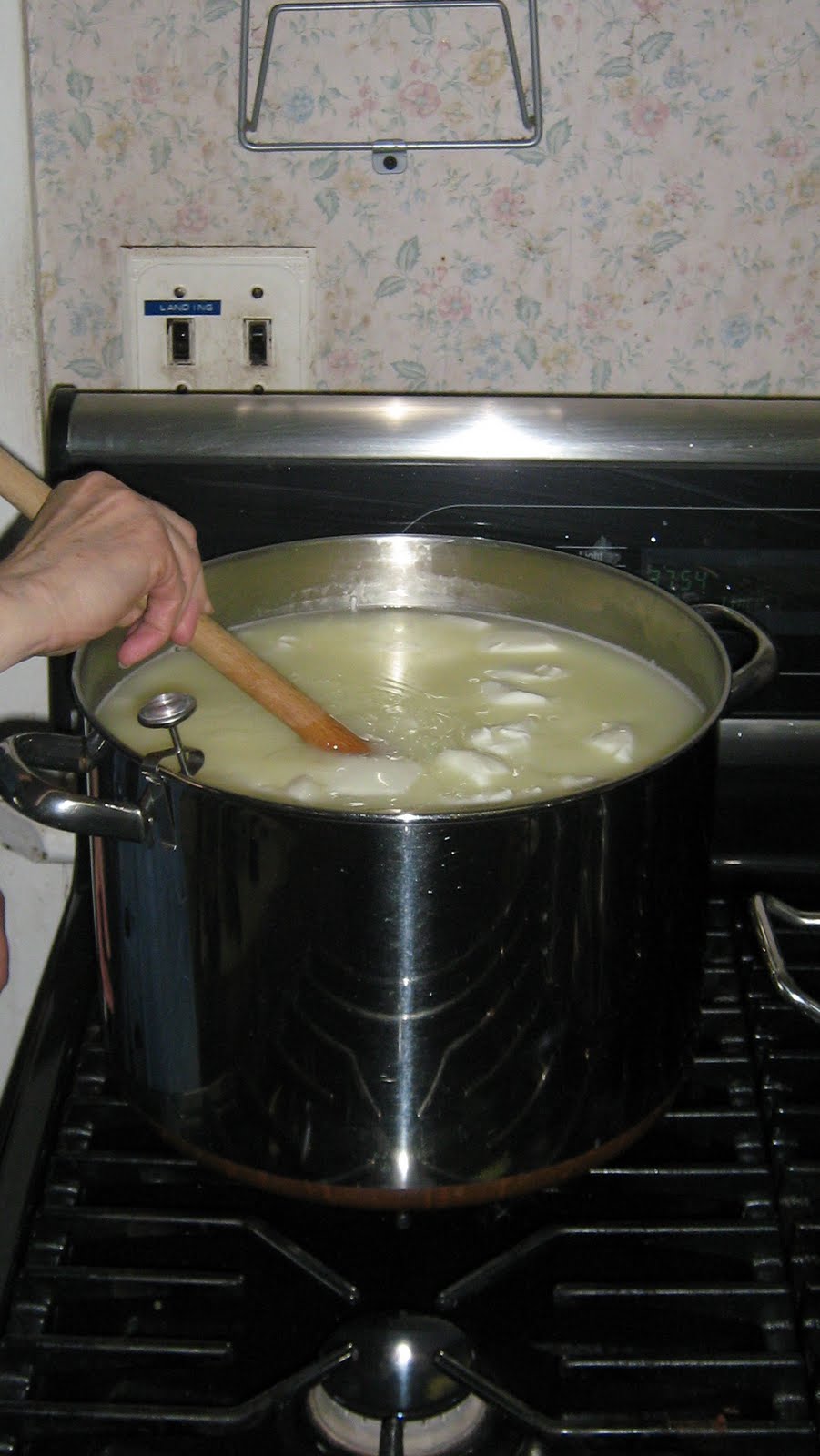
My mom heating the whey, after curdling.
 One point I don't think I've mentioned is that my family actually has a history with Mexico; I grew up partially as an Old Colony Mennonite, also informally known as Mexican Mennonites because of their strong presence in the states of Chihuahua and Durango in Mexico.

The curds and whey.
In Mexico, the cheese that these people make is famous.  The cheese is delicious.  I've been fortunate enough that my parents, who grew up in Mexico, know how to make this cheese at home.

The pictures in this post are some pictures of cheese being made in my parents home.  This was today.  The cheese will be ready in about a month; my dad gets a little impatient, though, and starts eating the cheese before its ready.

My son and I pressing the cheese.
Oh well, the cheese is delicious anyway, as anyone who has bought it in Mexico will know.