Showing posts with label Religion. Show all posts

Thursday, April 17, 2014

Springtime - New Life Arises from Death

This year, Lent started off cold and snowy, with bare trees and everyone feeling like winter just wouldn't come to an end.  As Lent continued, the snow began to give way, the earth began to thaw, and little green sprouts pushed their heads up through the piles of dead plant life from the fall and dirt piled up from the winter snow.

Around the middle of Lent, our family planted some sunflower seeds inside - one of the clearest reminders that new life rises out of death; a plant, having dried up and died, leaves a dry seed as a reminder of its death.  We buried the seeds, seemingly dead, in the ground in hope that new life would come.

In the Roman tradition of the Church, there has existed a strong idea that the Feast of the Resurrection is closely tied to the arrival of spring and the new life that it brings out the death seen in winter.  In fact, many great theologians, from St. Ambrose to Pope Benedict XVI, have believed and given great strength to the idea that Christ did in fact rise from the dead on March 25, the same day he was conceived, and the same day that God created the world - all great signs of hope and new life.

---

Now, only 3 days for the celebration, even the 10-foot piles of snow have receded, green grass has pushed up through the matted brown grass of the fall, and tulips and daffodils are just about ready to bloom and celebrate the greatest event of all history with the world.

Just about all the sunflower seeds we planted have sprouted and many have grown a few inches tall.

The world (or at least the part of it where we live) is just about to burst with new life, proclaiming the new life that Christ brought us in his death and resurrection.


Here are some more pictures of our sunflower plants:

 These are the egg carts we planted them in just until they germinated:

The transplanting process:

The wagon I use to take them outside to get some direct sunshine on warm days:

Monday, January 27, 2014

"Come as You Are" Revisited: Is the Church for Saints or Sinners?

Just over three years ago, I wrote a post in this blog called "Come as You Are;" the post had nothing to do with Kurt Cobain but the title was ideal. The post shared an observation about my mother-in-law's feelings about the Catholic Church; while the faith and moral teachings are very important to her, she takes pride in the fact that it is a place where sinners and the down-and-out in general could approach God without being turned away or judged.

I then went on to make some observations about how she saw this as a contrast to the various new denominations that have begun proselytizing that country in recent times.

For most of the time since then, I was rather doubtful of that post, thinking that I had probably gone off track.  Yet, I justified it by the fact that I was not yet Catholic and only just beginning to take a renewed interest in my Christian faith.

Looking back and re-reading the post today, however, I realize that I really was onto something, at least in the general sense.  I have come across some new ideas and had some new experiences that help put the idea of "come as you are" into a more solid context.  Most importantly, I see that the message was not just for others, but also for me.

Two Opposite Errors


When it comes to opening a church to all alike, there are two opposite errors which both essentially keep people from really coming as they are - both push people to pretend they are someone they are not.  One is to assume that everyone who passes through the doors of a church must be a saint, or become one quickly.  The other is to deny that sin exists and just declare that everyone is a saint regardless of how they live.

Closed Congregations

I'd guess that just about everyone has had the experience that when they walk through the doors of a church and suddenly get an urgent feeling that they are very out of place. Putting the truly closed congregations aside, there are many ways a church can deliver this message even if their doors are quite open.  Most kinds of uniformity can do this.  For example, in Mexico men of certain denominations will wear golf shirts, tucked into casual dress pants and have a neatly combed side part.  While such dress is certainly tasteful, anyone who's been to Mexico knows that it is also very unusual.  Thus, the average Mexican (or even expat) wandering through the doors to worship God on Sunday morning  would find himself standing out like a sore thumb, and probably immediately being approached to be welcomed as the new-comer.

As this last example shows, some of the factors which tend to close off a congregation are meant in truly good will and kindness.  Yet, the experience I just described is quite off-putting to many people.    The way of dressing is certainly connected to a saintly way of life and albeit given in warmth and kindness the invitation includes an unspoken assumption that your differentness is an indication of sinfulness.

Many people desire a church of more "saintly" Christians, and all too often outward signs that even unofficially indicate this can be a way of alienating outsiders.

Open Doors and No Walls

Then their is the opposite situation.  The idea that sin simply doesn't exist.  A question that shows a concrete parallel is this: what is the point of having open doors if your church has no walls? While a church like this may give the impression of welcoming everyone, the truth is that they welcome no one; no one is given the benefit of approach God as a sinner, which we all must do.

A Field Hospital for the Sick

One of my favorite images from Pope Francis so far is his comparison of the church to a field hospital after the battle.  The problem with both situations I describe above is that both assume that the church is here only for or primarily for saints; (one tries to make quick work of sanctifying everyone, the other simply declares everyone a saint.)  Christ said the opposite; he told us he came for the sick, not the sick, not the healthy.  Like Christ, his church is here for the sick and the wounded.  This means two things - first of all that we must acknowledge that nearly of all of us have been wounded in the battle, and secondly that we must have our doors open to the most deeply wounded.


Here is one of the hardest things I have learned, and a point I still struggle with in action; when the wounded come in fresh from the battle field, unsure if they will make it or not, they must not get the impression that they are in the company of the healthy, and have made a mistake by entering a place they don't belong, as in my first point above, but the should see clearly that they have indeed made it to the hospital, the place where the wounded have gathered for healing - for care and for medicine.

This seems like a paradox, since the first aspect most of us will judge in a church is how "good" the people are; yet, I can guarantee you that a newcomer will feel much more at home in the company of those acknowledge their own faults than those who pretend not to have any - and, most importantly, it is simply the truth - pretty much all of us are sinners in need of the Great Physician.


Everyone must become aware of their sins, not so they feel ashamed or out of place at church, but on the contrary so they feel confident to bring their sins with them and know they can leave them there, just as everyone else does.


Confession to a Priest

Three years ago, when I wrote that post, I had a sense of arrogance.  While I was convinced that I was coming the fullness of the faith, at the same time I was sure that I would have a good deal to "teach" most Catholics, who knew so little about the Bible and even their own faith.  When I wrote about "come as you are," I was, somewhat subconsciously, writing for the "others," those real sinners out there.

What I have learned the most since then is that "come as you are" is for all of us, not just those who have done (or are doing) the more obvious or sins.

For a church really to be open for all to "come as they are," even those stable within the church must have the benefit of being allowed to come as a wounded person, finding medicine for their wounds, forgiveness for their sins.

The best and easiest way for this to happen is sacramental confession, where you confess your sins to a priest who absolves those sins.

One of the surest signs of an unhealthy Catholic parish is an empty confessional; not because the people are more or less sinful, but because it indicates that the most regular church-goers are not ready to recognize their own short-comings - they are not prepared to come as they are.  How can we expect others to come as they are we do not?

Rosaries and Freedom of Worship

Yet, it is important that recognize that not everyone is ready or willing to receive such medicine.  Not everyone arrives ready to confess their sins (and consequently not ready to receive Christ, physically through communion, or otherwise.)  Even these people need medicine, perhaps more so than those who are in line for confession.


Whether people have come prepared to receive Christ or not, I would say one of the most helpful things a church can do is to allow people to focus on God and pray in the way they are best disposed to do.  I think one of the biggest obstacles we place create in worship is uniformity in worship.  When you walk into a church and everyone else stands and sits at the right time, says all the right responses, is swaying their hands in the air during the music, or hugging everyone around them at some point in the service, it likewise creates pressure for everyone to be a good, joyful Christian.

Christian joy is wonderful, and necessary, but the bottom line is that not all those wounded in battle will enter the field hospital bubbling over with joy; and if they aren't, they shouldn't feel that they have to pretend they are. (Just like those who are should feel free to show it.)

In recent decades, much has been said about people praying the rosary during Mass - for the most part, the practice has been condemned; people shouldn't be distracted from paying attention and participating.  Yet, while the rosary is certainly not the ideal form of participation, it is most certainly one good example from Catholic worship of an easy way for people to focus on God and worship him on a day that for ever reason their mind might otherwise be distracted and wandering.

It's not about defining some sort of requirements; quite the contrary, I would say that the best situation would see a bit of everything - during a hymn, for example, some people may be singing loudly, others re-reading the Gospel reading, others on their knees praying quietly, etc.  It allows all (regulars or not) to come as they are and worship as they need.

(I imagine this picture is from the
outside of the churching looking in)
 
Come as You Are

When I walked through the doors of Our Lady of Guadalupe parish in Playa del Carmen several years ago, I was impressed that while words from the pulpit were not minced or spared when it came to sins, so many sinners came willingly as they were.  The confessional always had a line up that lasted through the first half of the mass.  Even those arriving late would go to kneel in front of the altar, light a candle and say a prayer before going to confession or joining the service.  All those sinners, I could see, were welcomed and taken care of. 

What I didn't realize at the time is that the part most appealing to me, what ultimately drew me closer, wasn't that others could come as they were, but that I could come as I was (and as I still am) - as a sinner, wounded in battle and in need of medicine.

Thursday, January 23, 2014

The Great Secret Knowledge and JRR Tolkien

The Secret Truth

I have encountered a good deal of people, not to mention movies, that seem to believe that somewhere out there is some secret knowledge that is the key to all things.  Whether it was destroyed in the library of Alexandria, burned with Tenochtitlan or hidden deep in the "secret vaults" of the Vatican, there is some great knowledge that the powers that be have destroyed, repressed, hidden and forbidden the world from finding.  They know this knowledge will destroy their power (so the story goes,) so they spare no cost to keep it. (Think "Davinci Code," and the like.)

Others are content to believe that the secret is simply safely kept by a monk without any vice or plot living quietly in the mountains; it is not "protected," but has simply not been discovered by the world because we haven't taken the time out of our busy lives to travel to Tibet, wander down the mountain path barefooted and there meditate in this most perfect of monasteries.

Delving into the Darkness

Yet, there is something misleading - perhaps even poisonous - about the idea that truth can only be found in a deep and hidden secret that only few will ever find.  Those who choose this path are inevitably looking to obscurity, or - more concretely - to the darkness; after all where else are secrets hidden?
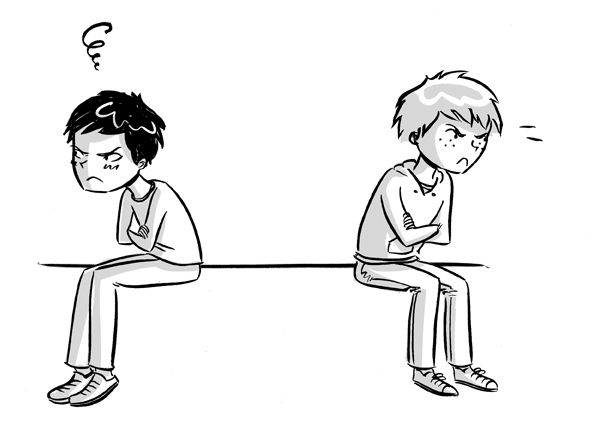
Those who continually delve into the darkness looking for what the light of the sun will  never reveal are always left uneasy and discontent that there is yet some greater secret that some greater power is maliciously hiding from them.  Thus, they are left digging deeper, winding further into the darkness in the hope of finding that secret that none other, or at least only few others, have discovered. Until, like the dwarves of Moria, they delve too deep.
Here we see Gandalf battling the Balrog which they awoke:


Tolkien and the Secret Knowledge

The fantasy of J.R.R. Tolkien suggest that he held a similar opinion - i.e. that looking for secrets in the darkness was indeed poison to the soul.  Here I will use some clips from the movies based on his novels to show the point more visibly.  Besides the dwarves, consider Saruman, who seeking to know the plans of the Enemy, became ensnared by him:


and likewise, Denethor, the Steward of Gondor, whose madness drives him to kill himself:


or Theoden, who was rescued from his darkness, but had sought the secret counsel of Saruman:


There are also the kings of men who became obsessed with seeking answers in the stars or locked away in their towers; the ones who considered the names of their ancestors more important than that of their sons.  Their nobility and kingdoms soon faded.

The Anxiety of Loss


One might note the anxiety felt by the characters of the Lord of the Rings who sought counsel in dark secrets found in the fact that they could not keep the Ring for themselves to keep in secret and use as a final and ultimate weapon:


A similar anxiety can be noted in the way of thinking discussed at the beginning of this post.


On the contrary, the noble and free peoples of Middle Earth - most clearly, their heroes - sought victory in open battle, sought joy in their families and neighbours, and dwelt in the light of day.  No seeking answers in the darkness.


The Faith of Light

Faith in God is a faith of light, not of obscurity and hidden secrets.  God's greatest gift - salvation through the incarnation, death and resurrection of Christ - is most certainly a mystery, but by no means a secret.  It is not only "in the light," but it is in fact the source of light.  It is there in front of us as a free gift for everyone who is willing to receive it.
All of these characters, while not being evil in their beginning or (for the msot part) in their intentions ended up serving wickedness and coming to bad ends. 

While Tolkien's fantasy cannot rightly be called allegory, Tolkien knew that faith in God is a faith of light, and that the desire for unknown secrets leads people to believe lies; this is clearly reflected in his fantasy stories.

Monday, October 28, 2013

The Beautiful Face of Mary

The traditions that depict the ancient saints according to various events of their life and attributes of their person are beautiful - and it is just as beautiful that there is variety in the different cultures and traditions within the depiction of the same saint.  Even Christ has a very broad variety of depictions in sacred images.

The Virgin Mary is no exception to this.  I have seen icons of our mother's beautiful face in so many styles and traditions - Byzantine, Japanese, Ethiopian, Renaissance and even Inuit, to name just a few.

Yet, in the case of the Virgin Mary, the most saintly of all saints, we have a special gift that we do not have for any other ancient saint; we have an exact image of her face.

From almost 500 years ago, we have this event:
'the peasant Juan Diego saw at the Hill of Tepeyac, near Mexico City, a vision of a girl of fifteen or sixteen years of age, surrounded by light. It was the early morning of December 9, 1531 (celebrated as the Feast of the Immaculate Conception in the Spanish Empire). Speaking to him in Nahuatl, his language, the girl asked that a church be built at that site in her honor; from her words, Juan Diego recognized the girl as the Virgin Mary. Diego told his story to the Spanish Archbishop of Mexico City, Fray Juan de Zumárraga, who instructed him to return to Tepeyac Hill, and ask the "lady" for a miraculous sign to prove her identity. The first sign was the Virgin's healing Juan's uncle. The Virgin told Juan Diego to gather flowers from the top of Tepeyac Hill.

Although December was very late in the growing season for flowers to bloom, Juan Diego found Castilian roses, not native to Mexico, on the normally barren hilltop. The Virgin arranged these in his peasant tilma cloak. When Juan Diego opened his cloak before Bishop Zumárraga on December 12, the flowers fell to the floor, and in their place on the fabric was the image of the Virgin of Guadalupe, miraculously imprinted there.' (from Wikipedia.)

One of the most miraculous parts of this image is that it remains in its original form, on the original cloth.  This is not an artist's rendition, an age-old tradition of depiction, nor someone's attempt to replicate what they saw in a vision; it is an image of the Virgin Mary directly imprinted on a cloth.

Basically, this means we know what her face looked like, at least in her early/mid teens when she bore Christ.  And as we know from Revelations chapter 12, in this apparition she is pregnant with Christ. (The image on the cloth is that described in that chapter.)

Recently I have been looking at this image and reproductions of it closely.  I am amazed by how beautiful her face is.  Yes, the image is aged, but it is not so hard to look past that.

Now, this does not diminish or remove the beauty or importance of the rich traditions of images of the Virgin Mary.  Yet, it is simply amazing that we can say that we have this direct image of her.

Thursday, September 19, 2013

Who is the Virgin Mary?

"This is how it is with Mary: If you want to know who she is, you ask theologians; if you want to know how to love her, you have to ask the people." 

- Pope Francis

Thursday, August 22, 2013

When Cowards Attack - A Warning to Would-be Proselytizers

I have no problems with a good argument about religion.  (I tend to loose most of mine, but that's another story.) A one-on-one discussion or even argument on even ground between two people who have both chosen to "draw their swords" and duel is fine.  After all, we shouldn't shy away from defending and promoting what we believe.

However, I have a bone to pick.

There are some Christians, and people of similar beliefs, out there who are cowards.  They choose a person who:
  • is not interested in arguing
  • is not used to arguing
  • is not good at arguing
  • is always very nice and respectful to everyone
  • who feels pretty bad about arguing and being berated
  • has not initiated a discussion on religion
When they are alone with this person, or with a few others so they can gang up on this person, they rip a layer off of them. The do not give them a chance to speak, they do not respect their beliefs, and they just pound on them verbally.

And these people are spineless, gutless, good-for-nothing cowards.

They are often very nice people on the surface. For example, the last person I met like this was a "kind" old Mennonite lady (I think she was Mennonite - it was at least a similar denomination.)  I can tell you, though, her heart is rotten at its core.

Now, I'm not talking about myself when I talk about the people who get picked on.  I can hold my ground, or at least handle defeat if I can't.  If I get pummelled in an argument, well, it's probably my own fault, since I probably started it.  But I'm talking about other people who are far kinder, gentler and more loving than myself.

And how do I know these "attackers" are cowards?  Well, if another person walks into the room that may defend the person they are attacking, they shut up.  They stop. Suddenly they're nice again, only sneaking a few "nice" passive attacks hidden behind sly poison like "I'll pray for you that you'll understand" - lie as venomous as Satan himself.

Some Advice

So, now I've told you who I'm talking about. If you're someone who knows me and you're reading this blog, you're probably not one of these people.  As I said, I'm not talking about fair arguments, or even heated arguments; I'm talking about cowards who attack others who can't defend themselves.

Advice: if you know someone like this, perhaps at your church, or someone of similar beliefs, perhaps you don't shut them up because you think they're defending the Truth; they're on your side - on Truth's side - after all, even if they're a bit abbrasive, right?

Wrong. Shut them up.  Tell them that they are cowards and that they ought to be ashamed of themselves.  If they don't stop, stop associating with them.  Be a real man (or a real woman, if such is the case) and defend the person they attack.  Even if you don't agree with the religion of the person they are attacking, you don't have to defend the religion.  You just have to defend the person.

"Look, you're being an asshole.  Shut up and leave this poor person alone.  You can talk about God a lot, but why don't you try showing His love?"

That simple.

Don't put people you love and care about into the pain coming into contact with them because you don't want to offend an asshole.

Let me make this plainly clear; even if they understand the greatest mysteries of the Faith and God, and know the truth better than any human alive, if they are such dogs to treat another person like this, then they do not have the love of God in them.

Now for my warning ...

So, even though it's unlikely that anyone like this who I know will read this blog, let me put my warning out there:

I will no longer tolerate this.  Until now, I've been of the opinion that if I don't see it, I can't say anything.  But as I said, these cowards shut up when another person walks into the room.  No more.  If I find out this has happened, and I am anywhere near such a person, I will go back to them and put them in their place.  I will ensure that they feel like the dirty scum they are - they will feel a hundred times worse than the person they were picking on.

Thursday, May 9, 2013

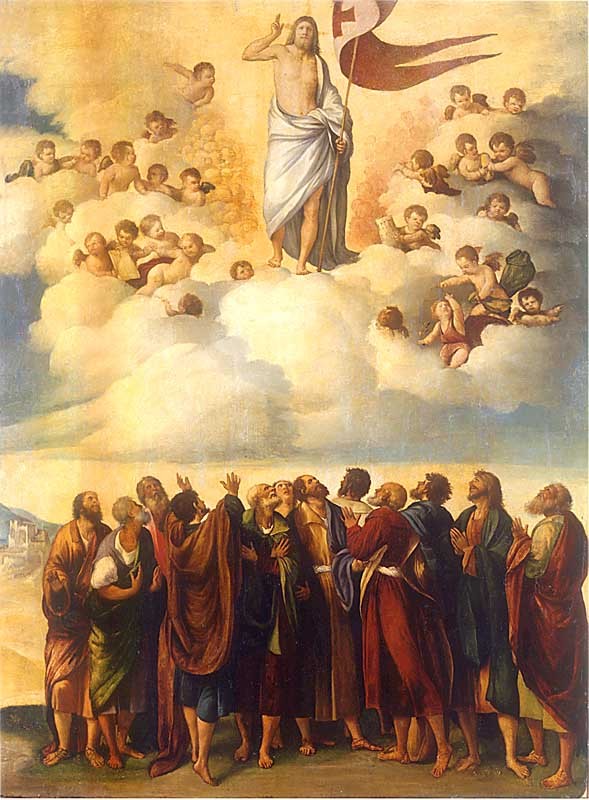
The Ascension of Christ

Today, 40 days after Easter, is Ascension Day, the day on which Christ ascended into heaven.

Dosso Dossi "Ascensione di Cristo" (from Wikipedia)
O God, whose Son today ascended to the heavens as the Apostles looked on, grant, we pray, that, in accordance with his promise, we may be worthy for him to live with us always on earth, and we with him in heaven. Who lives and reigns with you in the unity of the Holy Spirit, one God, for ever and ever.
The Celebration

The day is the celebration of one of the most glorious events of Christianity, with important theological significance; Christ, as a human, is now at the right hand of God the Father.  We will be having an extend family/neighbors/friends dinner this afternoon to celebrate.

Unfortunately, the Catholic Church in Canada (Latin Rite) has transferred the liturgical celebration of Ascension to day to the following Sunday (with the result that it becomes "just another Sunday" and most Catholics have joined the rest of Anglophone Canadians in not knowing that it exists.)

Mennonites

Traditional Mennonites celebrate this day and take the days between now and the weekend off.  They also have a church service in the morning.  I joined my mother at her Old Colony Mennonite service.  Ascension Day, for them, marks the beginning of the services for the preparation of baptismal candidates.  They begin preparation earlier, but this is the beginning of the official "handing down" of the faith in the context of the church service.  It is in the form of questions and answers, all taken from their short catechism booklet, similar to the Roman Catholic baptismal symbol (i.e. the Apostle's Creed in Q & A format) but much longer.  There were 11 candidates - 9 young men, 2 young women.

The sermon is also directed to these candidates.  The minister said some good things about baptism as our spiritual rebirth, our entry into the Church, the beginning of the Christian life and our obligation to be the light of faith to those around us.

Prophet Isaiah


Today also happens to be the feast day of the Prophet Isaiah.

Sunday, March 24, 2013

On Liturgical Beauty and the Mass of the Poor

These days, many people are talking about a more austere style of Mass as opposed to the style richer in the highly developed traditions of the Roman Church.  While I have my opinion on this distinction, I am highly unqualified to speak about the topic.  There is a related distinction which I am equally unqualified to discuss, but in which I have personal experience to share.  This distinction is "Mass for the poor" as the not-poor express it vs. how the poor express it.


Catholicism in Mexico
First of all, I do believe that if the poor really had their way, Roman Catholic Masses would be very beautiful. However, that is a different subject.  What I can say about my experience in Mexico is that, in that country, when middle-class attempt to have a "Mass for the common people" it looks and feels very different from a "Mass for the common people" which is actually attended by the poorest people.

A Middle-Class Mass

While in Mexico, it is impossible to say one parish is solely middle and upper class, since people of most classes will be mixed in most parishes, there are definite tendencies and there are definitely parishes which the poor, by their own account, say are parishes for the "rich" (which to them, includes the middle class) and are not for them.  Therefore, they avoid going to those parishes. (The poor in Mexico are usually quite accepting of the placement of their class and feel little desire to break class boundaries.  In my experience it is more the middle class which has taken up this battle.)

Ironically, it seems to me, that it is mostly these very parishes - the ones which the poor see as "beyond their class" - that make the greatest effort to have Masses for the people, include "indigenous" elements and decorate their churches in a way that is more distinctly "Mexican" (meaning not traditional) and "personal, warm and friendly" often featuring expressive art in current contemporary styles, as well as a distinctive stylized theme of lettering and symbols.  Sacred images tend to be rare.  The music tends to have a contemporary folky style.  While I can not claim to be doing anything but speculating, it seems to be these parishes that are striving for a more "indigenous Mexican expression of the Faith."

What's most striking to me is that you can see that a good deal of money, time and effort are invested into making this happen.
Catholicism in Mexico
The Poor Mass
Just so you know, I'm not going to be heaping  praise on the virtues of the poor here; their music tends to be very bad, and on the whole, their parish churches visually reflect the poverty of people.  However, what I will be praising is their authenticity.  Let me describe one parish I attended daily for almost a month.

It's name, perhaps somewhat significantly, is San Francisco de Asis.  It is a typical structure of the poorer neighbourhoods of Mexico City, built of concrete blocks, which are finished inside and out with fairly unappealing colours of paint and imitation stones.  The roof is fiberglass.  Inside the church, simple shelves screwed onto the walls hold statues of saints, which would have been unusually nice, had the paint not been flaking off of them. (I remember St. Francis and St. Charbel, whose shelf was piled high with the ribbons which people use to make requests of him.)  The altar, cloths, tabernacle and other items of high importance all looked like mismatched combinations of rejected items from other parishes.

I remember waking up at my in-laws apartment (around the corner,) getting my 2 young sons dressed, and hurrying out the door as the 8 am bells rang from the church.  There are enough parishes in the surrounding communities, all of which ring their bells every time they have Mass, that it would have been a beautiful moment of sound, had the traffic on the main road, which was backed up and almost at stand-still since about an hour earlier, with it's noisy engines, loud buses and blaring horns, not drowned out any church bell that wasn't within two blocks.

The people arrived on foot.  Since it was a weekday morning, most were elderly ladies clearly belonging to the impoverished neighbourhood surrounding the church.  It was about a third full.  The priest offered a very simple but "clean" mass.  There was no choir.  No organ, no piano, no guitar.  All singing - including the prayers such as the gloria and hymns - was lead by the elderly ladies, especially by a group about five pews back from the front.

I remember their singing.  It was neither traditional nor was it "folky" or "indigenous." In artistic aesthetic terms, it would be hard to call it "beautiful" or "creative" or "expressive."  Their old voices crackled in off key notes.  Were they the same songs that are sung in the nicer parishes?  Perhaps.  They sounded so different I couldn't tell. Yet their voices had something in them that I don't remember hearing in the more carefully crafted "popular" Masses - a sort of passion and adoration.

One day of the week, after Mass, the priest would present a relic of St. Francis.  Almost all present lined up in front of his shrine to kiss the relic.

Something about Mass at this parish touched me.  While there is no doubt that the Mass was greatly lacking in beauty and talent, the people were not striving to "express themselves" or their culture.  They were, quite on the contrary, striving for something more beautiful than what they could attain.

That in itself was very beautiful.

Beauty like this cannot be planned through a liturgy team, finances, art, creativity, self-expression or any sort of intellectual idea of "appeal to the masses."  It is also something that could not be imitated.

I would love it if every day of my life, I were near a Mass in a traditionally decorated church with gold and beautiful paintings, with bells, incense, and awe-inspiring chant rising to its high ceilings.  However, that option lacking, a Mass like the one I just described is probably where I have found the greatest beauty.


I could (and I intend to) write more about this parish, but for today's point, this will be enough.

Saturday, October 13, 2012

Our Lady of Guadalupe Parish Church, Playa del Carmen


Our Lady of Guadalupe Parish, Playa del Carmen
The parish where I first saw joining the Catholic Church a real, feasible action was the parish church of Our Lady of Guadalupe, Playa del Carmen (Paroquia de Nuestra Senora de Guadalupe.)  This church (both the building and the people) holds a special place in my heart.  It was (and still is) like a home along the journey.  Perhaps it could be compared to Rivendell somewhat; it's not the destination of the journey, nor is it Paradise or even the most important place in the journey, but it has offered me a place and time of rest, consolation and safety along an otherwise perilous road.

Nestled in the middle of Playa del Carmen's first (and least reputable) slum, its off-white steeple with stain-glassed windows rises above half-built concrete homes with fiberglass roofs, haphazard stores, taco carts and greasy little restaurants where thick smoke pours out of the chimneys from the chicken roasters.

The building itself is beautiful.  This is not because of the contrast to the slum around it; in fact, it would probably be more beautiful standing by itself or in a large spacious yard so you could actually see the whole thing.  But the surrounding neighbourhood is part of the church, as the church is part of it.  Many of the people who worship there live in these homes and the parish offers (to all who seek it) care, education, teaching in the Faith, blessings and the Sacraments of the Church.  The old Irish priest who started the parish about 20 years ago is respected and called "Father" by everyone I know of.  My point is; the parish and the community are inseparable.


Likewise, the building and the beautiful things which have happened there are closely bound to each other.

I think the building would be described as a neo-mission style. (Excuse the out-of-focus images; I'm getting used to using a completely manual lense.)

The Sanctuary

The main image, below the crucifix, is the Virgin of Guadalupe (patroness of the parish, and, of course, Mother of the Church), the Virgin Mary as she appeared to a native at the time of the Spanish Conquest. On each side of the image of the Virgin, you will see:


Christ as a Child with St. Joseph (the patron of our family.)

St. Juan Diego, the native Mexican to whom the Virgin Mary appeared.
 For nearly 2 decades the church was without windows.  Now, little by little, stained glass is being installed:

The steeple, looking south.
The 8 windows in the steeple and the two windows below it depict the story of the Virgin of Guadalupe appearing to St. Juan Diego.  The large one in the picture above shows the Virgin Mary giving the saint roses.  The bishop had been doubting that these appearances actually happened, so the Virgin Mary gave the roses as a sign to be brought to the bishop; at that time roses didn't exist in the area where the appearance took place (Mexico City), so the only explanation could be a miracle.

St. Juan Diego, showing the roses to the doubters. (Below the steeple, south)
Archangel Michael (north side, next to the sanctuary)

This is newest stained glass image, installed this summer, entitled, "Who is like God?"  The words of the Archangel Michael as he casts Satan from Heaven, who had claimed to be like God. (The anguished face of Satan is hidden behind the woman singing in the choir.  But you can see his wings.)

East end, opposite the sanctuary
This image is also dear to our family; St. Joseph, Christ and the Virgin Mary as the Holy Family.

The lower row of windows throughout the nave of the church still do not have glass; however, the upper row of 12 windows (6 on each side) offers some of the titles of the Virgin Mary.  My favourite is this one:

 "Refuge of Sinners" 
One of the Stations of the Cross

One of the confessionals (There's one on each side, near the back entrance.  Confession is heard during Mass.)

A view from the main entrance, looking towards the sanctuary.

The main entrance.
 The tables in the foreground are where homeless people, low-income workers eat during the week.

Side entrance (north side)
West end of the building.

Another image of the face of the Virgin of Guadalupe can be seen above the windows of the church offices.  The blue tarp is the area where people eat breakfast after Mass. (It's redundant and pointless to call it "socializing" or "fellowship;" for Mexicans every time you eat it's socializing and fellowship!)

This area is actually the plaza which serves primarily as the patio for the parish school, of which I didn't take pictures.  The school will need a post in itself.

Thursday, August 30, 2012

What Does that Prayer REALLY Say?? (Morning Edition)

Father John Zuhlsdorf, an American Roman Catholic priest, writes an excellent blog (What Does the Prayer Really Say?) about all sorts of things related to the Church.  It's probably one of the most prominent Catholic blogs out there.  When I first discovered his blog, I would go through and pick out the posts about "juicy" stories, like the conflicts between the American bishops and the LCWR (an organization of primarily liberal and rather un-nun-like nuns,) the "culture wars" in the U.S., ripping apart the silliness of the National Catholic Register (which he calls the "Fishwrap") etc.  These are good (and often entertaining) posts.

A Roman Missal (from Wikipedia)
Yet more recently, I've been taking a closer look at some of his other posts.  I started off by following his recommendation and listening to some excellent recordings of Gregorian chant (the Divine Office recorded every day - Latin text with English translation facing is provided); then started carefully reading some of his posts about certain prayers said during Mass (mostly the Collects, see "WDTPRS 21st Ordinary Sunday: the smoke of Satan v. invisible love," for example) and then his commentaries on some of the Saints (see "Beheading of John the Baptist," for example.)  I realized that there is a rich source of information in these which brings out the beauty of the prayers and the stories of the Saints.  (For any lovers of Latin or grammar, they also include grammatical and lexical analyses of the Latin texts.) He has many similar commentaries on other Catholic topics.

From what I gather from the name of the blog, this was the original  purpose; up until very recently, the English translations of the Latin prayers were grossly oversimplified often to the extent of loosing much of the meaning.  He would make his own faithful translation of the Latin, comment on the meaning, and compare it to the emptiness of the English translation then in use.

Then in 2011, something important happened; the world's English speaking bishops (together with the Vatican) created and approved a new translation which was much more faithful to the original.  Comparing these new translations to his "slavishly accurate liturgical translations" there is often very little difference.

When this happened, I remember one commentator asked, "What are going to call your blog now that they fixed the translations?"

Yet, Fr. Z (as he calls himself) continues to have the same name for his blog, and continues to post his analyses and comparisons of the prayers.  Why?  I can't answer for him, but I suspect that it's at least partly for this reason:

Even though the translations are fixed, there are MANY, MANY people who may listen to the words in Mass and give them little thought (this is often my case, I have to admit).  Even when we do pay attention, there are intricacies and depth in the words and phrases that are not immediately grasped.  The first time I carefully read one of his commentaries on a Collect prayer, its meaning had an entirely new depth in Mass that Sunday, it's beauty and truth stood out that much more profoundly.

Coming from a fairly intense Evangelical-style Protestant background, I am constantly reminded by those around me to avoid "vain repetitions."  When repeated or prescribed prayers are understood in the way they are by Fr. Z, they are anything but vain, and hold true beauty and depth.  If anyone is battling the tendency to simply repeat or read out a prayer without giving thought to the meaning, it Fr. Z in his commentaries.

So, even though the translations are fixed, we still need to know What the Prayer Really Says.  Fr. Z's title and original purpose is as relevant as ever.

If you are Catholic, I suggest that you before you go to Mass on Sundays (perhaps sometime during Saturday) look through his posts for the last week for his commentary on the Collect (I'm not sure if he always does one.)  Whether you are Catholic or not, take a look at one of his commentaries on the Saints and read through them carefully and slowly.  They're worth it.

Wednesday, August 15, 2012

"He was never really my friend ..."

When a friend turns against us, abandons us or fails us in a most serious way, our most common reaction (in my experience) is to explain the action as the former friend's true nature; "I guess I never knew what he was really like. Now I know what kind of a person he was all along, and he sure wasn't my friend."

We assume that the worst of what the friend demonstrates is his "true nature;" we were fooled and deceived, and now this act of treachery sheds light on reality.

Yet, why is it that we choose to assume that the worst in a person is that person's true nature? Why can't we assume that in the past, that person had true friendship with us?

Consider an (imaginary) strong man who roamed the wilderness, killing wild animals with his bare hands for his food, not only surviving but thriving in all kinds of weather.  One day, the land where he lives is invaded by people who attack him and try to drive him away.  As a fearless and ruthless warrior he fights off one attack after another, until finally his invaders begin to prevent him from getting food and tire him in endless harassment. Finally, tired and weakened he succumbs in battle and is killed.

No one would doubt that this man was at one time physically very strong.  Yet that changed. (Don't take this story as an "allegory" for friendship, it is only demonstrating one isolated point.)

Few (if any of us) are as strong in friendship and in love as my imaginary warrior was in hunting in battle; even if a friend succumbs after the second or even first turbulence hits a friendship, that doesn't mean he never truly cared for us.

The same is true of religion; when someone abandons or renounces the religion we adhere to, our first reaction is often to assume that the person never truly believed it in the first place.  That person was fooling others, and possibly themselves - true belief never existed.  But who's to say that they didn't believe it authentically in their heart at one time?  The onslaughts of life can shake even the firmest of human strength.

In friendship, relationships, religion, family roles, etc. we all have the free will to do right and wrong, and to react to others in a right or wrong way.  This means that even the strongest of love and the strongest of faith can fail - especially if we are so proud to think that we have some special strength so that we could never unjustly turn on a friend or abandon our faith.

Deceptions and revelations of people's "true nature" do happen; but I think at times we are too willing to write off the battles, the victories and the defeats of life to an oversimplified explanation, rather than to allow them to be simply what they are.

Thursday, June 28, 2012

Mexico's Elections 2012 - Why I'm NOT Voting, and a Note about the PRI

Founder of PRI, responsible for the death of 90,000 Mexicans
Mexico's presidential elections are coming up this Sunday, the same day as Canada Day.  I'm a Mexican citizen, and have the right to vote in these elections.  Unfortunately, I won't be voting.  Here's why:

I left Mexico for Canada in April of this year.  Some time after arrival, my wife investigated how to register to vote from abroad.  As it turned out, we had to apply at Mexico's embassy in Toronto in January 2012 at the latest.  At the time she found the info, the applications which were received were being evaluated for possible approval.  Essentially, unless we had made a special trip to Toronto in January just to register, it would've been impossible.  Alternatively, we could make a special trip to Mexico on July 1st just to vote.  Since my wife is pregnant with twins (and getting really close to delivery) and Mexico can be little unruly at election time, we had to rule this possibility out.  (The budget was also a factor.)

This was a great disappointment.  We had been talking about the candidates and trying to choose the best one to vote for.  A friend of mine made a comment something like this on Facebook: "Not voting is one of the most cowardly actions to take at election time."  I agree. And I'm sad that I can't vote.  I believe it's not only our right to vote when we can, but our obligation.

Now, a note about the candidates.  While I'll refrain from saying which candidate I would have voted, I will say who I definitely wouldn't have voted for.  Although Enrique Pena Nieto is young and hansom, and claims to have distanced himself from his party's past, I still don't think a president from his party would be a good idea; his party is the PRI - the Institutional Revolution Party, which I wrote about before (The Institutionalized Revolution & Mexican Bureaucracy.)  Besides being the engineers of the bureaucratic mess that defines most of Mexico's government organizations, they also have a track record of hanging on to power and the presidency in an oligarchy style, and of violent repression of opposition.

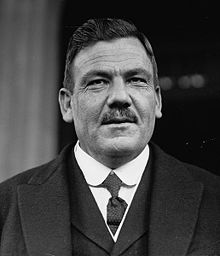
Many people like to talk about the 1968 Tlatelolco massacre in which somewhere between 30 and 300 civilians (mostly student protesters) where shot.  I agree that this event was horrible. However, it seems that little is being said about the very origins of the PRI;  the party was created by president Plutarco Elías Calles, who was also the instigator of the Cristero War, in which over 90,000 people were killed in less than 3 years. (That's double of even the biggest estimates of President Calderon's 6 year war on drugs - this is also a problem, but at the very least, this is an war against illegal - and often inhuman - activity, while the Cristeros War, which killed twice as many people in half the time, was a war against people's religious freedom.)  So, about 1968, what could you expect from a party which was born from so much bloodshed?
"The bodies often remained on the poles until the... town renounced public religious practice." (Wikipedia)

Both are horrible tragedies. It also speaks very poorly of the party that the government documents about the 1968 event were kept continually secret and not released until a president from a different party was finally elected (Vicente Fox, 2000) and ordered the release.  As for the Cristeros War, children in schools run by states governed by the PRI (which is the majority) still don't learn about that war as a part of Mexico's history. A party that has not yet taken responsibility for their past, and continues to try to hide its past atrocities is ready to take the presidency again.

Wednesday, May 2, 2012

Cowboys and Catholics

Since I’ve been interested in the Catholic Church, I was always impressed by the fact that John Wayne, the archetypal Hollywood cowboy, was a Catholic (convert).  I don’t really know anything about his personal life, but I have a few random, possibly unrelated and probably irrelevant and unjustifiable thoughts about this fact.

1. I suspect that the Catholic priests, always in the form of an “old Spanish padre,” holds some important place in the genre of Westerns. I’ve forgotten too much about Westerns to confirm this, but it seems to me that cowboy heroes in movies are mostly indifferent to religion but end up being protectors of innocent religious people when they do show up.

2. If I understand the little I’ve read about his life, John Wayne showed his Catholic Christian values as a political figure; he was typically a hero for conservatives, but a frustrating one, since there were times when he would support the “liberal” side of issues when it came to showing mercy and forgiveness.  Politics have little or nothing to do with real cowboys, and there’s no reason to think that John Wayne’s political stances have any reflection on a real connection between Catholicism and cowboys; the same could almost be said of his religion.  Yet, it in the end, it is John Wayne.

3. There is a good deal about cowboys that people would not generally connect with Catholicism; they tend to be lone renegades, just doing their own thing, not telling anyone how to live, or letting anyone else tell them how to live.  Not too many people would think “Catholic” when they hear this idea.  (Although the Catholic Church does have plenty of renegades – but that’s besides the point, and it’s quite a different kind of renegade.)
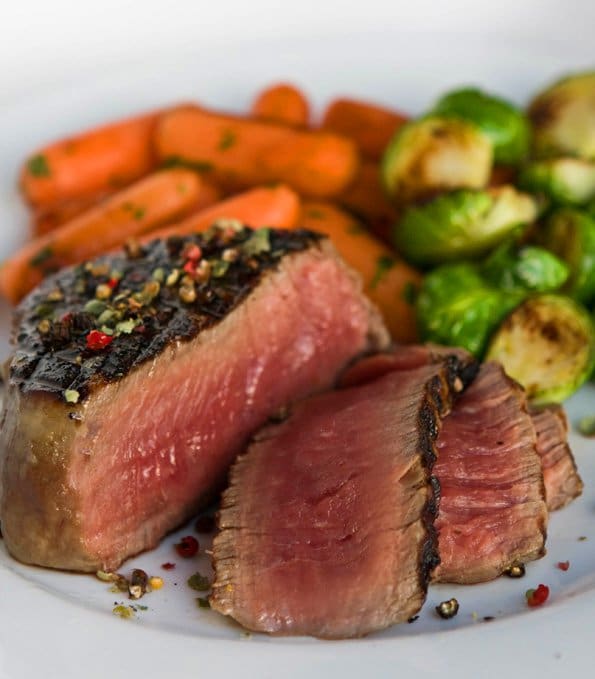
Yet, there’s at least one thing somewhat Catholic about the archetypal cowboys. The archetypal cowboy knows he’s a sinner – even though he would never say it in those terms.  He knows that the way he lives is wrong, despite the fact he doesn’t want anyone to change it, anymore than he wants to change what’s wrong about others.  Also when it comes right down to it, he’ll stand up for fight for what’s right; he’ll protect those who really are good when they’re not strong enough to do it themselves.  These two points aren’t exclusively Catholic, but could fit into certain brands of Catholic thinking.

I wish I knew enough to prove some of these points or give examples. I could probably think of a few country songs I’ve heard recently, but I won’t bother for now.  In any case, if cowboys and Catholics have nothing else in common, John Wayne is a pretty good connection just by himself.

Wednesday, February 29, 2012

Why I'm Not Vegetarian


First of all, I need to start of by saying this is not an anti-vegetarian rant. In many ways, I sympathize with and practice vegetarianism, (depending on how you define vegetarianism - I point I'll get to below.)  I eat very little meat.  My family buys and eats small portions of meat once a week, and we're happy with that.  We would probably be just as happy if we ate no meat at all.  For lent, we are eating no meat (except on Sundays if the occasion arises, which it usually does with our very carnivorous friends and family.)  Lent is hardly a change or challenge.  During normal weeks, we don't miss it or even think of it if we miss our weekly trip to the butcher.  So why don't I just take that easy step and make myself vegetarian?  Here are my reasons.

Vegetarianism is a means not an end.  In its proper context, practicing vegetarianism at times, most of the time or even all the time is a means to accomplish something else - health, religious devotion, saving money, economic improvement, protesting animal abuse, etc.  In their proper context, I consider all of these valid; I would definitely say some of these goals are more important than others, but all have some degree of validity.  But when we define vegetarianism as a practice which is a means to accomplish another goal, it means that there is no such thing as a "vegetarian."  Both a monk and an animal rights activist may practice vegetarianism, but it would absolutely incorrect to lump both together under the category of "vegetarian."  Their reasons have nothing to do with each other, and their manner of living and focus in life are entirely different.

Vegetarianism is something you can do sometimes, and not at others. This definition of vegetarianism (a means to accomplish other ends) is the definition I support. Depending on the purpose, I sympathize with and practice vegetarianism.  This definition allows someone to practice vegetarianism 95% of the time, then eat meat at the family Christmas dinner without feeling they've "lost their (meat) virginity," so to speak; it allows people to practice vegetarianism during religious fasting, and enjoy eating meat again when the feast day comes.

The label "vegetarian" makes vegetarianism an end rather than a means.  I would say most if not all vegetarians start off with something like I described above; they abstain from meat for a specific purpose which is an end more important than the practice itself.  Yet, I  feel that often once people make the leap and finally to call themselves "vegetarian," (note: this is not giving up meat altogether, but actually taking on the label) the relation of means vs. end gets turns on  its head.  Vegetarianism is now the end, and the purpose, and all the other ends (religion, health, animal rights, economy) suddenly become the means to justify being Vegetarian.  A vegetarian trying to convince someone else to become vegetarian (a situation that couldn't happen in the above definition) will give a long list of justifications - "Take your pick," is the message, "so long as you become vegetarian, it doesn't matter what your reason is."

Vegetarian purity. Once someone calls himself "vegetarian," he is committing himself to NOT eating meat pretty much at all costs.  I've seen vegetarians have a whole household running around trying to change the food so they can eat it. If a "vegetarian" eats meat once, they've committed a grave error on a moral level. They're left with the moral conflict of whether they will continue to be vegetarian or give in to their failure and abandon their cause.  Being vegetarian, if you're not careful, can become like a religion in itself.

I probably don't have to say that I'm not a fan of this kind of vegetarianism. Besides the fact that I still haven't heard a compelling reason to give up meat completely (to eat less or even little meat, yes, but to eat no meat, no,) I've never liked the idea of putting my hosts to all sorts of trouble to accommodate my preference.  The most important point is, I see vegetarianism as a means to accomplish more important goals.

I will continue to practice vegetarianism as often as it's necessary or reasonable to do so.  I'll continue practicing vegetarianism many days of my life because meat costs too much; I'll continue practicing vegetarianism during religious fasts to focus on God and give more to others.  On the other hand, for now, I'll continue eating meat when my family feels like it, to celebrate feast days and (usually) when I'm at another person's house and they offer me meat. But even if one day I stop eating meat altogether, I still won't be "vegetarian," because it will still be a means to accomplish another end, and not an end in itself.

Thursday, February 23, 2012

Good-bye, Meat!


A Torta Cubana (source: Prone to Wander Blog)
One folk etymology of  the word carnival is that it comes from the middle Latin "carne vale" which means "farewell to meat." So, while I didn't watch any brightly coloured dancers or have any big festivities during Carnival, on Shrove Tuesday, I said good-bye to meat. I ate a huge meat-filled "torta Cubana" (a sandwich like the one in the picture - see Vitamin T - The Mexican Special) and drank a litre of beer ("caguama" is the word they use here in Mexico - see Illegal Immigration - An Alternative Approach and the label "Beer.") and said good bye to both for the 40 days of Lent.

As a side note, this connects to a theme I've been meaning to write about for a while, namely vegetarianism, and my opinion that the proper place of vegetarianism is as means that leads to another end - first and foremost religious, and also health and economy as secondary reasons.  Interestingly enough, the "economics" of not eating meat is actually part of the religious reason; one reason to avoid eating meat (or abstaining from other items) is to save money to give to the poor.  The other part has to do with focusing on God rather than the flesh (the other meaning of "carne.")

Vegetarianism (as I see it) is misled and misleading when it becomes an end rather than the means. But more about that when I finally get around to writing that blog.

In the mean time, good-bye meat and good-bye beer.

[Note on the etymology of Carnival: the more philologically accepted etymology seems to be that it's from Italian "carne levare" which means "putting meat away."  It basically amounts to the same thing.  See - http://www.etymonline.com/index.php?term=Carnival.]

Tuesday, February 21, 2012

The Basilica of Guadalupe - A Pilgrimage

The image of the Virgin Mary (not original)
This last Sunday, our family made our first pilgrimage to the Basilica of Our Lady of Guadalupe in Mexico City.  The Basilica is the site where the Virgin Mary appeared to St. Juan Diego, a native Mexican, during the Spanish conquest. As far as I know the story, she instructed him to tell the bishop to have a church built in her honour on that site.  The bishop refused to believe him until she re-appeared to him, burning an image on his cloak, and giving him roses to take to the bishop.  Roses did not exist in this part of the world, and the bishop knew this; combined with the image burned on the Saint's cloak, the bishop was convinced and began the construction of the church, which took over 200 years, later given basilica status.  The cloak was kept as a relic, and is on display in the New Basilica. The original Basilica still stands, along with several chapels built throughout the centuries. The new, modern Basilica directly beside the old one, dating from the 70s.

My wife and I had visited when we first met, bet I was visiting as a tourist then, only for the sake of curiosity. This time we came for mass, prayer and veneration.  We also bought a few icons. The following are some pictures.  I don't have pictures of the icons, and they are not with me right now, but I'll post more later on.  The image of the Virgin of Guadalupe in the above is a copy of the original; it is not possible to get close enough to the original to take a picture without flash (which is not permitted inside either Basilica), but it is in tact.

My family in front of the Old Basilica
A family - the father on his knees carrying their baby
This is a fairly common sight at the Basilica.  Some pilgrims will approach the New Basilica (the one where the original image of the Virgin of Guadalupe is now located) on their knees.  Some will start at the entrance to the large plaza (500 meters?), others will approach on their knees kilometers before reaching the Basilica.  Those approaching in this way have a special and urgent request from the Virgin Mary.  In the case of the family in this picture, the request is for their baby, and for this reason the father (on his knees) is carrying the baby. He would carry the baby in this way the entire distance.


Devotees of the Virgin of Guadalupe in the Old Basilica


Lighting a votive candle for the Virgin Mary before Mass
 (You can see my one-year-old poking his head out beside me.)
The new Basilica and the old Basilica
Sanctus Deus, Sanctus Fortis, Sanctus Immortalis, miserere nobis.
 "Holy God, Holy Mighty, Holy Immortal, Have Mercy on Us."  The Trisagion prayer, inscribed above the doors of one of the chapels.
Blessed Pope John Paul II
Blessed Pope John Paul II has a fairly strong devotion in Mexico.