Showing posts with label Kids. Show all posts

Wednesday, October 10, 2012

Sunflowers

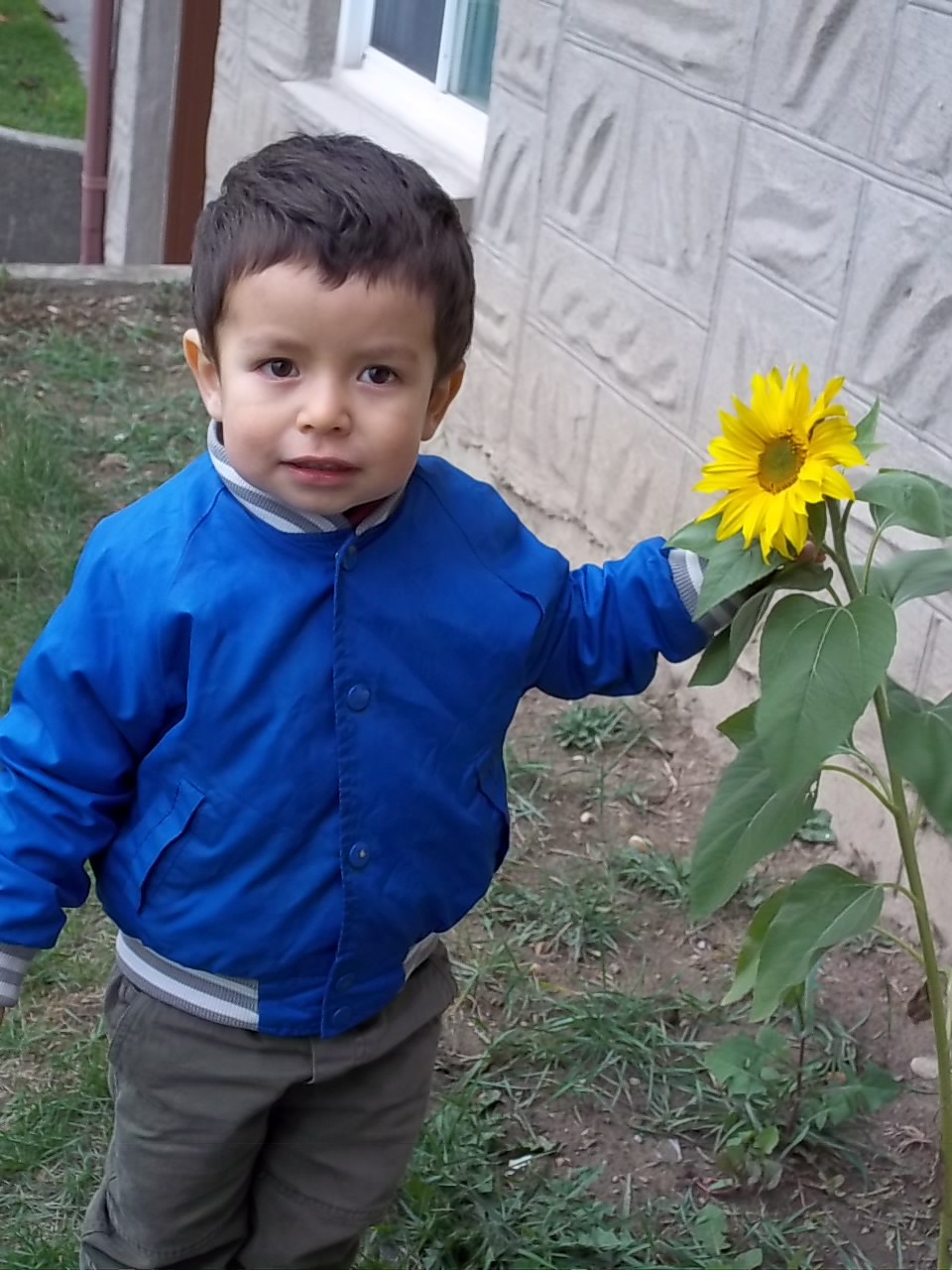
During June, my sons and I planted some sunflower seeds in the flower garden beside the house.  We planted 12 seeds.  We planted them late (I think May is ideal) and it was a very dry summer.  However, with nightly watering and the daily careful watching of my 4-year-old, two finally sprouted.  Both grew up and finally, last week while I was here in Mexico, the flowers opened.  My wife sent me pictures.

First, this is us planting them in June:

Now, three months later, here are my two sons, each with the sunflower that they claimed as their own (well, really the older one dictated which one belonged to whom, but they're both happy:)


Monday, May 14, 2012

My 4-year-old Loves Maps

This is a picture that my 4-year-old son drew at home last week:


When he showed to to me he pointed to the top of the green shape covering the middle/lower half of the page and told me: "Look, here's Canada."  Then, pointing to the middle of the same shape, "this is the United States," specifically pointing out that's where his godparents live, and, finally, pointing to the upturned part at the bottom, "and this is Playa del Carmen." The small green circle at the top of the shape is Mexico City - a little out of place, but I can live with that.

It's a map of North America.  He loves maps!

I remember loving maps when I was a kid/teenager.  I still do.  I'm proud that my 4-year-old son can draw a map of North America that actually resembles North America!  (Besides Mexico City, Greenland kind of got shifted to the other side, but, hey, he's 4, and he drew it from memory, without looking at a map.  I think it's amazing!)

Tuesday, March 6, 2012

Family Planning, the Other Way Around

Generally, when we say "family planning" we mean limiting the size of our families.  Just recently, it occurred to me that many people who have very large families actually plan to do so - it's not just an accident.  They're "planning their families" too, but simply planning to have lots of children.

This weekend we visited my wife's grandpa's farm again.  One evening we were sitting in the house for the evening snack, and my wife's great uncle showed up.  As with everyone else, we told him the exciting news that we were expecting our third child.  Like everyone else, he was very happy to hear the news.

"That's wonderful," he said.  "It's a good start.  There are people out there these days who don't want to have any babies."  He shook his head in disapproval. "We need to have children.  There's always enough work for everyone." (On the farm, they always end their day without finishing the many tasks that could be done.)

Great-Uncle Palemon, Proud of Our Good Start
He then went on to tell various stories of couples he knew of who had had 15, 20 and even 30 children.  My wife simply nodded as though she agreed this sounded like a good idea, not daring to argue.  Her great aunt stood by listening, nodding in real, heartfelt approval of these wonderful stories.

My wife's grandpa had also given another perspective; "The more children we have, the more we have.  We all work hard together and share, and that way no body is ever lacking anything."  (By "we" he meant the extended family and even the community as a whole - not one isolated family.)  More children is a form of stability and a guarantee that there are always people to help each other.  For my wife's grandpa, this point was especially important, since he is now older and unable to manage his farm alone, and is becoming more and more dependent on his children and grandchildren. There's also a social importance - the simple love of being around family (in their view) makes it good and pleasant to be around many children and grandchildren and have their company.

These three elderly people believe in family planning.  Not in the sense of actively limiting your family size as we use the phrase now, but rather planning to have as many children as possible. Having more children is a good thing all senses - morally, economically, socially, etc.  So you plan to have many.

(It's important to note that these people aren't Catholic - in fact, there quite aggressively anti-Catholic.  This is simply a matter of traditional values.  They also aren't rich or even average in wealth - even by the standards of the impoverished countryside where they live, they are among the poorest.  But again, lots of kids is an economic support as well, besides being morally correct and more pleasant.)

As a disclaimer on behalf of my wife's beloved family members, they weren't spitting out babies once a year for several decades.  One of them had 6 children and the other had 7 - far from the 15 and 20 of her uncle's wonderful stories.  This was as many children as they could physically have.  Back in their days, they didn't have access to baby formula or bottles, meaning the babies were breastfed as long as they needed milk and couldn't drink out of a cup.  This was an obstacle to their having more babies, not a method of avoiding babies.  So instead of having babies every year, they would have a baby every 3 or 4 years.

(On the farm, entire families share one bedroom - although I don't really know, I'm guessing this factor also created certain practical limitations on parts of the process.)

So my wife's great uncles and aunts didn't have 15 or 20 children. They wish they could've.  But they couldn't.  It simply didn't happen.  One thing is for sure - they weren't trying to prevent it.  They were trying to have as many as possible.  That was their plan.

I was talking to my brother-in-law about this on the drive home.  We realized the gigantic families of 15 - 20 are not a product of old-fashioned ideas, but rather of modernism getting mixed up with old-fashioned ideas;  when innovations from the modern world remove the natural obstacles to having children, suddenly people who want to have as many children as possible can have 15, 20 or even more.  Those who don't want this many children need to find artificial (or natural) ways to prevent it.

Thus, in the past family planning meant planning to have as many kids as you could.  You wanted 15; if you were lucky you'd get 7.  An "accident" (e.g. the wife got sick and couldn't have kids for a while) meant you didn't get as many kids as you wanted. Now, family planning means you plan to prevent having kids, whether it be artificially or naturally.  You want one or two children.  An "accident" means you have a second or third that you weren't planning on.  To most of our generation it's absurd to think that a third child could actually be a part of a plan of any sort.

The phrase "family planning," wouldn't necessarily have to mean limiting family size.  We simply assume that it does. It's incredible how things change.

Saturday, January 28, 2012

Crate training for ... kids?!?


 Planning for are upcoming return to Canada, we are getting our dog ready to come with us this time.  (Last time he stayed with our former landlady, a dear friend of ours who loves the dog and treats him very well.)  Part of our preparations were to buy a crate (yesterday.)  If you know anything about dogs who've never been in a crate, you'll know that they don't like it, and it's a process to get them confident and comfortable to enter their crate.  (See below.)


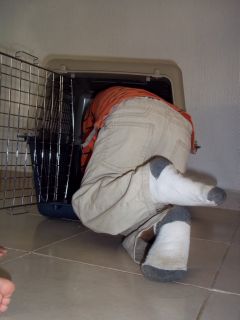
But we had an unexpected result of putting the crate out in our living room; our two kids transformed into puppies and decided that the crate was a great place to play.  They spend the entire morning today fighting about who got to be in the crate.  We had to make them take turns sitting in the crate, pretending to be happy puppies in their new house.

The one-year-old loves to take the dogs food and spread it all over the floor, so when we put the dog's food into the crate to help him get used to it and start enforcing the idea that the crate is associated with good things, the baby got extra excited and got in before the dog did. It was almost impossible to get the baby out of the crate at that point.  When we did, he was angry.

  If only the dog were this excited about the crate ...


Yes, the dog gets to use his crate, too.

Saturday, January 14, 2012

A Young, Up-and-Coming Photographer?

My wife has a habit of letting our children play with our electronic equipment.  While I generally disapprove of the habit, at least one good thing has come of it; our 4-year-old son has learned to use a camera, and is actually pretty good at taking pictures (considering his age.)  He usually manages to center his subject and get a pretty good distance so the subject is just about the right size.  Take a look at some of his recent pictures.  What you think?  Will he take after his mother in being an excellent photographer?
Self-portrait; he missed the other person, but that's a question of the length of his arms


Friends of the family.

Friend, dog, brother, mother.


Baby brother's new trick.
Dad and baby brother "working" at their respective computers.
His mother.  Light behind the subject, but, you know, details can be worked on.

Saturday, January 7, 2012

A Tragic Wedding

Wedding crown, veil and crossA few weeks ago, I wrote about the sad love story of “Alfredo” and Lola, a tragedy that I watch play out every day of my life.  This weekend, on Saturday, January 7, 2012, this story took yet another tragic turn.

Lola’s aunt, being single herself, was worried that the family wouldn’t be seeing any grandchildren anytime soon, decided to obligate Lola to marry Ramon, her family’s preferred son-in-law, in an official wedding, assuming that this would somehow help in bring about the desired grandnephew or -niece.

“Alfredo” was invited to the wedding, and, against his will, his parents forced him to go and sit quietly in repressed suffering while he watched the love of his life first make vows she could never truly believe in her heart, and then sign a contract, vowing and promising to remain loyal to the chosen husband of her arranged marriage, implicitly renouncing and disowning the true love of her life (“Alfredo"), forever.

Poor “Alfredo.”  But such is life, and I only hope that he can overcome this tragic event in his life.  Just now I saw him in his house, downcast, almost expressionless, as though reality was no longer real.

For anyone who didn’t read the first part ("Forbidden Love"), “Alfredo” is my dog Simba.

Dog wedding, bride and groom
Lola and Ramon are the neighbours’ two Chihuahuas.  The aunt is the owner’s 8-year-old sister, who really does believe that having a wedding would make the two dogs have puppies.  Eager for the puppies, she really did have a wedding on Saturday, which included a wedding dress and a veil for the “bride,” a bowtie for the “groom,” and the traditional Mexican elements of the “crown” (like a wreath made of flowers) placed on the bride’s head after the vows, and the rope that is placed around the newly married couple to symbolize the new-found unity.

There were also vows (said on the dogs’ behalf) and a marriage certificate (signed by inking and stamping the dogs’ paws.)  There was a reception where mole with chicken (a traditional Mexican dish, prepared by the girl’s mother) was served.

Dog in loveShe also sent out hand-written invitations earlier in the week, one specifically to Simba, who really is in love with Lola. The rest is as told above.  (I’m not sure if I should say this publicly, but I saw the way Simba was looking at Lola during the ceremony, and I suspect that he thinks he still Dog wedding, Chihuahua in a wedding dresshas a chance …)

Wednesday, December 21, 2011

Smashing the Seven Deadly Sins, and Other Observations about Piñatas


A little girl, destroying the seven deadly sins.
Recently I heard of an interesting explanation for the Mexican tradition of piñatas at posadas (see also my post from two days ago: "Why didn't you tell me you were the Virgin Mary?") Traditional piñatas have seven points on them, which represent the seven deadly sins.  The piñata is smashed during Advent and at Christmas to represent the victory over sin that Christ's birth promised.

Of course, to the children and adults hitting the piñata, the only thought in mind is breaking it open to rush for the falling candies, but the idea is out there.

So, here are some pictures of the piñata from our recent posada.  The piñata in the pictures has 5 points, but right after we had a larger one with seven points.

By the way, notice how I'm standing between the child with the stick and the other children, who seemed oblivious to the fact that a passionately swinging stick meant to smash a piñata could hurt them.  A neighbour later told me that these attempts at organization and safety showed how "European" or "American" (i.e. not "Mexican" or "Latin") I was.  Apparently an injured child is part of the routine.

"We try to control the kids, but they just don't listen," is the usual explanation.  I guess destroying sin has its price.  Since there were no injuries, it looks like this year I spoiled part of the tradition! (Needless to say, everyone was happy about that part!)

My son, giving it all to put a hole in the piñata.
Kids rushing for the candies falling from heaven.  See the rewards of battling sin?
All the neighbours from our street for a group photo.


Friday, December 16, 2011

Can my kid watch that TV show?

Do you check what your kids watch at their friends' house?
Today, my wife and I entered a new phase of parenthood; for the first time we had to address the question of whether a T.V. show that the neighbours' kids were watching was appropriate for our 4-year-old son.  Ever since infancy, we had been selective about what he watched, and time has always been limited (he doesn't watch T.V. or movies every day, and the ones he does, it's max. one movie or the equivalent.)

But today, the neighbor's kids (who deserve a few blog posts of their own, and from now on are getting a special label on this blog) showed up at the door and asked if our son could go to their house to watch a certain T.V. show.  Their mother pays almost no attention to what they do. (Today, for example, she left them playing outside, and went to visit a friend, locking the door to keep the house safe.  The kids were out on the front lawn, outside of the safely locked house.  This was after the T.V. incident.)  So now the question wasn't just about what we select, but also about evaluating what other people select and approve of.

To be honest, when my wife shouted the question up the stairs, it caught me off guard, and I realized that I had forgotten that as a parents we would not only have to guide our son in the process of choosing his own movies and T.V. shows, but also in the process of deciding whether his friends' shows were acceptable or not.  Knowing how the neighbour family worked, my first reaction was to assume it probably wasn't a good idea.  But since I was working at my computer I took a minute to look up the T.V. show in question.  (It's a pretty common show which I recognize from quite some time ago, but I couldn't remember much about it.  I'm not going to mention the name of it here, because this post isn't about that show in particular, but the idea in general.)

The general consensus (from internet reviews) seems to be that the show is moderately violent, promotes some airy-fairy moral values and is generally low quality (some pre-teens called it "cheesy.")  For this reason it got high ratings from "parents and educators" (I didn't waste my time to check who these "parents and educators" were.)  Presumable, since the violence isn't severe that and some commentator can cut and paste some moral values out of the plot, that makes a crappy T.V. show good for kids.

If you haven't already guessed, I find this criteria less than compelling.  First of all, it is STILL VIOLENT, even if it is "acceptable" violence. Secondly, lower violence is NOT the only criteria that makes a kids show good (this erroneous way of thinking is why Barney has made it so far in the world.) Yes, part of the criteria my wife and I use for T.V. shows is that they're not violent.  But we also count positive criteria.  We also consider whether it teaches anything positive either in terms of morals or education ("teamwork" because the heroes work together to rip the bad guy to shreds doesn't count)  and entertainment value.  If you exclude entertainment value, there's no reason whatsoever for T.V. or movies; even "educational" kids programs are made to entertain to some degree - if not, you could just use a book and pictures and probably get better results.

Back to the main story, after a quick review, I said no, not only because the show seemed poor both in terms of values and quality, but also because I remembered that my son had already watched a movie today.


So, we have now begun our role of teaching our son how to evaluate the shows and movies his friends choose, helping him to develop strong values, but avoid vast tyrannical prohibitions at the same time.  The good thing is that now, at 4-years-old, it's fairly cut and dry - we just say "yes" or "no" according to what we know is better. I know the hard part will come later.

[This idea is actually closely related to that of the 3 posts ago: A Trip to the Library – Educational or Entertaining?]

Wednesday, June 29, 2011

Toilet Training a 6-Month-Old

Baby on the ToiletI would’ve never imagined that a six-month-old could begin toilet training, until, on the advice of my mom, my wife and I started toilet training our baby who is was just over 5 months old at the time.  It works like this:

  • Whenever you check the diaper, and it’s dry, you hold the baby over the toilet.  With any luck, he’ll go pee.
  • If you check the baby’s diaper after a long nap or just any long period, it’s wet, but you suspect it’s been wet for a while, you hold him over the diaper to go pee.

Surprisingly, it was successful!  Even more surprisingly, we’ve had the following results:

  • The baby has started waiting to go pee until he’s over the toilet! Not every time, of course, but about 4 times a day.
  • Sometimes, he “tells” us by making a worried face, wining and waving his arms (again, this is only sometimes.)
  • Two or three times now, he’s woken up to “tell” us he has to go pee; one night he started wining, so I warmed up the bottle, but he didn’t want it.  I checked his diaper, it was dry.  So took him to go pee, and he went back to sleep immediately.  All he wanted was to go pee.
  • He almost always makes his bowel movements on the toilet (I’d say 90% of the time.)  He’ll “tell” us by making a scrunched up face, looking at my wife and grunting.  He always waits until we have him over the toilet.  Only once, when we were in a car and couldn’t get him to a toilet, he started crying and finally went in his diaper.

It seems that our baby at this age already understands that having a wet or dirty diaper is uncomfortable, and prefers to avoid it.  He knows how to communicate distinct needs to some extent.  I think it also helps that we praise him a lot for it; he always gets a proud smile on his face looking at us, clearly waiting for his praise.

Wednesday, June 22, 2011

Back to the Fields – Picking Garlic Scrapes

Garlic PlantI've always wondered what it is like for families coming from other countries that do temporary field work on top of their regular jobs to help get ahead in their new home; many Mexican immigrants, among others, have experienced this.  Here in Ontario, many "Mexican Mennonites" who have arrived from Mexico over the past decade participate in this kind of activity, bringing their whole family out to the fields.
Two days ago, my wife and I decided to try it out for ourselves (we don't bring the kids along.)  The job we found, through our neighbours, was picking the tops off garlic plants; after I finish my day's work on the computer, we drive out and start the field work.
The hardest part about this job is bending over.  You half to walk along the rows of garlic, snapping off the tops.  The second hardest part is that the juice from the plant burns, especially if it gets between your nails.  Today, the only pain I feel is in my thumb nails; or perhaps it's just that the pain is so sharp that I don't feel the rest of it.
Both evenings we've been there, we go with neighbours, and see other families show up.  The kids run along the rows breaking off the tops almost as fast as I do; it's easier in a way since they don't have to bend over.  Apparently some families, eager to earn money, started taking their kids during the day, instead of sending them to school.  The farmer realized what was happening and started sending families away if they showed up with kids during school hours.  (The work is come-and-go as you please - you just have to ask him where to work when you show up, and report what you've done when you leave.)  I'm really happy that he made that decision.  It's good to see that at least one person values education over quick cash.  He pays decently as well.
This isn't the first time I've done work like this, but it's the first time seeing families work like this together. My parents always told me about it (they had to do it when they arrived from Mexico as kids.)  It's a new experience.  For me it's not quite the same since it's not out the same pure necessity that the other families have.  But at least I can see it, feel it, and do it, first hand.

Tuesday, June 21, 2011

Learning to Ride a Bike – A Father’s Day Gift

Me, my neice, and my son on his bikeThis Father’s Day was very special for me since I had the joy of helping my son to ride a bike for the first time.  A while back, I put up a post about the day my son first rode a tricycle, which was in Mexico (My son learns to pedal a trike!).  Now, this next step of learning to ride a two-wheeled bike My son, happy to be learning to ride a bike, with his helmet onwas here in Canada.

My goal for the day was to have him try to ride the bike without training wheels at least once (with help of course.)  This was too ambitious, and my son simply didn’t want to.  But by the end of the day he was confidently riding the bike with training wheels, moving ahead at a good speed and using the back-pedal brakes.  I’m proud of him.

Wednesday, March 2, 2011

Cloth Diapers - Advantages and Disadvantages

The "Fancy" Cloth Diapers - The folded diaper cloth is inserted into the decorated liner
While we used only disposable diapers with our first baby (who's now 3) we've used almost only cloth diapers with our most recent baby.  Throughout North America, including Mexico, there seems to be a small but growing trend to go back to cloth diapers, along with breast-feeding, etc.  The good news is that this makes cloth diapers more available   The bad news is that as soon as something becomes associated with a "natural" or "organic" lifestyle, it becomes more expensive.  The better news, however, is that even with more expensive cloth diapers, it's still much cheaper than even discount disposable diapers.

Our baby wearing one of these nice cloth diapers
When we tell people we are using cloth diapers, we get varying reactions, including, "Are you crazy?  What's the point of making so much work for yourself?", "That's neat, but it's just too much work for me", and, very rarely, "Wow, we're doing that, too."  Both of our mothers were very enthusiastic about the idea, but kind of shook their heads at the fancy and expensive cloth diapers we ordered over the internet; they both thought it would work just as well to use traditional diaper cloth and the nylon shorts.

We are now using both traditional cloth diapers (composed of a cloth, safety pins, and nylon liner shorts) and our collection of "fancy" diapers; the truth is at first the traditional cloth diapers were all we wanted, but we couldn't find the nylon shorts anywhere (diaper cloth is easy enough to find at any fabric store.)  So, we looked on the internet and ordered some nice hand-made cloth diapers with colourful designs.  My parents live in a Mennonite community in Canada, so finding the nylon shorts was easy enough.  My mother sent some to us by mail, and they work great.

Generally speaking, the following are the advantages of cloth diapers, from what we have found:

  • They reduce garbage considerably
  • They are much better for the baby's skin (they're made of cotton.)  With our second baby, we haven't had a single diaper rash, even living in a hot, humid climate.  With our first, living in a cool, fresh climate (Mexico City) he had rashes quite often using disposable diapers.
  • They are cheap.  For the nicer designed ones, a package of 12, which is usually meets our needs with a daily wash cycle, we spent about $200 dollars; even cheap disposable diapers run up close to $100 per month, so in three months that money and more has been saved back.  The price of the detergent (which is a very simple detergent) is negligible, and since the daily wash load of diapers fits into the "small" or "medium" setting on the machine, our water bill hasn't risen noticeably.
  • They look nice (our "fancy" internet diapers.)
 The disadvantages are:

  • They need to be washed every day. But once you're in the rhythm of this, it's five minutes in the morning to start the machine, and another 20 minutes to hang them and fold them.
  • "Solids" need to rinsed out.  But this is usually only one diaper a day.  It's also just a matter of a quick rinse; the machine does the real work.  As my mother-in-law says, "It's just milk, anyway."
  • You need to carry the dirty diapers with you when your out and about.  The cloth diapers we bought over the internet close up very nicely and don't let odours out.  The biggest problem is the bulk of carrying them.  We still haven't tried the traditional cloth diapers, but we'll probably just save those for at home.
  • They take a little longer to put on.  The fancy ones from the internet go on just as quickly as disposables, but take a few minutes to prepare (inserting the diaper cloth into the decorated liners), which my wife usually does ahead of time.  The traditional ones are only slow when you first start, and once you get the hang of it are almost as fast as the other ones.
  • If you're using the traditional ones, they need to be changed immediately.  The fancy ones have an extra liner and help keep moisture away from the skin a little longer.  In any case, it's best for the baby's skin to change any diaper (even disposables) immediately, so this really shouldn't be an issue.
The components of a traditional clothe diaper - cloth, safety pins, and nylon liner "shorts"

As you notice, I have a "but" for every disadvantage.  The truth of the matter is, my wife and I are NOT super fanatics for "natural" trends; we try to do a little, but will give something up quite readily if it doesn't look like it's worth the trouble (I'm not proud of this, it's just to put this into perspective.)  Cloth diapers are much easier to use than most people imagine.

In terms of the environmental point, some people will argue that the water used is as bad or worse than the garbage generated by the disposable diapers. This is especially true here on the Yucatan Peninsula, where otherwise correctly treated and disposed waste water still damages the coral reef.  However, besides the huge factor that it's still better for the baby's skin, the water used for washing is equal to about 2 flushes of the toilet, or for what many people is a standard shower.  While waste water and clean water usage is a real issue, it should be addressed in terms of rain water collection and alternative treatment and disposal methods, since even without washing diapers, it's still just as big of an issue.  It should not be used as an excuse not to use cloth diapers.
Our baby using a traditional cloth diaper.

(I know some people who consider themselves people who "care about nature" but don't recycle, don't use alternative products and don't use in any other environment-friendly activity in their lifestyle, since for everyone of them, they've found a opinion that feels that the alternative is worse than the normal main-stream practice.  So, care for environment seems to mean, for these people, doing everything like we are now, and discouraging any alternatives.  I see this as a cop-out to avoid saying that they just can't be bothered. I'm less concerned when people say they just feel they're too busy, or don't care much; at least they're being honest, and those problems can be addressed by making things easier.)


Back to the main point, we're fans of cloth diaper use (both fancy and traditional), and we would recommend it to anyone who is wondering.  Our baby's skin is better, we're saving money, we're doing one more little thing to reduce garbage, and our effort has been minimal.  I would only recommend that anyone interested who has never changed a cloth diaper before use the fancier ones, to start at least. The nylon shorts for the traditional ones are harder to find these days, and if you prepare the the fancy ones ahead of time, they're really easy to change.  Since they come with neat designs and look really nice, it's also easier to get excited about them; motivation is important since our modern lifestyle makes it hard to "get into" something like this.  (The novelty wears off after a few times of washing the "solids" out, but excitement can give the routine a nice and necessary boost at the beginning.)
Our diapers drying inside (after washing!) on a rainy day - we don't have a dryer.

Tuesday, February 22, 2011

"The seats on the bus go bump, bump, bump ...."

A bus in Playa del Carmen near where I live.
A favorite activity that my son and I enjoy on the way to school is imagining all the different possible versions of "The wheels on the bus ..."

If you've only ever been on a bus in Canada or the U.S., you'd have no idea of how much fun this can really be.  Our favourite is "The seats on the  bus go bump, bump, bump."  The most fun is trying to sing, as the seats, the whole bus, and the people on it actually go "bump, bump, bump" so much that you have to hold onto something to stay in your seat, or at least avoid ending up on the floor.

In the small mini-buses (like in the picture) the morning and afternoon school rush often leaves us standing up in the middle; usually when there's an adult with a seat, they'll at least give the three-year-old a place to sit, but when everyone else has a 3,4 or 5 year old, or just no body is that thoughtful, we're left standing, him holding onto my leg, and me holding on the rail at the top, not being able to stand up straight because the bus is just too small.  We still sing our song, though.

When my wife was going to fly for the first time (this was after we were married with our first baby, who is now the three-year-old), she was concerned that he wouldn't handle the flight well.  I reassured her that if the baby survived the buses on Mexico City's old roads (where we lived at the time), the take off and landing would hardly be noticeable.  I was right; our baby didn't cry.

I've been on the old buses running through the mountains in Greece, and they're even more fun.  Mexico's old inter-city bus services used to be like that - both my dad, my wife, and many Mexicans I know experienced those buses - but they're now quickly being modernized, with soft, comfortable seats and movies; the old highways that were almost wide enough to avoid oncoming traffic, and really made the bus bump, are being replaced with wide, smooth, modern highways.

In the mean time, many of the city buses still go bump, bump, bump, enough to be fun, and give people with motion sickness a hard time.  Singing helps.

Monday, February 21, 2011

"I want Canada music."

These days, my son loves the idea of Canada. (Photo from Wikimedia Commons.)
Ever since my parents left on airplane to head back to Canada after their last visit, my 3-year-old son has been very intrigued by Canada.  When we get on the bus, sometimes he asks us if the bus is taking us to Canada.  If I say no, he asks if the bus is going to Cancun, where we can get an airplane to Canada.  When we ask where he wants to go in the evening, he says Canada.  A few days ago, he was packing a little bag he has to go to Canada.  (The baby's clothes, diapers, toy cars and a book were the key items.)  He loves to wear a Canada t-shirt he has, and gets excited when he sees others wearing Canada shirts; this is fairly common among Mexicans here in Playa, since it seems fairly common for Canadian tourists to give away Canada paraphernalia to their hotel workers, tour guides, etc.

Yesterday morning I asked him what kind of music he wanted to listen to.  His answer:

"I want Canada music!"

The music which best fits that description is Gordon Lightfoot.  Of course, there is lots of great Canadian music of all kinds, but little of it is as Canadian in its essence.  He was very happy with the choice, and kept coming up to ask me, "This is Canada music?"

The only problem was I couldn't get him to say "Canadian music."  Every time I corrected him, he just insisted that it's "Canada music."  Oh well, that will come.  At least he's getting to like my music too; a while back, he always preferred his mom's music.

(See: Gordon Lightfoot for Mexico; A Musical Exchange)

No worries on the Mexican side, though. He proudly identifies himself with both countries, both flags (which appear on his blanket,) and both languages.  The two concepts show up at different times, but currently he has a strong identification with both.

Monday, January 3, 2011

The Morning Edition - Raising Kids

Here's something new I'm going to add; the "Morning Edition."  This will be just a brief overview/commentary on of my themes, and links to the posts I've already written.

Today will be the first theme I actually wrote about in my blog - my experience raising my son (now sons, plural) in Mexico.  So far, I've written about:

Raising Kids to be Bilingual (click on the title to read)
HA banana-shaped lunch container,  which I thought was useless, but some readers really disagreed.
My son learning to pedal a trike!
My son's opinion on the language our dog speaks - and our new baby
Mexican Birthday Parties and Introverts
Kids preferences on how many friends to have (a typical Mexican opinion vs. my own.)
Some of my son's little habits

Not all of them are directly related to living in Mexico as a Canadian, but a few of them comment on differences.  I still have a lot more to write both about my kids specifically, and about some ideas that seem pretty common in Mexico, but I don't think would occur to anyone in Canada or many other places.  Some of these will come soon.

I hope you enjoy reading a post that you haven't yet

Wednesday, December 29, 2010

"Dad, I want to go pee ..."

Making orange juice with my son
For about the last month, every time I sit down for dinner, and I'm about to take my first fork full of food, or the first fork full of my second helping, this is what my 3-year-old son tells me.  Almost without exception.

There are two things I can't figure out.  One is this: why does he always need to go to washroom, exactly when I am about to start eating?

The other is: why haven't I started planning ahead and take him to the washroom before we sit down for dinner?  For some reason, the thought never occurs to me before, and just as I'm lifting my first forkful, I hear him say, "Dad ..." and in the pause that follows I suddenly remember that, once again, I forgot to take him.

For the last 6 months or so he has wanted that I do everything for him and with him; my wife and I believe that this is somehow related to the pregnancy and presence of the new baby.  So it's not even a possibility that someone else could take him, without going through a process of convincing that is longer and requires more effort than just taking him.  During the past month, 3 of his grandparents were here who were eager to do anything and everything for him.
Reading the Hobbit for Bedtime

"Jorge, let me take you," one of them would inevitably offer.

"No," he always replied with a clear confidence.  "My dad.  Only my dad," pointing to me, just to make sure they knew who he meant.

There have been a few times where he needs to go twice during one meal - once as I lift my first forkful, once when I just begin my second serving.  And he always goes.  It's not fake or consciously planned.

I'm going have to do something to remind myself.
Making pancakes with my son.

On the other hand, I should probably just enjoy the time that he wants to do everything with me and everything I do is right.  The only thing that I do wrong right now (in his eyes) is that whenever food runs out, he thinks that I ate it all.  For example if there was a package of cookies, and later there are none left, he complains - "Ai Papa!" starting with this Mexican form of scolding, "Don't eat all the cookies!"  When I'm taking food that he likes, he watches carefully that I don't finish the package, or take too much. Other than that, he sees almost everything I do as correct, and wants to do everything with me - for the moment.

I'm sure that a few years down the road he'll reach a point that he wants to do nothing with me and everything I do will be wrong.  Considering that, I'll enjoy this current stage while it lasts.

(Enjoy the pictures of some of our favourite activities together; not entirely related to this post, but nice reflections of the time we spend together.)

Sunday, December 12, 2010

How many friends do you have?

Most people can't put an exact number on this (unless you count the facebook number), but generally, if you have only a handful of friends, you'll probably consider yourself an introvert.

There are probably as many introverts in Mexico as there are anywhere else, but Mexican culture is definitely extrovert-focused and dominated; mixed with a good dose of chaos and seemingly irreconcilable contrasts, these are some of the aspects which drew me to Mexico in the first place.  For this reason, however, especially extrovert Mexicans can be alarmed and concerned by introvert behaviour, and their concern is re-enforced by cultural values.

In September, when my son who was just under 3 at the time started pre-school, he returned from school during the first few weeks to tell me and his mother that he played and worked alone; he didn't have friends, or even other kids that he just played together with.

The first day or two, my wife understood, but after a week and even more so after a month she was concerned, wondering if we needed a special meeting with the teachers or maybe if he was still too young.

I didn't see any problem.  Asked him if he was happy at school.  Yes.  I asked him if he was happy playing alone.  Yes.  Both his teachers had also told us that he was doing fine.

When I was a kid in elementary school, I think I can count all the friends I had and played with for the entire 5 years on one hand, with fingers to spare.  I only ever played with 1 or, at the most, 2 friends, and avoided large groups of kids.  When there were visitors at home, I went to do stuff alone in my bedroom or sleep.  Of course, in junior high I made more friends, and opened up a little more in high school and beyond.

I told my wife this.  She wasn't shocked, having known me for a number of years now, but as a child she had been the complete opposite. Her dad would send her to buy something at the market on the corner, which should have been a 5 minute task, and an hour later he would have to go find her; she had stopped to talk to the neighbors, later she was chatting with the lady at the house ware booth, etc.  At family gatherings, she would get up and sing in front of her aunts and uncles.  I remember how much I hated when even a few of my aunts and uncles were focusing their attention on me to confirm that I still looked like my cousin (I wouldn't have minded looking like my cousin too much if she hadn't been a girl, but the unbearable part was being the center of attention.)

When we go to a party or to visit people, she enters the middle of the room, and begins to talk to just about everybody; I accuse her of picking the place where the majority of people can see and hear her, but she denies making any such decision - it's simply where she ends up.  My personal preference is to blend into some group near an edge of the room and little by little making rounds to talk to people, again, avoiding being the centre of attention.  This is difficult in Mexican culture since it's customary to greet everyone when you enter a social setting.  I got over this difficulty quickly, since Mexico leaves no room for hiding in the corner. As I mentioned in my last post, there's always the uncle who pulls you out for a shot of tequila and draws a lot of unwanted attention to the fact that you're not a part of the party; it's much easier just to go and greet everyone and dive right in from the onset.  My wife and I have been aware of this difference from the first months we knew each other.

After considering where our son's introvert tendencies came from, she became less concerned, and agreed that if he was happy, all was good.

Our son is less introvert that I am, and by month 3, to my wife's delight, he was telling us that he was playing and working with other children.

"How many?" we asked.
"A lot!" was his answer, spreading out his arms to emphasize the point - "a lot" is an expression which he liberally applies to any number greater than 2.  Recently he has even produced the names of the 3 children he plays with.

There are definitely introverts in Mexico, but I feel fairly certain that they are seen (and see themselves) as the "other people," the ones that are different from the norm.  Mexicans are, in general, fairly accepting of differences, but like to draw those differences out into the spotlight - a fact that can be uncomfortable for introverts.  Canada seems to let introverts keep to them selves a little more.

But, as the saying goes, if you can't beat'em you might as well join'em.  As a Canadian introvert living in Mexico, I've had to get used to letting myself be the center of attention, laughing at it, and even enjoying it. It's been good for me, just like it was good for my wife to realize that it was OK for our son to have only one or two friends, and even play alone if he wants.

Saturday, December 11, 2010

Mexican Birthday Parties and Introverts

As far as I can can tell, a typical Mexican birthday party for children includes 4 standard items:

The Song and Cake for a Triple Birthday
  • The Piñata - most people know how a piñata works.  Piñatas in the shapes of favorite movie/TV characters are popular.
  • The Birthday Song & Candles - "Las Mañanitas" is more elaborate than "Happy Birthday" in both tune and words, with poetic complements like "the day you were born was the same day all flowers were born." Like "Happy Birthday" it is sung with the candles lit on the cake.
  • The Birthday Cake.  After blowing out the candles, the child (or adult) takes a bite of the cake.  Usually someone shoves their face into the cake while they are taking the bite - a stark contrast to the lovely complements of the song. (Contrasts like this are typical of Mexican culture).
  • A bag of Candies for the kids adds to what they already collected in the piñata.

Of course, other games and activities are often added.

Ever since moving to Playa del Carmen the already very festive season from November to February has been made even more festive with many birthday parties (one of which is my own on the same day as my wife's saint day.)  Today I was at one birthday party in which by the time the piñata was broken, the boy who was turning 6 was upset and sitting on his aunts knee, sulking.  I don't know about what.  During the song, he just sat there staring blankly into the candles.  He refused to blow them out, which his 3-year-old sister did for him in the end.  His dad took it upon himself to shove his face into cake.  He never did take a bite, and after his mother wiped the icing off, he went upstairs crying, and the party went on, everyone very happy and festive.

Although the parents told me this boy was just upset because of some meaningless temper tantrum, it made imagine how I would have been as a boy.  I was very introvert, and I hated being the centre of attention during the song and candles.  Getting my face shoved in the cake would have probably been enough to make me go up stairs to sulk alone for the rest of the evening.  For two of the four birthdays I've had in Mexico I did get my face shoved in the cake, but now, as an adult, it's fun for me. (Of course, playing the game of pretending to avoid it is part of the show, and makes it that much more fun for everyone when that unexpected quiet person beside you is the one to give you the shove; last time it was my mother-in-law.)  But as a kid things would have been different.

Even as an introvert adult sometimes Mexico can be overbearing; shortly after getting married, I visited my wife's uncle's home.  All the uncles and aunts wanted to see us dance together, which I'm not good at, and I don't like doing, especially if people are specifically watching me.  The more I protested, the more aunts and uncles joined in the urging.  Finally I gave in.

"You're right.  He really can't dance," said one aunt.
"No, no, definitely not," said another. "When are you going to teach him?"

I sat down, red with embarrassment.  The aunts went back to their conversations, and the uncles went back to offering every type of liquor they had available; "offering" means pouring a glass of liquor and putting in front of you, then asking if you wouldn't prefer to have another in addition (replacement or refusal weren't options.)  No body, except me, seemed to give the bad dance performance any further thought.

Today my parents, who are visiting, saw the preparations for the party across the road and the large number of guests and thought it must be a special age.  As far as I can tell, 6 years isn't one of the special parties. In general, however, I think birthdays here get much more attention.  By our standards, they might be overdone; but by any standards Mexican parties are a lot of fun.

On the whole, I believe being an introvert kid in Mexico would be harder than being an introvert kid in a country like Canada.  I'll be writing more on this in days to come.

Thursday, December 9, 2010

What language does your dog speak?

My Son and Our Dog
My dog speaks English; at least he responds to English commands better than Spanish ones.

One day my wife was at the vet with a friend of ours, and she repeated over and over, with absolutely no result "sienta te."  Finally she said, "Simba, sit." The dog sat immediately.

The reason for this is clear; I've always been the dog-lover in the couple, and I was the one who did the little training which our dog had.  He responds to "come" much better than to "ven" and upon the command "go home" runs directly to our door.

My three-year-old, however, disagrees. He has started stringing more words together and distinguishing his English sentences from his Spanish sentences, he has started talking in Spanish to the dog.  One day when I noticed this, and asked him, "Does Simba speak English or Spanish?"

"Spanish," was his immediate and very confident answer.

So I demonstrated to him that the dog responds much better to English.

"No," he replied with unwavering confidence, "Simba speak Spanish.  English, NO."

During this last week, since our second son was born, I noticed the three-year-old also speaks Spanish to the baby.  So, I also asked about the baby's language.  Again, Spanish was the final answer.  I demonstrated that I could speak English to the baby.  That was fine, but the older brother insisted that the baby spoke Spanish, not English.

So, worried about the status of English in my child's world, I asked him if he spoke English or Spanish.

"Both."  At least that was a relief.

I'm going to persist with the dog, however.  Our dog speaks English.  Even the neighbors know that, and have learned a handful of English commands just for him.  Hopefully, I can get my son to acknowledge this at some point.

Wednesday, November 17, 2010

My son learns to pedal a trike!

Using the Trike as a Scooter
Well, this post comes after almost a week of no posts - a bad cold and catching on missed work from that cold.

Today I have exciting news; my son finally learned to pedal his trike!  in less than 2 weeks, he'll be 3 years old.

He's had his trike for some time now.  The trike is about 16 years old; our former land-lady's daughter, who is now about 17, just getting ready to move out and go to university, used the trike when it was new.  Since then she passed it down through younger cousins, and children of cousins to use.  While the trike was well used when it reached us, it still works just about perfectly, except that the back wheels wobble a little, but not enough for the driver to notice.

My son's trike riding experience started with him sitting on it, and us pushing him around - a tiring activity, for us.  He then progressed to standing on the back, holding onto the handles (which are high) and using his foot to push it, using it like a scooter.  This is where he had been for the past few months, and now and then I would convince to try sitting down, and I would help him push the pedals with his legs.  About 2 weeks ago, he advanced about one wheel turn (half a meter?) and then I got busy and didn't try again for a while.

Tonight I was finally outside with him in the evening again, and I convinced him to try the trike sitting down; once he got started, he got into a rhythm using the pedals and kept going the whole length of our small block, about 50 meters.  I was delighted!  My wife was watching the neighbors' 2 year-old girl, and came running over (with the girl) to see.

Later in the evening he showed some of our friends; I had to convince him with a candy, since now and then he's kind of shy about performing in front of people.  I think I was that way as a kid.  At other times, though, he quite happy to show off.

This was an exciting day for me!