Showing posts with label Playa del Carmen. Show all posts

Monday, January 27, 2014

"Come as You Are" Revisited: Is the Church for Saints or Sinners?

Just over three years ago, I wrote a post in this blog called "Come as You Are;" the post had nothing to do with Kurt Cobain but the title was ideal. The post shared an observation about my mother-in-law's feelings about the Catholic Church; while the faith and moral teachings are very important to her, she takes pride in the fact that it is a place where sinners and the down-and-out in general could approach God without being turned away or judged.

I then went on to make some observations about how she saw this as a contrast to the various new denominations that have begun proselytizing that country in recent times.

For most of the time since then, I was rather doubtful of that post, thinking that I had probably gone off track.  Yet, I justified it by the fact that I was not yet Catholic and only just beginning to take a renewed interest in my Christian faith.

Looking back and re-reading the post today, however, I realize that I really was onto something, at least in the general sense.  I have come across some new ideas and had some new experiences that help put the idea of "come as you are" into a more solid context.  Most importantly, I see that the message was not just for others, but also for me.

Two Opposite Errors


When it comes to opening a church to all alike, there are two opposite errors which both essentially keep people from really coming as they are - both push people to pretend they are someone they are not.  One is to assume that everyone who passes through the doors of a church must be a saint, or become one quickly.  The other is to deny that sin exists and just declare that everyone is a saint regardless of how they live.

Closed Congregations

I'd guess that just about everyone has had the experience that when they walk through the doors of a church and suddenly get an urgent feeling that they are very out of place. Putting the truly closed congregations aside, there are many ways a church can deliver this message even if their doors are quite open.  Most kinds of uniformity can do this.  For example, in Mexico men of certain denominations will wear golf shirts, tucked into casual dress pants and have a neatly combed side part.  While such dress is certainly tasteful, anyone who's been to Mexico knows that it is also very unusual.  Thus, the average Mexican (or even expat) wandering through the doors to worship God on Sunday morning  would find himself standing out like a sore thumb, and probably immediately being approached to be welcomed as the new-comer.

As this last example shows, some of the factors which tend to close off a congregation are meant in truly good will and kindness.  Yet, the experience I just described is quite off-putting to many people.    The way of dressing is certainly connected to a saintly way of life and albeit given in warmth and kindness the invitation includes an unspoken assumption that your differentness is an indication of sinfulness.

Many people desire a church of more "saintly" Christians, and all too often outward signs that even unofficially indicate this can be a way of alienating outsiders.

Open Doors and No Walls

Then their is the opposite situation.  The idea that sin simply doesn't exist.  A question that shows a concrete parallel is this: what is the point of having open doors if your church has no walls? While a church like this may give the impression of welcoming everyone, the truth is that they welcome no one; no one is given the benefit of approach God as a sinner, which we all must do.

A Field Hospital for the Sick

One of my favorite images from Pope Francis so far is his comparison of the church to a field hospital after the battle.  The problem with both situations I describe above is that both assume that the church is here only for or primarily for saints; (one tries to make quick work of sanctifying everyone, the other simply declares everyone a saint.)  Christ said the opposite; he told us he came for the sick, not the sick, not the healthy.  Like Christ, his church is here for the sick and the wounded.  This means two things - first of all that we must acknowledge that nearly of all of us have been wounded in the battle, and secondly that we must have our doors open to the most deeply wounded.


Here is one of the hardest things I have learned, and a point I still struggle with in action; when the wounded come in fresh from the battle field, unsure if they will make it or not, they must not get the impression that they are in the company of the healthy, and have made a mistake by entering a place they don't belong, as in my first point above, but the should see clearly that they have indeed made it to the hospital, the place where the wounded have gathered for healing - for care and for medicine.

This seems like a paradox, since the first aspect most of us will judge in a church is how "good" the people are; yet, I can guarantee you that a newcomer will feel much more at home in the company of those acknowledge their own faults than those who pretend not to have any - and, most importantly, it is simply the truth - pretty much all of us are sinners in need of the Great Physician.


Everyone must become aware of their sins, not so they feel ashamed or out of place at church, but on the contrary so they feel confident to bring their sins with them and know they can leave them there, just as everyone else does.


Confession to a Priest

Three years ago, when I wrote that post, I had a sense of arrogance.  While I was convinced that I was coming the fullness of the faith, at the same time I was sure that I would have a good deal to "teach" most Catholics, who knew so little about the Bible and even their own faith.  When I wrote about "come as you are," I was, somewhat subconsciously, writing for the "others," those real sinners out there.

What I have learned the most since then is that "come as you are" is for all of us, not just those who have done (or are doing) the more obvious or sins.

For a church really to be open for all to "come as they are," even those stable within the church must have the benefit of being allowed to come as a wounded person, finding medicine for their wounds, forgiveness for their sins.

The best and easiest way for this to happen is sacramental confession, where you confess your sins to a priest who absolves those sins.

One of the surest signs of an unhealthy Catholic parish is an empty confessional; not because the people are more or less sinful, but because it indicates that the most regular church-goers are not ready to recognize their own short-comings - they are not prepared to come as they are.  How can we expect others to come as they are we do not?

Rosaries and Freedom of Worship

Yet, it is important that recognize that not everyone is ready or willing to receive such medicine.  Not everyone arrives ready to confess their sins (and consequently not ready to receive Christ, physically through communion, or otherwise.)  Even these people need medicine, perhaps more so than those who are in line for confession.
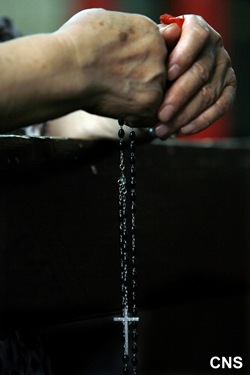

Whether people have come prepared to receive Christ or not, I would say one of the most helpful things a church can do is to allow people to focus on God and pray in the way they are best disposed to do.  I think one of the biggest obstacles we place create in worship is uniformity in worship.  When you walk into a church and everyone else stands and sits at the right time, says all the right responses, is swaying their hands in the air during the music, or hugging everyone around them at some point in the service, it likewise creates pressure for everyone to be a good, joyful Christian.

Christian joy is wonderful, and necessary, but the bottom line is that not all those wounded in battle will enter the field hospital bubbling over with joy; and if they aren't, they shouldn't feel that they have to pretend they are. (Just like those who are should feel free to show it.)

In recent decades, much has been said about people praying the rosary during Mass - for the most part, the practice has been condemned; people shouldn't be distracted from paying attention and participating.  Yet, while the rosary is certainly not the ideal form of participation, it is most certainly one good example from Catholic worship of an easy way for people to focus on God and worship him on a day that for ever reason their mind might otherwise be distracted and wandering.

It's not about defining some sort of requirements; quite the contrary, I would say that the best situation would see a bit of everything - during a hymn, for example, some people may be singing loudly, others re-reading the Gospel reading, others on their knees praying quietly, etc.  It allows all (regulars or not) to come as they are and worship as they need.

(I imagine this picture is from the
outside of the churching looking in)
 
Come as You Are

When I walked through the doors of Our Lady of Guadalupe parish in Playa del Carmen several years ago, I was impressed that while words from the pulpit were not minced or spared when it came to sins, so many sinners came willingly as they were.  The confessional always had a line up that lasted through the first half of the mass.  Even those arriving late would go to kneel in front of the altar, light a candle and say a prayer before going to confession or joining the service.  All those sinners, I could see, were welcomed and taken care of. 

What I didn't realize at the time is that the part most appealing to me, what ultimately drew me closer, wasn't that others could come as they were, but that I could come as I was (and as I still am) - as a sinner, wounded in battle and in need of medicine.

Saturday, October 13, 2012

Our Lady of Guadalupe Parish Church, Playa del Carmen


Our Lady of Guadalupe Parish, Playa del Carmen
The parish where I first saw joining the Catholic Church a real, feasible action was the parish church of Our Lady of Guadalupe, Playa del Carmen (Paroquia de Nuestra Senora de Guadalupe.)  This church (both the building and the people) holds a special place in my heart.  It was (and still is) like a home along the journey.  Perhaps it could be compared to Rivendell somewhat; it's not the destination of the journey, nor is it Paradise or even the most important place in the journey, but it has offered me a place and time of rest, consolation and safety along an otherwise perilous road.

Nestled in the middle of Playa del Carmen's first (and least reputable) slum, its off-white steeple with stain-glassed windows rises above half-built concrete homes with fiberglass roofs, haphazard stores, taco carts and greasy little restaurants where thick smoke pours out of the chimneys from the chicken roasters.

The building itself is beautiful.  This is not because of the contrast to the slum around it; in fact, it would probably be more beautiful standing by itself or in a large spacious yard so you could actually see the whole thing.  But the surrounding neighbourhood is part of the church, as the church is part of it.  Many of the people who worship there live in these homes and the parish offers (to all who seek it) care, education, teaching in the Faith, blessings and the Sacraments of the Church.  The old Irish priest who started the parish about 20 years ago is respected and called "Father" by everyone I know of.  My point is; the parish and the community are inseparable.


Likewise, the building and the beautiful things which have happened there are closely bound to each other.

I think the building would be described as a neo-mission style. (Excuse the out-of-focus images; I'm getting used to using a completely manual lense.)

The Sanctuary

The main image, below the crucifix, is the Virgin of Guadalupe (patroness of the parish, and, of course, Mother of the Church), the Virgin Mary as she appeared to a native at the time of the Spanish Conquest. On each side of the image of the Virgin, you will see:


Christ as a Child with St. Joseph (the patron of our family.)

St. Juan Diego, the native Mexican to whom the Virgin Mary appeared.
 For nearly 2 decades the church was without windows.  Now, little by little, stained glass is being installed:

The steeple, looking south.
The 8 windows in the steeple and the two windows below it depict the story of the Virgin of Guadalupe appearing to St. Juan Diego.  The large one in the picture above shows the Virgin Mary giving the saint roses.  The bishop had been doubting that these appearances actually happened, so the Virgin Mary gave the roses as a sign to be brought to the bishop; at that time roses didn't exist in the area where the appearance took place (Mexico City), so the only explanation could be a miracle.

St. Juan Diego, showing the roses to the doubters. (Below the steeple, south)
Archangel Michael (north side, next to the sanctuary)

This is newest stained glass image, installed this summer, entitled, "Who is like God?"  The words of the Archangel Michael as he casts Satan from Heaven, who had claimed to be like God. (The anguished face of Satan is hidden behind the woman singing in the choir.  But you can see his wings.)

East end, opposite the sanctuary
This image is also dear to our family; St. Joseph, Christ and the Virgin Mary as the Holy Family.

The lower row of windows throughout the nave of the church still do not have glass; however, the upper row of 12 windows (6 on each side) offers some of the titles of the Virgin Mary.  My favourite is this one:

 "Refuge of Sinners" 
One of the Stations of the Cross

One of the confessionals (There's one on each side, near the back entrance.  Confession is heard during Mass.)

A view from the main entrance, looking towards the sanctuary.

The main entrance.
 The tables in the foreground are where homeless people, low-income workers eat during the week.

Side entrance (north side)
West end of the building.

Another image of the face of the Virgin of Guadalupe can be seen above the windows of the church offices.  The blue tarp is the area where people eat breakfast after Mass. (It's redundant and pointless to call it "socializing" or "fellowship;" for Mexicans every time you eat it's socializing and fellowship!)

This area is actually the plaza which serves primarily as the patio for the parish school, of which I didn't take pictures.  The school will need a post in itself.

Wednesday, October 3, 2012

Back in Mexico ... for Now

A typical store in Colosio
As I mentioned last post, I'm back in Mexico for a few weeks.  Since I'm here alone, I spend most of my time working; for brief times in the evenings I walk through Colosio, the neighbourhood my family and I first lived in when we arrived in Playa del Carmen.  The community is disorganized and dirty; it's full of half-built homes and shirtless men sitting on the sidewalk.

Right now my neighbor across the street is loudly singing passionate love songs; does this mean his girlfriend left him?  This is what it meant other times.  Who knows.  Today, in the middle of the week I can hear loud music from at least one house; while I was walking, I weaved my way through a house party that had overflowed into the street.

However, among all the dirt, chaos and noise, there are so many little things to discover; even the music and parties might be considered something good, so long as you're not trying to sleep.

Tonight I went to a bakery which has gained such a good reputation for its fresh bread that in the evenings there are perpetual line ups of people waiting to buy the bread as it comes fresh out of the oven.  Tomorrow I will write about this bakery.
 
This morning I walked past the community's church; it was dark and rainy out, and the inside was lit by a mix of candles and the electric light illuminating the Virgin of Guadalupe (for whom the church is named.)  Inside, the rain could be heard on the roof and there was a silent beauty.

There are more.  But for now, in the middle of such an unsightly neighborhood, I remember why I love Mexico.

(I need to get a memory card for the camera I have so I can add some pictures. The one I have here is recycled.)

Monday, January 30, 2012

Poverty Is NOT a Problem ...

This says: "I have time and money to waste ..."
... in  a place where people so much money, food, possessions, etc. that they take a complete papaya, nice, ripe and perfect for eating, and smash it against a wall, letting it rot on the sidewalk, just because they feel like it.  Or in a place where kids have enough money and time at their disposal to buy spray paint and graffiti walls all night.  Or where people can buy their kids a coca cola and large bag of chips every day for their snack.  Or where people can buy take out food and throw half of it away.  Or ... I could make this list much longer, but I won't.

I live in a community which by many people would be considered "poor" or at least (even in Mexico) significantly below average.  I've estimated that the average household income in our neighborhood would probably be a bit over $7000 CDN, annually.  (Based on the cut off for mortgage requirements for buying a home.)  From my experience, the cost of living is about 1/2 of that in Canada, so by Canadian standards we could say it's equivalent to about an annual income of around $14,500.  By all the standards, it's well below the Canadian poverty line , which is about $30,000, I believe.  (The Canadian "poverty line" is a joke anyway, since it has no relation to poverty; it's measured as the bottom quarter of household income, not by basic needs or standards of living, but that's a different story.)
Too much money? Too much to eat? (A papaya)

The average household income in Mexico is about $10,000 USD per year, according the CIA Word Factbook.  So it's even noticeably below this country's average.

So, my community is officially poor. Yet, at the same time, I walked out of my house this morning to take my son to school and saw a papaya splattered all over the neighbour's house and sidewalk, left there to rot.
I go for walks every day, and every day I see new graffiti on the walls.  I see garbage bags ripped open by dogs with half-eaten take-out meals strewn all over the sidewalk.  I've been to countless parties where people pick a few things off their plate and throw the rest away.

On one level it's annoying that the first three habits make my community dirty, but that's a different issue.  The issue here is that people are absolutely wasteful.

I think our definition of poverty has been very, very skewed.  If we define poverty in terms of material needs - food, clothing and shelter in their most basic and necessary sense - then I've never seen poverty.  I know it exists somewhere, but I've never seen it.  I'd guess that people who REALLY were poor would absolutely never consider destroying any kind of food, just for fun, even to prove a point.  I'd guess that knowing what hunger really is like, from experience (which I don't, and, as far as I know, no one I know does) would simply eliminate that possibility that you could throw away food.  I'd guess that you'd never consider wasting what little money you had on a can of spray paint to graffiti your neighbour's wall.

Yet, all of these these problems are usually associated with poverty.  It's strange, isn't it?  I'd say the problem is abundance and idleness, not poverty.

The person I know who is closest to poverty does not consider himself poor.  While his living conditions are substandard (by our standards), he does not feel he is lacking anything in life, and would never ask anyone for anything.  He works hard, every day of his life.

Yet the "poor" people in my neighborhood can throw away food, give their kids money to buy spray paint, etc., etc.  Then they complain about the government and big companies.


While it's less visually obvious, I'd say the problem is just as big in Canada.  And we like to talk about the 99% and all of that.  People like to talk about poverty, yet I see so much complete wastefulness, that I can't take it seriously.

My wife and I believe in helping the poor.  And we do.  We help the poorest people we know every time we have a chance.  But as long as people have enough money and idle time to waste food and vandalize their neighbourhood, I don't feel sorry for them.

Tuesday, January 24, 2012

Roasting My Own Coffee

My home-roasted coffee
As of this weekend, I just discovered a very nice way to have very good, freshly roasted coffee at home all the time; roast your own coffee.  Especially in Playa del Carmen, where there are no coffee roasters (as in Cuernavaca, Mexico City or Toronto.)  The best I had found here so far was a coffee from Chiapas, but was pre-roasted and pre-ground; it was good, but, you know, there's nothing like coffee that was roasted this same day. (To be fair, there are excellent grocery store brands too, but I almost never go to the grocery store, so I don't feel it's worth the time walking through the whole store, going through the check-out line, etc.)

On Sunday, having found out that the coffee vendor had moved to a new spot inside the municipal market, I went through the market to find him.  On the way, however, stopping by a shop that sells bee propolis (the pollen that the bees collect from flowers, before they turn it into honey, which is good for sore throats and colds.)  Just out of curiosity, I asked if he happened to sell coffee; I felt that since my other coffee supplier moved his shop, I was justified in shopping around.

He didn't sell coffee, but he did sell the green coffee beans, he told me.  The coffee was also from Chiapas, and it was less expensive (about $10 CDN / kg or about $4.50 a pound.)  I remembered that my wife had bought a little coffee grinder (to grind grain for the baby.)  Roasting my own coffee would be fun, I thought.  So I bought a quarter kilo (about half a pound) and was happily on my way home to roast and grind my own beans.  The result has been amazingly good coffee!

Here are pictures of the process:
The shop where I bought the green coffee beans


Another view of the shop (with me on the other side)

The green coffee beans

Coffee beans roasting - about half-way done.


Me stirring the coffee beans (about halfway done)
 
When the coffee is almost done, it will fill your house with smoke.  Beautiful smell.  My wife wasn't impressed.

Cleaning some of the left over husks off the coffee beans; I'm not sure if this is necessary, or perhaps it should be done when they're still green?.
The ground beans, ready to brew
Brewing ...

The finished product - delicious, home-roasted coffee!

Tuesday, January 17, 2012

After 4 Years of No Pipe ...


Pipe Tool, Pipe and Package of Tobacco
After more than 4 years of not smoking my pipe, I finally took a little detour on our last family outing to the beach and bought a pack of pipe tobacco downtown (Playa del Carmen).  There was little variety, and the workers new nothing about the tobacco - they only read me the name from the package, as though I couldn't do it for myself.  So I choose the flavour that sounded most like the ones I used to like - sweet rum.

Fortunately, the package was well sealed and the tobacco inside was still relatively fresh.  (I've had some in Canada that was completely dry and crumbly, and hence virtually useless.  Never from the Walper Tobacco Shop downtown Kitchener, though.  Theirs was always fresh.  They're located in the Walper Hotel, at the corner of King and Queen if anyone's interested.  Best tobacco shop I've been to to date.  I intend to go back on my next visit to Canada.  See their Facebook page for some OK pictures.)

Me smoking a pipe in 2006 when my wife and I met - a favourite picture of hers
My pipe was safely put away in a box under the bed; I was actually surprised since my wife tends to through (or give) anything away that we haven't used in a year.  She had stored it with her wedding veil and about 5 other items of sentimental value that have official and permanent immunity to spring cleaning (which never happens in the spring, but at random times throughout the year.) Perhaps she gave the pipe this immunity since was because when we first met I used to smoke my pipe.  Or maybe out of thoughtfulness for me, since she knows how much I used to like it.  In any case, I was touched.


My pipe tool (as seen in the picture above) was neatly stored in my old wallet where it has been untouched for the last 4 years.  (The same old wallet I've used for almost a decade, I believe - the same one I've always used to store my pipe tool - besides cash and bank cards.)  It's a great wallet, from Mountain Equipment Coop.  Still as good as new - except that it's dirty. I could probably clean it.  I'm sure if I didn't use it, my wife would throw it out.  But that's beside the point right now.

My old MEC wallet with the pipe tool inside
On Sunday evening, I packed my pipe and sat down on my front lawn, with the cool evening breeze (refreshing after the hot day), packed my pipe, and enjoyed a good smoke for the first time in four years.  I enjoyed it.  I still like the flavour and the process packing, lighting, and doing something that is slow and, by it's very nature, not rushed.

(A little note: I thought it would be worth pointing out that I have smoked a pipe, it just wasn't mine, and definitely not often; I think it was probably 2 or 3 times.)


The Walper in Kitchener - I didn't buy my tobacco here this time, but I will next time.

The pipe tobacco selection in the Walper

Monday, December 26, 2011

Come to Mexico for a Great Vacation ... at Starbucks?

Playa del Carmen's Beaches
I've complained before that people come down for vacation to Mexico and in reality see nothing of Mexico.  But forget about culture, history and tradition.  We know 95% of tourists simply don't care about that stuff. But what about the wide, beautiful beaches that made places like Playa del Carmen and Cancun so famous?  It's the same story.

This afternoon my family and I went down to the beach. Weaving our way through the crowded Fifth Avenue (the main tourist street, running parallel to the beach, a block or two away) we saw crowds of mostly non-Mexican tourists (including many Americans, Canadians, Europeans, etc.)  A block and a half later, after about 2 minutes of walking, we arrived to the beach.  I would say about 90% of the people were Mexicans - a complete turn around from the trendy main drag, filled with stores and restaurants that you could easily find in any major North American city.

We arrived in the mid afternoon when it was still warm and sunny, and stayed until the early evening when the sun had gone down.  I waded in the water with my kids, and later went into the water alone, floating on my back and looking at the stars and moon above me.  It was absolutely beautiful!

Yet, I couldn't help but wonder; why do all these Americans, Canadians and Europeans spend so much money to come to come to the beach, and then not go to the beach?  The big selling point here in Playa del Carmen is the beaches, which are some of the world's most beautiful - so beautiful and relaxing, in fact, that they made me (a former and very decided hater of beaches) fall in love with beaches.  Yet instead, they go to drink beer at a bar.

It's not only downtown.  I've been to resorts and seen pictures of others, where it's the same story.  The pools, beach clubs, restaurants and tennis courts are full of people and alive.  If there are lounge chairs or canopy beds down where the sand begins, an adventurous spirit may wander down.  But the actual sand of the beach is empty of northern tourists, and you would think there's something wrong with the water, since no one's in it (even now in the middle of "winter" the water is comfortably warm; these tourists wouldn't know that, though.)

So, just my same question again - why would you spend all the money to come down here, and instead of enjoying some of the most beautiful beaches to be found, go to Johnny Rockets and Starbucks?

Monday, December 19, 2011

"Why didn't you tell me you were the Virgin Mary?"

Would your recognize the Virgin Mary?

This weekend, I participated in my fourth Mexican "posada," which is a communal re-enactment of the scene where Joseph and Mary arrive to Bethlehem and look for a place to stay, which take place during the 9 days before Christmas.  The re-enactment is followed by a party where a very traditional hot fruit punch is served to all those who participate, along with snacks, a pinata and other elements of Mexican festivities (=loud music & tequila.)

In the Mexican re-enactment, a group of neighbours and friends from the community get together, light candles, and show up at the door of a the person hosting the party.  The people outside with candles play the role of Joseph and Mary (it doesn't matter how many people there are)  and the people inside are the innkeeper.  The re-enactment is in the form of a song where each "role" sings short verses in response to each.

Joseph asks for a place to stay, the innkeeper sends him away, threatening a beating if doesn't leave.  Joseph implores him for the sake of his pregnant wife and finally, 12 verses later, convinces him to let them in.  Everyone enters singing joyfully of the night Christ was born.  I've been to some (like last night) where a prayer is said, then the punch is served, etc.

Last night I especially noticed Joseph's final method of convincing the innkeeper:

"My wife Mary is Queen of Heaven, and will be the mother of the Word Divine."

The interesting part is actually the innkeeper's response, after so vehemently denying them service:


The festivities beginning, just after the re-enactment (my posada last night)
"Are you Joseph? Your wife is Mary? Enter, pilgrims. I did not know!"


If he had only known that it was Joseph and the Virgin Mary!  My first reaction to this is probably typical of a more reasonable Northerner; "What a silly little song! As if the innkeeper would've known or cared who Mary was."

Besides no mention of such a dialogue in the Bible, the idea that the innkeeper could've known who Mary the Queen of Heaven was is simply absurd and anachronistic.

But then I had a second thought. From what I understand, these plays are part of a long-standing Catholic tradition of re-enacting the Gospel, still very much alive during Advent and Easter time in Latin America and other some other Catholic areas.   On one hand, there's a cultural element here; everyone knows who the Virgin Mary is.  I'm guessing that one of the original purposes was to present these key stories to an illiterate population.  These re-enactments pull the events out of history and put them into Mexico in the current day and age where it only makes sense that all Joseph would have to do is identify his wife as the Virgin Mary.  The recognition of her roles and titles would also serve to teach and reinforce these concepts in addition to the story.

A Posada (not mine, just a good picture)
Purely for the sake of speculation, there might be something more to this.  The idea of "showing what happens" was (and is?) also the main idea behind religious icons, according to Pope Gregory I (6th century) among others.  I have also heard the Mass described in a function of "reenactment."  Both icons and the Mass show "historical events" in eternal terms, not merely placing the past into the present, but actually showing eternity within the framework of time. (The reason why icons of John the Baptist show him with his head firmly attached to his shoulders, but also holding his own head on a platter at the same time, and the reason why the Mass seems to "repeat" Christ's death and resurrection; it is not "repeated" but is eternity reflected in the framework of time.)

Perhaps there is an element of this idea behind the Catholic reenactments and the Mexican Posadas; in eternity, the innkeeper would know the significance of the event that's about to happen (the birth of Christ), and Mary would not be a simple Jewish girl from Galilee - she would already be The Queen of Heaven and the Mother of God (as is believed in Catholicism) and it would be necessary to recognize her as such.

I'm not sure if I'm taking this idea too far, but this "anachronism" becomes much more interesting when considered in these term.

Wednesday, December 7, 2011

A Trip to the Library – Educational or Entertaining?

Elmira LibraryWhen I was visiting a library in Halifax this summer, I overheard a German family discussing some videos that the pre-teen children were choosing.  The parents were looking over the case of a video somehow related to Shakespeare – I’m guessing it might have been that version of Romeo and Juliet with Leonardo Dicaprio.

“Is this really educative?” asked the mother. (She said “educative” rather than “educational.”)
The father took the case. “I don’t think they have anything to do with Shakespeare these days,” he observed.
They proceeded to discuss the item in terms of morality, quality, entertainment and educational value.

Listening to the conversation, I realized two things; one is that this is probably a good thing; the other is how rare this kind of care is among parents these days.  In the whole week I spent in that library, this was the only family in which the parents were actively engaged in the values of their children’s choice of material.  Everything about it would be foreign to so many people; encouraging kids to go to the library, going with them as a family, reviewing and discussing the material they choose, caring, talking to them about it, knowing something about it …

For me, it was as though the conversation was from another world.  Where I live in Mexico, libraries are few and far between, and the few that exist are way underused. It would be a miracle that parents even encourage their kids to go to a library, let alone care what their kids are doing there.  When my wife and I arrived to Canada, she was simply overjoyed to have a good library right in the community, within walking distance.  While I think there’s a better culture for visiting the library, but I suspect it’s much more for entertainment than for learning. I also suspect that few parents actually supervise and discuss the educational, moral and quality value of what their kids choose.

With only a 3-year-old, I it’s not much of a task to review the content of the books yet. That’s coming in a few years.  I suspect one day we’ll be that odd family in the library who actually cares about all of that stuff.

Wednesday, August 31, 2011

Short Shorts in Halifax

short shortsFor people who live in a touristy beachfront town in Mexico like Playa del Carmen, where it’s common to see people in all places hardly wearing anything at all, it’s difficult to find a place where they can be surprised by the revealing clothing.  This is the case for me and my wife, but on a recent visit to Halifax, we were, indeed, surprised by the shortness of the shorts that women were wearing there.

About two weeks go, my wife and I were parked at Tim Horton’s in Halifax (a very popular doughnut shop chain in Canada) for her to use the washroom.  Just before she came back out to the car, a group of young women walked out of the doughnut shop; I couldn’t help but to notice how incredibly short their shorts were.

When my wife got into the car, she looked over at me and asked, “Did you see those girls?”  She had also noticed.  I don’t suppose too many people – male or female – couldn’t notice.

As we were driving, we came to several conclusions:
  • This was not an isolated incident; short shorts are much more common – and shorter - in Halifax than any other place we’d been recently. Out of pure curiosity my wife and I counted as we drove down the street and it seemed that half of all the young women were wearing these really short shorts.
  • Coming out of Mennonite country, this sight was probably surprising because of its sharp contrast. But …
  • even in less “modest” parts of Ontario (like Toronto) we were sure we hadn’t seen this many short shorts.  My brother said it was because Halifax is a university town.  But Waterloo is even more of a university town, and I can’t recall seeing ANY short shorts there; I visit the city once a week on average, usually driving right through the university district.
  • The most important fact is that for the past few years we were living in Playa del Carmen, on a Mexican beach where “modesty” is not an idea that really factors into clothing styles.  Sure, on the beach women wear bikinis, and off the beach clothing is often fairly scanty, I don’t recall seeing shorts as short as the ones in Halifax, or in that frequency.  While you can easily predict the shock of a couple coming out of Mennonite country, clothing really does have to be revealing to shock people coming from a touristy beach town like Playa del Carmen.

I don’t why, but Halifax seems to have a trend towards really short shorts.  The weather most certainly doesn’t justify it; Halifax was no longer hot at this time, and the evenings were actually getting cool, at least by our standards. We’re not sure how they managed not to feel cold.

Friday, May 13, 2011

Springtime in Canada

Tulips and DafodilsWhile living in year-round warm weather sounds (and is) attractive for many reasons, there’s something wonderful about the passing of real seasons – seasons you can see, feel, smell and even hear.

I love the weather in Mexico – especially places like Cuernavaca – but the seasons really only pass on the calendar, and the change between sunny and rainy or hot and really hot (in the case of Playa del Carmen) really don’t match up with the traditional northern seasons I love so much, besides the fact that the complete appeal to all senses isn’t so noticeably present.

Today my wife, who can’t stand weather colder than 20 degrees Celsius, told me that there was something extraordinarily beautiful in seeing gardens full of freshly blooming flowers, bright green leaves just beginning to sprout from their buds, and lush, green grass, all against a sunny sky, on a day that’s finally warm enough to take off your sweater – after so many weeks of cold, grey, rainy days, with spring battling to emerge from a unseemly long season that resembled late winter more than anything else.  You can smell the flowers and freshly cut grass.  You can hear the birds singing in a sort of relief, a proclamation of the coming warmth.

Getting on an airplane and flying somewhere warm just doesn’t have the same rich appeal to the senses.

There’s is something very beautiful in this changing of the seasons in Canada.  I love every season in Canada just because it is such a beautiful contrast to the one that proceeds it.

Friday, February 25, 2011

Our New Park

My family in the park (this is the playground side, with fewer trees.)
About 4 or 5 months ago, a new park was opened in our community, just across the main road, a 3 minutes walk from our house.  With the completion of the development, it's also our last park; there are a total of 7, all within walking distance.  These parks represent one of the best features of the planning of our community; no other community anywhere in Playa del Carmen has this concentration of parks.  All of them also have plenty of trees, which are mostly the native trees left in tact, adding necessary shade for the heat of the Caribbean sun. 

Most of the other parks in the city, as well planned and beautiful as they are, have been completely cleared with a few scraggly palms added that do nothing either for shade or for the visual appearance of the park.  (I still can't figure out the obsession with palm trees; in a suitable habitat they grow nicely, but they give little shade, and die as quickly as they grow.  In Mexico City, some idiot city planners have tried to grow palms in Santa Fe, which is naturally a cool hilly climate where pines grow.  The palms grow to about 3 feet tall, and whither up, looking quite sad compared to the majestic pines towering over the hill tops a few kilometers away.)

This new park is also the nicest in the community, providing an ideal balance of trees, walkways, benches and playgrounds.  We're in love with this park and delighted that it's so close to us.

The park closest to our house (about a 2 minute walk away) is about 1/4 of the size.  It was also nice, but was less planned.  Worst of all, though, was the fact that within weeks of its opening it was vandalized.  I could live with graffiti, but the kids who did it also nearly dismantled the playground, disfiguring every part they possibly could.  It's now been put back together, but from the original parts, so it's still deformed and rather shabby looking.  My wife was there when they wrecked part of it, and came home very upset and frustrated, nearly in tears, because they were very rude to her when she tried to convince them to stop.  By the time I arrived they had left.

The worst part about it is that everyone on the street (not our street) knows who it was.  But no one wants to say or do anything for fear of getting on the bad side of the parents of the kids.  I wish parents would pay just a little attention to their kids.  Disinterest and complacency are destructive.

No one has touched the new park yet.  I hope they don't.  After half a year of walking halfway through the community to get to the next park to avoid being reminding of how disappointed, upset and frustrated we were to see our first new park vandalized, we've finally got the best park in the community right across the street.

Moms, dads, kids, teens and dogs all come out every evening to play and relax, and it's really becoming sort of a hub for this part of the community.  We love it.

Right now we feel like we live in the best place in the world!

For 2 other pictures (one before the development), read:
The Neighborhood I Call Home

Tuesday, February 22, 2011

"The seats on the bus go bump, bump, bump ...."

A bus in Playa del Carmen near where I live.
A favorite activity that my son and I enjoy on the way to school is imagining all the different possible versions of "The wheels on the bus ..."

If you've only ever been on a bus in Canada or the U.S., you'd have no idea of how much fun this can really be.  Our favourite is "The seats on the  bus go bump, bump, bump."  The most fun is trying to sing, as the seats, the whole bus, and the people on it actually go "bump, bump, bump" so much that you have to hold onto something to stay in your seat, or at least avoid ending up on the floor.

In the small mini-buses (like in the picture) the morning and afternoon school rush often leaves us standing up in the middle; usually when there's an adult with a seat, they'll at least give the three-year-old a place to sit, but when everyone else has a 3,4 or 5 year old, or just no body is that thoughtful, we're left standing, him holding onto my leg, and me holding on the rail at the top, not being able to stand up straight because the bus is just too small.  We still sing our song, though.

When my wife was going to fly for the first time (this was after we were married with our first baby, who is now the three-year-old), she was concerned that he wouldn't handle the flight well.  I reassured her that if the baby survived the buses on Mexico City's old roads (where we lived at the time), the take off and landing would hardly be noticeable.  I was right; our baby didn't cry.

I've been on the old buses running through the mountains in Greece, and they're even more fun.  Mexico's old inter-city bus services used to be like that - both my dad, my wife, and many Mexicans I know experienced those buses - but they're now quickly being modernized, with soft, comfortable seats and movies; the old highways that were almost wide enough to avoid oncoming traffic, and really made the bus bump, are being replaced with wide, smooth, modern highways.

In the mean time, many of the city buses still go bump, bump, bump, enough to be fun, and give people with motion sickness a hard time.  Singing helps.