Showing posts with label Christians. Show all posts

Sunday, April 27, 2014

Our Newly Canonized Pope Saints!!

What a wonderful gift to the Church that these two saints are now officially recognized as such.  In heaven, in the presence of Christ, they will certainly be praying for us, and bringing us many blessings.

Saints John Paul II and John XXII, pray for us, bless us and intercede for us to Christ our Lord!


Thursday, April 17, 2014

Springtime - New Life Arises from Death

This year, Lent started off cold and snowy, with bare trees and everyone feeling like winter just wouldn't come to an end.  As Lent continued, the snow began to give way, the earth began to thaw, and little green sprouts pushed their heads up through the piles of dead plant life from the fall and dirt piled up from the winter snow.

Around the middle of Lent, our family planted some sunflower seeds inside - one of the clearest reminders that new life rises out of death; a plant, having dried up and died, leaves a dry seed as a reminder of its death.  We buried the seeds, seemingly dead, in the ground in hope that new life would come.

In the Roman tradition of the Church, there has existed a strong idea that the Feast of the Resurrection is closely tied to the arrival of spring and the new life that it brings out the death seen in winter.  In fact, many great theologians, from St. Ambrose to Pope Benedict XVI, have believed and given great strength to the idea that Christ did in fact rise from the dead on March 25, the same day he was conceived, and the same day that God created the world - all great signs of hope and new life.

---

Now, only 3 days for the celebration, even the 10-foot piles of snow have receded, green grass has pushed up through the matted brown grass of the fall, and tulips and daffodils are just about ready to bloom and celebrate the greatest event of all history with the world.

Just about all the sunflower seeds we planted have sprouted and many have grown a few inches tall.

The world (or at least the part of it where we live) is just about to burst with new life, proclaiming the new life that Christ brought us in his death and resurrection.


Here are some more pictures of our sunflower plants:

 These are the egg carts we planted them in just until they germinated:

The transplanting process:

The wagon I use to take them outside to get some direct sunshine on warm days:

Saturday, March 15, 2014

Stations of the Cross Restored and the Prayerful Elderly

Stations of the Cross at Our Parish
This Lent  we are having the Stations of the Cross at my parish (St. Mary Queen of Heaven, Linwood, ON) again.  I have to confirm this, but I believe it is the first time these prayers and meditations have been held here since we started sharing a priest 13 years ago.  Of course, they are being led by a layperson while the priest leads the stations at the main parish nearby (St. Clements).

We though at first that it might be only my family showing up, but we were pleasantly surprised to be joined by 6 elderly parishioners from the community. 
Detail of the 12th Station
These parishioners, along with a few others who join when they can, form a core group of what the pastor praised as "our prayerful elderly."


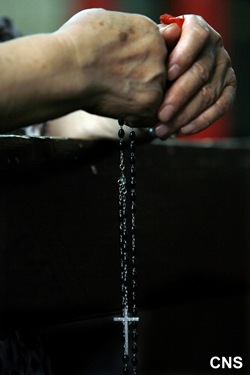
They always come 30 minutes early for Mass to say the Rosary and pray and a number of them always come to Adoration of the Blessed Sacrament and Mass (in honour of Our Lady of Perpetual Help) on Wednesdays.

It hadn't occurred to me very directly before our pastor mentioned it, but this group is a true gift for our parish; I don't doubt that the dedicated and constant prayers of this group are a strength and blessing for the rest of us.

And I am delighted that they have blessed the newly re-established Stations of the Cross by joining us.

One of our crucifixes

Wednesday, March 5, 2014

Strict Lent - How to Make it Work!

Today, Taylor Marshall (whose blog I recommend) shared a story of how he ruined his Easter one year by trying to go too hard on himself at Lent -How My Strict Lent Once Ruined Easter – A Lesson on Lenten Crash and Burn.  Excellent post - go and read it!

I wrote the following as a response on how I moderate my Lenten penance.

1. Talk to Your Priest


I tend to "go hard" (this year, for example, I'm giving up meat, coffee and Facebook) but I moderate this in several ways. One is I take the advice of my priest; if he says something is too much, I believe him. Dr. Marshall mentions this point and it's very important; most priests have seen enough crash and burn stories that they can see it coming if you're being too hung up on going all out. I have done this since I first joined the Catholic Church (this is only my 3rd Lent) and priests are very helpful in giving direction like this.
 
2. No Penance on Sunday!
 
We must remember that Sundays are not days of penance; it's not that penance is "optional" but, from what I understand, it is actually incorrect, since every Sunday is like a mini Paschal feast, we are to celebrate on Sundays. Every Sunday I will be enjoying my meat and coffee (I'll stay off FB, though, since that could lead to a habit, and it's not really "festive" to go on FB in any way); this way it's only 6 days at a time, and these urges don't build up so much. I enjoy it thoroughly and in moderation. We're usually at my parents' house for lunch on Sundays, and they inevitably make a nice roast. My mom has coffee with the desert, and I wait till it's served (rather than gorging into the coffee the minute Mass ends), enjoy two cups with cake, maybe one more later in the day and leave it at that. (Basically, what I would do on a normal Sunday.)
 
Make sure the festiveness of Sundays is a celebrating Christ, not just gorging in the things you abstained from; we eat meat and cake, drink wine and coffee and spend our Sundays with family to celebrate the Resurrection. If you find yourself going crazy for meat (or whatever you gave up) on Sundays, it's probably a good early indication that you may need to make adjustments and you should talk to your priest to guide you through those adjustments, especially if you haven't yet!

3. Rededicate Penance to Christ

Even with the 6 day waits, it can be disastrous to start thinking about our penance day in and day out, and even more disastrous to become frustrated that you can't stop thinking about it. Meat isn't really an issue for me (my family eats meat only 2 or 3 times a week as it is), and I usually feel the break from FB is a relief; coffee could be a killer for me. But if I find myself thinking about coffee, instead of fighting it (which just turns into a frustrating battle with yourself over something silly), I let myself enjoy looking to forward to coffee, and then I pray a decade of the rosary or something like that, thanking the Lord for the coffee I'm going to enjoy on Sunday and rededicating what I have given up to Him.

4. Make the Penance a Gift

When I want coffee in the morning, I make a cup for my wife instead, who doesn't give it up. This seems like it would be counter-productive, bringing the temptation too close, but for me it works. I feel a certain satisfaction that someone else has enjoyed it and that I have made my sacrifice a gift. If you give up meat, buy a roast for the old widow next door (who in all likelihood hasn't given up meat.) We did that last year. If the temptation is too much, then find another kind of gift to give instead.

5. Don't Isolate Yourself

Try penances that other people around you are doing. Support helps. In the old days, besides being holier (as Dr. Marshall pointed out), people had the support of EVERYONE around them doing the same penance. Some Catholic and especially Eastern Christian communities still have that. We as North American Christians don't. Meat isn't hard at home for us, but my parents (who we visit often) rarely have a meal without meat. My wife and I support each other, and my parents are very understanding, so we get by. As for coffee, my wife doesn't give it up, but she also never makes coffee for herself at home (that's my job!) So, I don't have to smell coffee brewing from the kitchen, unless I'm the one who did it as a gift for my wife.

If you know that people bring cookies to work every day and you love them, or there's a bakery you walk by every morning, it could be torture to give up sweets. Don't choose penances to torture yourself. I give things up that are important, but not things that will be wafting in my face all the time.

6. Leave Yourself Some Pleasures

I love beer and wine. Having given up coffee, I can still sit down in the evening and enjoy a glass of wine with other people. I also enjoy my pipe. If I tried to give up alcohol and tobacco too, it would be torture since I wouldn't have that little pleasure to fall back on - and I can enjoy the pipe even on Ash Wednesday or Good Friday when I'm otherwise fasting as per the rule! Don't try to eliminate every one of the most pleasurable items, but rather specifically choose a couple that you WON'T give up.

7. Build Up Little by Little

In my three Lents I've progressed from giving up one thing to three. I don't expect to increase this by one item every year, but I hope that in 20 years I can handle more than I can now. Disciplines are developed with time, not over night. I will also not feel bad if one year I have to go easier on myself for some reason or another.

So, it's possible to go hard for Lent, but it's not by any means necessary or even helpful to torture yourself.  I think these little guidelines I've created for myself have been a big help.

Monday, January 27, 2014

"Come as You Are" Revisited: Is the Church for Saints or Sinners?

Just over three years ago, I wrote a post in this blog called "Come as You Are;" the post had nothing to do with Kurt Cobain but the title was ideal. The post shared an observation about my mother-in-law's feelings about the Catholic Church; while the faith and moral teachings are very important to her, she takes pride in the fact that it is a place where sinners and the down-and-out in general could approach God without being turned away or judged.

I then went on to make some observations about how she saw this as a contrast to the various new denominations that have begun proselytizing that country in recent times.

For most of the time since then, I was rather doubtful of that post, thinking that I had probably gone off track.  Yet, I justified it by the fact that I was not yet Catholic and only just beginning to take a renewed interest in my Christian faith.

Looking back and re-reading the post today, however, I realize that I really was onto something, at least in the general sense.  I have come across some new ideas and had some new experiences that help put the idea of "come as you are" into a more solid context.  Most importantly, I see that the message was not just for others, but also for me.

Two Opposite Errors


When it comes to opening a church to all alike, there are two opposite errors which both essentially keep people from really coming as they are - both push people to pretend they are someone they are not.  One is to assume that everyone who passes through the doors of a church must be a saint, or become one quickly.  The other is to deny that sin exists and just declare that everyone is a saint regardless of how they live.

Closed Congregations

I'd guess that just about everyone has had the experience that when they walk through the doors of a church and suddenly get an urgent feeling that they are very out of place. Putting the truly closed congregations aside, there are many ways a church can deliver this message even if their doors are quite open.  Most kinds of uniformity can do this.  For example, in Mexico men of certain denominations will wear golf shirts, tucked into casual dress pants and have a neatly combed side part.  While such dress is certainly tasteful, anyone who's been to Mexico knows that it is also very unusual.  Thus, the average Mexican (or even expat) wandering through the doors to worship God on Sunday morning  would find himself standing out like a sore thumb, and probably immediately being approached to be welcomed as the new-comer.

As this last example shows, some of the factors which tend to close off a congregation are meant in truly good will and kindness.  Yet, the experience I just described is quite off-putting to many people.    The way of dressing is certainly connected to a saintly way of life and albeit given in warmth and kindness the invitation includes an unspoken assumption that your differentness is an indication of sinfulness.

Many people desire a church of more "saintly" Christians, and all too often outward signs that even unofficially indicate this can be a way of alienating outsiders.

Open Doors and No Walls

Then their is the opposite situation.  The idea that sin simply doesn't exist.  A question that shows a concrete parallel is this: what is the point of having open doors if your church has no walls? While a church like this may give the impression of welcoming everyone, the truth is that they welcome no one; no one is given the benefit of approach God as a sinner, which we all must do.

A Field Hospital for the Sick

One of my favorite images from Pope Francis so far is his comparison of the church to a field hospital after the battle.  The problem with both situations I describe above is that both assume that the church is here only for or primarily for saints; (one tries to make quick work of sanctifying everyone, the other simply declares everyone a saint.)  Christ said the opposite; he told us he came for the sick, not the sick, not the healthy.  Like Christ, his church is here for the sick and the wounded.  This means two things - first of all that we must acknowledge that nearly of all of us have been wounded in the battle, and secondly that we must have our doors open to the most deeply wounded.


Here is one of the hardest things I have learned, and a point I still struggle with in action; when the wounded come in fresh from the battle field, unsure if they will make it or not, they must not get the impression that they are in the company of the healthy, and have made a mistake by entering a place they don't belong, as in my first point above, but the should see clearly that they have indeed made it to the hospital, the place where the wounded have gathered for healing - for care and for medicine.

This seems like a paradox, since the first aspect most of us will judge in a church is how "good" the people are; yet, I can guarantee you that a newcomer will feel much more at home in the company of those acknowledge their own faults than those who pretend not to have any - and, most importantly, it is simply the truth - pretty much all of us are sinners in need of the Great Physician.


Everyone must become aware of their sins, not so they feel ashamed or out of place at church, but on the contrary so they feel confident to bring their sins with them and know they can leave them there, just as everyone else does.


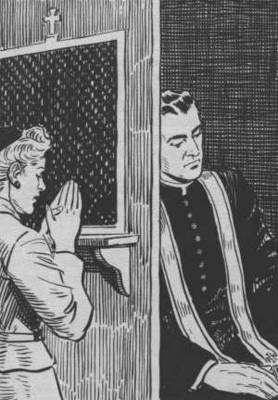
Confession to a Priest

Three years ago, when I wrote that post, I had a sense of arrogance.  While I was convinced that I was coming the fullness of the faith, at the same time I was sure that I would have a good deal to "teach" most Catholics, who knew so little about the Bible and even their own faith.  When I wrote about "come as you are," I was, somewhat subconsciously, writing for the "others," those real sinners out there.

What I have learned the most since then is that "come as you are" is for all of us, not just those who have done (or are doing) the more obvious or sins.

For a church really to be open for all to "come as they are," even those stable within the church must have the benefit of being allowed to come as a wounded person, finding medicine for their wounds, forgiveness for their sins.

The best and easiest way for this to happen is sacramental confession, where you confess your sins to a priest who absolves those sins.

One of the surest signs of an unhealthy Catholic parish is an empty confessional; not because the people are more or less sinful, but because it indicates that the most regular church-goers are not ready to recognize their own short-comings - they are not prepared to come as they are.  How can we expect others to come as they are we do not?

Rosaries and Freedom of Worship

Yet, it is important that recognize that not everyone is ready or willing to receive such medicine.  Not everyone arrives ready to confess their sins (and consequently not ready to receive Christ, physically through communion, or otherwise.)  Even these people need medicine, perhaps more so than those who are in line for confession.


Whether people have come prepared to receive Christ or not, I would say one of the most helpful things a church can do is to allow people to focus on God and pray in the way they are best disposed to do.  I think one of the biggest obstacles we place create in worship is uniformity in worship.  When you walk into a church and everyone else stands and sits at the right time, says all the right responses, is swaying their hands in the air during the music, or hugging everyone around them at some point in the service, it likewise creates pressure for everyone to be a good, joyful Christian.

Christian joy is wonderful, and necessary, but the bottom line is that not all those wounded in battle will enter the field hospital bubbling over with joy; and if they aren't, they shouldn't feel that they have to pretend they are. (Just like those who are should feel free to show it.)

In recent decades, much has been said about people praying the rosary during Mass - for the most part, the practice has been condemned; people shouldn't be distracted from paying attention and participating.  Yet, while the rosary is certainly not the ideal form of participation, it is most certainly one good example from Catholic worship of an easy way for people to focus on God and worship him on a day that for ever reason their mind might otherwise be distracted and wandering.

It's not about defining some sort of requirements; quite the contrary, I would say that the best situation would see a bit of everything - during a hymn, for example, some people may be singing loudly, others re-reading the Gospel reading, others on their knees praying quietly, etc.  It allows all (regulars or not) to come as they are and worship as they need.

(I imagine this picture is from the
outside of the churching looking in)
 
Come as You Are

When I walked through the doors of Our Lady of Guadalupe parish in Playa del Carmen several years ago, I was impressed that while words from the pulpit were not minced or spared when it came to sins, so many sinners came willingly as they were.  The confessional always had a line up that lasted through the first half of the mass.  Even those arriving late would go to kneel in front of the altar, light a candle and say a prayer before going to confession or joining the service.  All those sinners, I could see, were welcomed and taken care of. 

What I didn't realize at the time is that the part most appealing to me, what ultimately drew me closer, wasn't that others could come as they were, but that I could come as I was (and as I still am) - as a sinner, wounded in battle and in need of medicine.

Thursday, January 23, 2014

The Great Secret Knowledge and JRR Tolkien

The Secret Truth

I have encountered a good deal of people, not to mention movies, that seem to believe that somewhere out there is some secret knowledge that is the key to all things.  Whether it was destroyed in the library of Alexandria, burned with Tenochtitlan or hidden deep in the "secret vaults" of the Vatican, there is some great knowledge that the powers that be have destroyed, repressed, hidden and forbidden the world from finding.  They know this knowledge will destroy their power (so the story goes,) so they spare no cost to keep it. (Think "Davinci Code," and the like.)

Others are content to believe that the secret is simply safely kept by a monk without any vice or plot living quietly in the mountains; it is not "protected," but has simply not been discovered by the world because we haven't taken the time out of our busy lives to travel to Tibet, wander down the mountain path barefooted and there meditate in this most perfect of monasteries.

Delving into the Darkness

Yet, there is something misleading - perhaps even poisonous - about the idea that truth can only be found in a deep and hidden secret that only few will ever find.  Those who choose this path are inevitably looking to obscurity, or - more concretely - to the darkness; after all where else are secrets hidden?

Those who continually delve into the darkness looking for what the light of the sun will  never reveal are always left uneasy and discontent that there is yet some greater secret that some greater power is maliciously hiding from them.  Thus, they are left digging deeper, winding further into the darkness in the hope of finding that secret that none other, or at least only few others, have discovered. Until, like the dwarves of Moria, they delve too deep.

Here we see Gandalf battling the Balrog which they awoke:


Tolkien and the Secret Knowledge

The fantasy of J.R.R. Tolkien suggest that he held a similar opinion - i.e. that looking for secrets in the darkness was indeed poison to the soul.  Here I will use some clips from the movies based on his novels to show the point more visibly.  Besides the dwarves, consider Saruman, who seeking to know the plans of the Enemy, became ensnared by him:


and likewise, Denethor, the Steward of Gondor, whose madness drives him to kill himself:


or Theoden, who was rescued from his darkness, but had sought the secret counsel of Saruman:


There are also the kings of men who became obsessed with seeking answers in the stars or locked away in their towers; the ones who considered the names of their ancestors more important than that of their sons.  Their nobility and kingdoms soon faded.

The Anxiety of Loss


One might note the anxiety felt by the characters of the Lord of the Rings who sought counsel in dark secrets found in the fact that they could not keep the Ring for themselves to keep in secret and use as a final and ultimate weapon:


A similar anxiety can be noted in the way of thinking discussed at the beginning of this post.


On the contrary, the noble and free peoples of Middle Earth - most clearly, their heroes - sought victory in open battle, sought joy in their families and neighbours, and dwelt in the light of day.  No seeking answers in the darkness.


The Faith of Light

Faith in God is a faith of light, not of obscurity and hidden secrets.  God's greatest gift - salvation through the incarnation, death and resurrection of Christ - is most certainly a mystery, but by no means a secret.  It is not only "in the light," but it is in fact the source of light.  It is there in front of us as a free gift for everyone who is willing to receive it.
All of these characters, while not being evil in their beginning or (for the msot part) in their intentions ended up serving wickedness and coming to bad ends. 

While Tolkien's fantasy cannot rightly be called allegory, Tolkien knew that faith in God is a faith of light, and that the desire for unknown secrets leads people to believe lies; this is clearly reflected in his fantasy stories.

Thursday, December 26, 2013

So, You Have an Opinion about the Pope ... ?

Everyone and his brother (not to mention sister, mother and distant cousin) has an opinion about the pope.  These opinions are usually based in an inaccurate media image and fairly ignorant. So ...

Just Mind Your Own Business!

A point of constant annoyance to me has been that so many people who have a strong opinion of the pope are not Catholic, do not intend to become Catholic and really couldn't care less about what the Catholic Church teaches.

My first reaction was this; if you're not Catholic, not going to become Catholic, and not about to start following the teachings of the pope, what on earth makes you think you're entitled to an opinion?  It's unlikely that I would hold any opinion one way or another of the priests, pastors, gurus, television personalities, shamans, guides or leaders of your religion.

Or, on the other hand, why waste your time? Why not spend your time reading up on someone who offers teachings you may choose to believe?  There are, after all, so many religious leaders out there that you could probably find one you like and just leave us Catholics to opine about our pope; we have enough extremes within the Catholic Church, and we don't really need to add more to the mix.

But Wait, It Probably is Your Business!

Then I thought about my reaction a little more.  Is it only really Catholics who have a right to an opinion about the pope? Or do we even have special right that our opinion somehow counts for more?

Probably not.

Let's think about what Catholics claim about his position:

He is Christ's vicar on earth.  A vicar is a representative or deputy, someone who has been left in charge with due authority.

This means not only that as "supreme pastor and teacher of all the faithful," he "has full, supreme, and universal power over the whole Church," but also that he has "supreme, full, immediate, and universal power in the care of souls."

If you are a Christian - you are a follower of Christ - we believe that the pope has "full, supreme and universal power over" you as a part of the Church and is your supreme teacher.

Whether you are a follower of Christ or not, we believe that the pope has
"supreme, full, immediate, and universal power in the care of" your soul.


These are pretty bold statements; we don't put any condition on them such as "if you call yourself Catholic," etc. or even soften them with words like "we consider."  We aren't really offering an option.

So, if I am correct about this, it seems that whether I like it or not, you are probably entitled to an opinion about the man that holds such a position.

(Now, I hope that if you hold an opinion about Pope Francis, whether you are Catholic or not, whether you would ever join the Catholic Church or not, that you would take the time to read what he says and writes more in depth and more carefully than the sloppy media representations.  They are worthwhile teachings that I believe could help anyone.)

(By the way, Happy Feast of Saint Stephen, the first martyr.)

Monday, October 28, 2013

The Beautiful Face of Mary

The traditions that depict the ancient saints according to various events of their life and attributes of their person are beautiful - and it is just as beautiful that there is variety in the different cultures and traditions within the depiction of the same saint.  Even Christ has a very broad variety of depictions in sacred images.

The Virgin Mary is no exception to this.  I have seen icons of our mother's beautiful face in so many styles and traditions - Byzantine, Japanese, Ethiopian, Renaissance and even Inuit, to name just a few.

Yet, in the case of the Virgin Mary, the most saintly of all saints, we have a special gift that we do not have for any other ancient saint; we have an exact image of her face.

From almost 500 years ago, we have this event:
'the peasant Juan Diego saw at the Hill of Tepeyac, near Mexico City, a vision of a girl of fifteen or sixteen years of age, surrounded by light. It was the early morning of December 9, 1531 (celebrated as the Feast of the Immaculate Conception in the Spanish Empire). Speaking to him in Nahuatl, his language, the girl asked that a church be built at that site in her honor; from her words, Juan Diego recognized the girl as the Virgin Mary. Diego told his story to the Spanish Archbishop of Mexico City, Fray Juan de Zumárraga, who instructed him to return to Tepeyac Hill, and ask the "lady" for a miraculous sign to prove her identity. The first sign was the Virgin's healing Juan's uncle. The Virgin told Juan Diego to gather flowers from the top of Tepeyac Hill.

Although December was very late in the growing season for flowers to bloom, Juan Diego found Castilian roses, not native to Mexico, on the normally barren hilltop. The Virgin arranged these in his peasant tilma cloak. When Juan Diego opened his cloak before Bishop Zumárraga on December 12, the flowers fell to the floor, and in their place on the fabric was the image of the Virgin of Guadalupe, miraculously imprinted there.' (from Wikipedia.)

One of the most miraculous parts of this image is that it remains in its original form, on the original cloth.  This is not an artist's rendition, an age-old tradition of depiction, nor someone's attempt to replicate what they saw in a vision; it is an image of the Virgin Mary directly imprinted on a cloth.

Basically, this means we know what her face looked like, at least in her early/mid teens when she bore Christ.  And as we know from Revelations chapter 12, in this apparition she is pregnant with Christ. (The image on the cloth is that described in that chapter.)

Recently I have been looking at this image and reproductions of it closely.  I am amazed by how beautiful her face is.  Yes, the image is aged, but it is not so hard to look past that.

Now, this does not diminish or remove the beauty or importance of the rich traditions of images of the Virgin Mary.  Yet, it is simply amazing that we can say that we have this direct image of her.

Friday, October 4, 2013

How Many Extraordinary Ministers of the Eucharist Does a Catholic Parish Need?


Notice: only 2 Extraordinary Ministers for a huge parish
How many Extraordinary Ministers of the Eucharist does a Catholic parish need?

The short answer is, in most small to medium parishes, none.

I've been to medium sized parishes in the Mexican countryside where those partaking would rather line up out of the door and have mass go overtime overlapping with the beginning of the next mass (creating the kind of disorganized chaos that is a part of normal life in Mexico anyway) than receive the Eucharist from anyone but the priest.

These same parishes also offer communion under both species by means of intinction (dipping the Body of Christ into the Precious Blood), making it impossible to rush through in any way because of the special care required (and probably offering yet another reason not to have anyone but the priest delivering.)
Even the elderly man using the walker prefers to approach the altar

My wife and I are reminded of this every time we go back to Mexico.  While in Playa del Carmen, there are Extraordinary Ministers, and they do not practice intinction, our home parish here (Our Lady of Guadalupe) demonstrates the point as well.

We estimate that an any given Sunday Mass there are probably between 1000 and 1500 people present (and there are 5 Sunday Masses.)  And how many Extraordinary ministers are there?

2.

The priest is in the middle in front of the altar, and the other 2 (usually the leading nun, and a deacon) are at the front of the side aisles.  No one goes to the back of the church.  Everyone approaches the altar.

I have been to parishes in Canada that have less than 1/10 of that mass attendance.  Yet they have 2 or 3 extraordinary ministers.  One goes to the back of the (very small) church.  I'm not sure why that is considered to be necessary.

The Precious Blood and Body of Christ
(In Mexico there is also no row by row.  It's less organized but it removes the pressure that everyone should go up.  When you do row by row, there's always the chance of that awkward moment when someone ready to go up for communion waits for that person next to them kneeling and praying to go up, and the person coming out of the row behind them also waits for them.  It draws unnecessary attention to the person who doesn't go up for communion, and - in some cases - may pressure them to simply go up.  But that's a side point.)

Mexican Catholicism isn't by any means perfect.  It has its flaws - some of them glaring.  But there are certainly good points we could pick up from them.

Sunday, September 22, 2013

The Church as a Field Hospital After the Battle

After an outstanding show from the press of twisting and distorting what Pope Francis said in a recent interview, many bloggers and commentators have offered some very nice overviews showing what Pope Francis really said. 

Besides that, all you have to do is read the original completely, and you will see that Pope Francis did not say that abortion was OK, or that criticizing gay marriage is small minded.

Since there are so many good commentaries and rebuttals to the media misconceptions, I won't offer my own, but rather briefly summarize some main points I remember, and then a list of useful blog posts:

  • Problems (doctrinal disputes, etc.) should be solved on the most local possible level; a long-time Catholic principal.
  • The Church is not just the magisterium.  Lay people offer some very important contributions that theologians cannot, such as popular devotions.
  • We shouldn't focus only on abortion, gay marriage, etc. all the time. 
  • When we do, the focus should be an example of love, and the hope that those who've sinned in these ways will repent and find forgiveness.
  • When this doesn't happen, we must love these people none the less.
  • Whether talking about these or other concepts, first comes love for Christ, then out of that love discipline will grow.
  • The Church functions best as a "field hospital after the battle;the thing the church needs most today is the ability to heal wounds and to warm the hearts of the faithful; it needs nearness, proximity."
None of this implies a change of the Church's teachings on morals or other matters, but I see as a challenge about how we present these to the world, and how we interact with the world.  The final point, the "field hospital" metaphor, is the one which, for me, best summarizes what Pope Francis wants to see, which is a good thing!

Here are some good commentaries to read:


Friday, September 20, 2013

A Gospel of Love; Evangelization in Context

This blog post had been brewing in mind for a few weeks now, mostly in reaction to some of my own reactions. Now, just two days ago this interview from Pope Francis came out. (Read it, the original, completely.  It's worth it.  Don't read the mainstream news about it, though.)

So, this is now the perfect timing to repeat that message that our Holy Father is emphasizing so much; in order to evangelize, we must start with Christ's love.  By "evangelize" I mean to spread the Gospel ("Evangelia,") not the shameless proselytizing that we have a tendency to mistake for it.

After that, on top of that and in that context the rest will begin to come into place.

Let Your Voice Be Heard

Having said that it is necessary to take morality for granted from the very beginning.  It is important that people know where we stand.  In my case, inspired by some admirable friends, just this year, after a life of being a "closet" pro-lifer, I decided to "come out" and make my views known publicly, by means of this blog and on my Facebook page.

The Next Step ...

I'm content with this. Now, I feel that I have made it clear that abortion is unquestionably wrong. This is probably a good moment to focus on other points, except in cases where the issue turns up somehow - which happens often enough.  I am ready to begin looking for that next step - that important one - of first showing Christ's love in a very real way.

One thought I had several weeks ago is this; if we do not love the woman who has an abortion, and even the doctor who carries it out, our effort is lost.  And, we can't forget that we must love and pray for the baby; speaking for myself, it's often easy to get lost in the "cause" and forget even this first and most basic point.

What we hope for those who did this horrible act is repentance; what's required of us, even as we tell them what they've done is wrong, is absolute love.

Now to put this into real, concrete action ...

It's Not Just Abortion

If the pope's words from yesterday's interview struck a cord with me it's the fact that there are so many other places where we must take care to act in charity even as we engage others.  For example, in how Christians of different traditions approach each other.

We must share the truth of God's Church with everyone.  Yet, this only helps when others see authentic love along with it.  I think of my own journey to Catholicism; the final, most powerful and decisive step was to see the church's charity in very real action, together with an un-apologizing presentation of the church's teachings, presented in that same love.

However, I don't engage with other Christians with this in mind - i.e. I don't imagine that I will somehow lure them into being confirmed in the Catholic Church.  But charity must be at the heart of it when we engage with each other.  I hope that this intention has come through in true and recognizable charity whenever I have discussed or debated some point. If it hasn't then I ask forgiveness.

A few weeks ago I also posted about my reaction to certain disrespectful proselytizers.  While I don't take back that reaction in general, especially the point of defending those who need it, I take back the tone of "fighting back."  These are people who are attacking God's Church and more than anything, whenever possible, they need to see His love.  Can I step in to defend another person who needs it and yet reply in compassion and love?  That is my challenge.

The Challenge

When it comes to reform, everyone loves to see big visible and large shifts in structure, sweeping changes, etc.  Both those in and outside the Catholic Church, those of all stripes, are hoping to see the Curia turned on it's head and given a kick in the ass.  Yet, I don't think this is going to happen.  It's not going to happen because Pope Francis knows that those kinds of changes make a lot of noise, but don't in themselves bring about the deeper change necessary.

He reminds us: "You can have large projects and implement them by means of a few of the smallest things."  In this case, part of these "smallest things" is the simple act of reminding ourselves to approach others in Christ's love.  This will be the true reform of the Catholic Church, and - guess what?

No one will notice.

Those looking for the "big things" will be upset that the Curia still looks the same as last year, and that we haven't sold St. Peter's Basilica to feed Africa.  The only ones who will notice will be those simple human beings right next to us whose only contact with the Church is what they see in us.

Thursday, September 19, 2013

Who is the Virgin Mary?

"This is how it is with Mary: If you want to know who she is, you ask theologians; if you want to know how to love her, you have to ask the people." 

- Pope Francis

Thursday, August 22, 2013

When Cowards Attack - A Warning to Would-be Proselytizers

I have no problems with a good argument about religion.  (I tend to loose most of mine, but that's another story.) A one-on-one discussion or even argument on even ground between two people who have both chosen to "draw their swords" and duel is fine.  After all, we shouldn't shy away from defending and promoting what we believe.

However, I have a bone to pick.

There are some Christians, and people of similar beliefs, out there who are cowards.  They choose a person who:
  • is not interested in arguing
  • is not used to arguing
  • is not good at arguing
  • is always very nice and respectful to everyone
  • who feels pretty bad about arguing and being berated
  • has not initiated a discussion on religion
When they are alone with this person, or with a few others so they can gang up on this person, they rip a layer off of them. The do not give them a chance to speak, they do not respect their beliefs, and they just pound on them verbally.

And these people are spineless, gutless, good-for-nothing cowards.

They are often very nice people on the surface. For example, the last person I met like this was a "kind" old Mennonite lady (I think she was Mennonite - it was at least a similar denomination.)  I can tell you, though, her heart is rotten at its core.

Now, I'm not talking about myself when I talk about the people who get picked on.  I can hold my ground, or at least handle defeat if I can't.  If I get pummelled in an argument, well, it's probably my own fault, since I probably started it.  But I'm talking about other people who are far kinder, gentler and more loving than myself.

And how do I know these "attackers" are cowards?  Well, if another person walks into the room that may defend the person they are attacking, they shut up.  They stop. Suddenly they're nice again, only sneaking a few "nice" passive attacks hidden behind sly poison like "I'll pray for you that you'll understand" - lie as venomous as Satan himself.

Some Advice

So, now I've told you who I'm talking about. If you're someone who knows me and you're reading this blog, you're probably not one of these people.  As I said, I'm not talking about fair arguments, or even heated arguments; I'm talking about cowards who attack others who can't defend themselves.

Advice: if you know someone like this, perhaps at your church, or someone of similar beliefs, perhaps you don't shut them up because you think they're defending the Truth; they're on your side - on Truth's side - after all, even if they're a bit abbrasive, right?

Wrong. Shut them up.  Tell them that they are cowards and that they ought to be ashamed of themselves.  If they don't stop, stop associating with them.  Be a real man (or a real woman, if such is the case) and defend the person they attack.  Even if you don't agree with the religion of the person they are attacking, you don't have to defend the religion.  You just have to defend the person.

"Look, you're being an asshole.  Shut up and leave this poor person alone.  You can talk about God a lot, but why don't you try showing His love?"

That simple.
Don't put people you love and care about into the pain coming into contact with them because you don't want to offend an asshole.

Let me make this plainly clear; even if they understand the greatest mysteries of the Faith and God, and know the truth better than any human alive, if they are such dogs to treat another person like this, then they do not have the love of God in them.

Now for my warning ...

So, even though it's unlikely that anyone like this who I know will read this blog, let me put my warning out there:

I will no longer tolerate this.  Until now, I've been of the opinion that if I don't see it, I can't say anything.  But as I said, these cowards shut up when another person walks into the room.  No more.  If I find out this has happened, and I am anywhere near such a person, I will go back to them and put them in their place.  I will ensure that they feel like the dirty scum they are - they will feel a hundred times worse than the person they were picking on.

Wednesday, May 29, 2013

Henry Morgentaler - Should We Be Glad He's Gone?

Henry Morgentaler died today, at the age of 90.  Let's look at what this man did:

  • he repeatedly, illegally opened abortion clinics and appealed jail sentences until the Supreme Court of Canada  decided that he was right after all
  • he personally performed over 100,000 abortions (http://goo.gl/bmepp)
  • his clinics performed "many hundreds of thousands more"
  • his actions are largely responsible for the over 3.2 million abortions that have taken place in Canada since 1970 and the fact that these cannot be punished by law (http://cambridgerighttolife.ca/testepage/abortion/)
Thanks to him, legally in Canada:
  • over 300 abortions are performed ever day 
  • over 100,000 are performed every year
  • more than 3 babies are aborted for every
  • a live-born baby is killed after a "botched" abortion, once a week on average
All of this continues full tilt ahead as you're reading.


Dr. Morgentaler personally has the blood of over 3,200,000 babies on his hands, and the numbers rise.

So, shouldn't we be glad this monster is gone?

And about the Holocaust ... 

It makes me wonder about Dr. Morgentaler - why is it that having experienced the deadliest atrocity in history up to that time first hand, having miraculously survived it, that he would choose to be the leader of the only atrocity, the only large-scale, sanitized, clinicized mass-murder that overshadows that one?

Perhaps no answer will be discovered to that question.

A Lost Soul is a Catastrophe

As tempting as it is to say "good riddance," as good as it would feel for the moment, it is wrong.

One lost soul is a catastrophe, not a victory.  He gave his life to the Enemy, and that is sad. Yes, the 3 million lives he has cost Canada is a catastrophe.  But so is the fact that he died without (as far as I know or has been publicly stated) repentance.

I think of Dr. Bernard Nathanson who's life - despite having performed proportionally more abortions than Morgentaler - was a great victory.

God's Mercy

No, we cannot be happy that this man has died with the blood of so many innocent lives on it.  We cannot rejoice or claim any victory in this sad death.

God have mercy on the soul of Henry Morgentaler.

Thursday, May 9, 2013

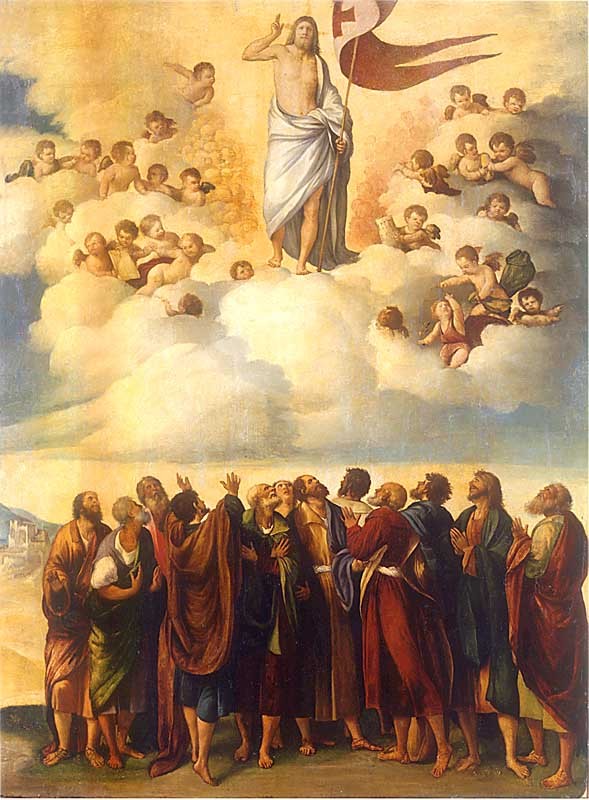
The Ascension of Christ

Today, 40 days after Easter, is Ascension Day, the day on which Christ ascended into heaven.

Dosso Dossi "Ascensione di Cristo" (from Wikipedia)
O God, whose Son today ascended to the heavens as the Apostles looked on, grant, we pray, that, in accordance with his promise, we may be worthy for him to live with us always on earth, and we with him in heaven. Who lives and reigns with you in the unity of the Holy Spirit, one God, for ever and ever.
The Celebration

The day is the celebration of one of the most glorious events of Christianity, with important theological significance; Christ, as a human, is now at the right hand of God the Father.  We will be having an extend family/neighbors/friends dinner this afternoon to celebrate.

Unfortunately, the Catholic Church in Canada (Latin Rite) has transferred the liturgical celebration of Ascension to day to the following Sunday (with the result that it becomes "just another Sunday" and most Catholics have joined the rest of Anglophone Canadians in not knowing that it exists.)

Mennonites

Traditional Mennonites celebrate this day and take the days between now and the weekend off.  They also have a church service in the morning.  I joined my mother at her Old Colony Mennonite service.  Ascension Day, for them, marks the beginning of the services for the preparation of baptismal candidates.  They begin preparation earlier, but this is the beginning of the official "handing down" of the faith in the context of the church service.  It is in the form of questions and answers, all taken from their short catechism booklet, similar to the Roman Catholic baptismal symbol (i.e. the Apostle's Creed in Q & A format) but much longer.  There were 11 candidates - 9 young men, 2 young women.

The sermon is also directed to these candidates.  The minister said some good things about baptism as our spiritual rebirth, our entry into the Church, the beginning of the Christian life and our obligation to be the light of faith to those around us.

Prophet Isaiah


Today also happens to be the feast day of the Prophet Isaiah.

Friday, April 26, 2013

Why Are "Catholic lawmakers hostile to abortion even when more moderate on other social issues?"

Before I say anything, I want you to click on the link below.  I want you to look at the green number that appears at the top of the page.  First see how many millions are listed there, then notice how quickly that number is going up?

http://www.worldometers.info/abortions/


When I opened the page it at 13,336,610.  It goes up by about 3 every second.

A law recently passed in Kansas limiting abortions
These are statistics for clinical murder.

The counter shows how many human beings are being murdered around the world every second - not total of murders, but only those murdered clinically, in a nice, safe, clean sterile setting that makes these murders seem like a "medical procedure."  This clean, clinical murder is called "abortion."

The total is the number of abortions that have taken place this year - since January. That's less than 4 months.  In less than 4 months, well over 13 million babies have been intentionally murdered in clinics.

That means that in less than 2 months, there were over 6 million clinically murdered babies.

According to the same webpage, the WHO reports that there are between 40 and 50 million abortions per year. That means that in less than 2 years, there are more than 75 million clinically murdered humans.

a precursor to abortionists
Why 75 Million Murders?

Why do I highlight the numbers 6 million and 75 million?  Well, about 80 years ago, a man took over the parliament of a prominent and very advanced European country.  He proceeded to start a program that led to and arranged for the clinical and systematic cold-blooded murder of over 6 million innocent people.  This program also lead to the deaths of 75 million people in the war which most people would consider the worst catastrophe in human history.

This man is an icon of evil; his actions and the way of thinking that led to those actions are unquestionably condemned by all reasonable humans.

Yet, the same number of cold, systematic, clinical murders that he committed in about 6 years was committed in the first two months of this year in the name of "choice" and "rights."

Of course, we're comparing planned, clinical murders in a handful of nations to those in the whole world .  So to make the comparison more fair, let's compare only to the U.S.  According to the WHO, there are about 3000 abortions a day in that country. That means there are 6 million every 5.5 years.  That means in the U.S. alone, abortion is outdoing the holocaust in a lesser period of time.

The same total number of people that died in horrendous 6-year war that evil man started have been murdered in abortions in only the past 2 years.  Both these numbers are world-wide.

A monster, because he made abortion look as dirty as it really is
The Holocaust of Our Progressive World

World War II and especially Hitler's Holocaust were horrible atrocities which should have never happened.  The numbers above show that abortion is an even greater atrocity - at least by 3x.

Abortion is the Holocaust of our modern, progressive, middle-class world.

Like the Holocaust, comfort, ease and - most importantly - the fear of shame or public humiliation for speaking out against it, make us quite us quite content to allow it to carry on quietly out of sight in safe, sterile clinics where it won't make us feel bad or guilty.

Unlike Hitler's atrocities, which eventually brought almost every other super-power nation against it, there is only one single nation in the world that has taken a decisive stand against abortion (Chile).  All other either endorse it as a "fundamental right" (increasingly more common) or turn a blind eye to it.

Many people are upset by what happened with Dr. Gosnell.  A few people are upset because he was murdering babies.  Most people are upset only because he wasn't as clean and clinically sterile as he should've been and - worst of all - that he let his filthiness spill out into the public eye to make us uncomfortable.

Like the brainwashed middle-class of central Europe in WWII, we are willing to turn a blind eye for the sake of comfort - we just want to be sure that it's kept comfortably clean and out of our sight.

Alberto Giubilini, advocate of "after-birth abortions"
The Final Solution

Post-birth abortion is not only a monster looming in the future used as a scare tactic by pro-lifers.  It is a common and accepted practice - even if it has not yet been given official legal approval.

It is already common practice for babies born live after botched abortions to be (a) left to die or (b) killed by the same techniques used in abortions.  This not a freak abuse limited to monsters like Gosnell.  In Canada, the government has reports of this happening to almost 500 babies in 10 years.  These are only the reported cases.  (In Canada, there is no legal requirement to report an abortion.)

Planned Parenthood practices both techniques (a and b) mentioned above.

The academic groundwork to justify "post-birth abortions" legally has already been laid by "credible" academics in influential places.  The justification is that a baby can be killed by the same techniques used in abortions “when circumstances occur after birth such that they would have justified abortion."  They use the term "after-birth abortion" rather than "infanticide" "to emphasize that the moral status of the individual killed is comparable with that of a fetus … rather than to that of a child."

(see http://articles.washingtonpost.com/2013-04-08/opinions/38362423_1_viable-babies-abortion-survivor-planned-parenthood)

Marc Thiessen - a critic of "post-birth abortion"
Basically, killing a baby just after birth can be justified by the exact same arguments used in favour of abortion. And these academics are right; there's no reasonable way you can justify that a baby is a conscious human being 1 minute after the leaving the mother completely if you did not recognize that status 2 minutes earlier when part of her was still inside her mother.

Currently, there are scientists studying the question whether a 2-month-old baby is a conscious human or not - and even a 5-month-old.  People should be paying much more attention to these studies, because if the "scientific consensus" answers the above question with "no" then we will soon be having academics, and then doctors and judges, talking about something like "pre-consciousness abortion" to describe a process for clinically murdering babies that are several months old.

Unlike the case with pre-birth abortions, for "post-birth abortions" we don't even need renegade doctors who want to be heroes. Planned Parenthood is already doing that quietly, behind the scenes, on public money and with public approval (given through silence.)  All it will take to implement this "final solution" is a couple of Supreme Court judges who want their names to be recorded in history as the fearless leaders of justice who overturned their nation's laws for the sake of "progress."


Saving a Mother's Live?

And the big question - how many abortions are procured to save a mother's life? This is after all, the end-all wildcard pro-choice argument that makes all pro-lifers shut up and be entirely ashamed of ever even thinking that abortion should be banned.

Reasons for abortions
In a U.K.study, 0.006% were in direct response to save a mother's life (i.e. she was dying and the abortion saved her), and another 0.37% were due to risk of the mother's life (i.e. it was unsure if she would've died or not, but the risk was high.)

That means, of the 13 million babies clinically murdered since January, probably only 78,000 - worldwide - were in direct response to the immediate threat of death for the mother.

Abortion is not right in any situation, but the point here is legal abortion has nothing to do with saving mothers' lives. 99.994% of abortions are carried purely for a matter of personal preference or convenience, justified on the assumption that the baby is not in fact a human.  This lends itself very nicely to post-birth abortion arguments.

(*U.S. stats will list 2.8% as "maternal health concerns." This does NOT indicate danger or even risk of death, but "health" in a far broader context. "Danger of death" does not show up on stats - I'm assuming because the cases are so rare.)


Me, holding my babies minutes after they were  born.
They were humans then, just as they were 8.5 months
before, at the moment of conception.
Some More Stats
  • Worldwide, there are 125,000 abortions per day - that's the entire population of Waterloo, ON, or Playa del Carmen, MX, murdered every day
  • In the US there are over 3000 abortions every day - that's the population of the township I live in
  • That's a total of about 20% of all babies in the U.S.
  • In Canada, there is one abortion for every 3 live births; that's 25% of all babies

So ...

I couldn't name a worst atrocity than this one. Go back to that counter again - http://www.worldometers.info/abortions/. Every time that number turns over, imagine a person in nice clean clinic, having surgical scissor being jammed up through her neck into her brain, or having her spinal cord severed, or being burned in chemicals or cut to pieces alive - of course, in each case this person is nicely sedated and muffled to ensure that other people in the room don't feel uncomfortable about the process - they might see her squirm a little, but doctors and scientists can reassure us that that's just an non-conscious reflex. Pleasant thought, isn't it?

Back to the Main Question

Why, then, is that "Catholic lawmakers in particular are often hostile to abortion rights even when they are more moderate on other social issues"?  Tara Culp-Ressler at ThinkProgress.org points out this fact as though it's absurd, some sort of silly contradiction.

I hope the numbers and comparison I shared above answer this questions satisfactorily. Abortion is not simply another "social issue."

Monday, April 22, 2013

I Don't Celebrate Earth Day - and This is Why


Earth Day - With Earth above humans
There is a whole bunch of new holidays that governments and international organizations have put into place that I simply couldn't care less about, one way or another.

Earth Day  is not one of these.  While I care a good deal about nature and the environment, I specifically choose NOT to celebrate Earth Day.  Why?

What is Earth Day?

Earth Day is a celebration of environmentalism.  The idea is to highlight and inspire people to start good ecological habits, do something to care for the environment or promote environmentalism, etc.  And as far as these actions themselves are concerned, I agree with them and believe they are good.

The Problem with Environmentalism

However, the problem I have with Earth Day is that its purpose is to promote environmentalism.  Environmentalism has problematic current within it - and I would say it's a strong one, although it runs below the surface in many cases - to place the environment and earth above and beyond humans themselves.

In extreme cases, the point is obvious. For example, I once read somewhere that fanatical environmentalists would rather procure an abortion than cut down a tree. Once I told a truly fanatical environmentalist (vegan and obsessed with animal rights to the extreme) about the death of a person; his answer was, "Good, another meat-eater dead."

Those are extreme cases and not worth dwelling on. But even in fairly non-fanatical environmentalism, I believe this same basic problem defines some basic assumptions and it is seen as normal that the care of nature should take precedence over the quality of life of humans.  The earth and protecting basically becomes an end.

This basic error is the reason I don't celebrate Earth Day.

Healthy Care for Nature

In a healthier view of caring for nature, it is a means rather than an end in itself.  We care for nature primarily because it is good for us.  Destroying nature will have (and has had) horrible consequences on the quality of human life.

His Holiness Benedict XVI, an open advocate of
protecting nature as a means, not an end.
However, since the purpose of caring for nature is to improve human life, we must also be prepared to use and adapt nature responsibly for that purpose when it is available.

Now, some people who celebrate Earth Day will probably object at this point and say that they agree with me. "You can believe that and still celebrate your view of caring for the Earth."

No, in fact, I can't. And this leads me to my last point.

No Room for God

Earth Day does not include God. It does not recognize Him, name Him or acknowledge Him.

"But can't I say that caring for God's creation is praising Him?"

You sure can, but that's not what Earth Day is about.  If it were, then somewhere, on all the pages of the official organizers of Earth Day, we would see the words "God's Creation."

Thus, it not only promotes a movement that puts nature above humans, but one that puts God's Creation above God.  This is, in fact, the root of the previous problem.  God created the universe to glorify Him.  He specifically created the Earth to be subservient to human beings, His children.  He created it to glorify Him, and part of this is to serve us.  We are given care of the Earth, together with use of it and command of it.

Now, if you take God out of the picture (as all Earth Day write-ups do)  then the reason for making care for nature a subordinate means to improve human life is greatly weakened and lines are blurred.  It is no longer necessary to make this distinction clear.

"I'll celebrate Earth Day to praise God, but you can do it to worship the earth and wish death upon meat-eating humans if you like; as long as we plant some trees together ..." Not a healthy message to put out there.

There are many, many Christians who care for the environment. Some of the most enthusiastic people I have known have been devout Christians.  So why is God excluded from Earth Day, then? As far as I can guess, the organizers wouldn't want to distract people of the matter of highest importance (environment) from one that to them is of secondary importance (God.)  They mention the improvement of quality of human life in passing, but not as a main point; they know they can safely mention it without risking removing the Environment as the end, the #1 item.

Replacing the Importance of Pascha (Easter)

On another point, I'm also distrustful of this holiday displacing Easter.  Easter, (or, by its correct name, Pascha) is the greatest celebration of the Christian year.  It is the celebration of the Resurrection of Christ, the most important event in history, the defeat of death and the victory of Christ bring us eternal life.

But isn't Easter is only 2 days - or 3 if you want to count Good Friday?

In the Western tradition, which includes most Christians I know, Paschatide (or "Easter Season") includes the 50 days after Easter - which makes sense since it is the most important festivity of the year. Earth Day almost always falls after Easter, so right in the middle of these 50 days of joyous celebration.  Easter is, in fact, a feast of renewal, of springtime; from what I've read, early Christian writings connected the renewal of nature in spring to the Passover, to the Resurrection, and even to the Creation.

I wouldn't begrudge Earth Day one simple day the 50 of Paschatide, but as the website for Earth Day Canada points out, "In Canada, Earth Day has grown into Earth Week and even Earth Month to accommodate the profusion of events and projects" (http://www.earthday.ca/pub/about/history.php.) So, now people are taking a full 30 days of Easter's 50 to devote an environmentalist cause that specifically excludes the mention of God?

I prefer to celebrate the Resurrection of Christ.

If Earth Day were to give due place to God and even mankind over nature, I would also not hesitate to mix the two holidays.  But I cannot justify mixing the holiday which has been the most important celebration of God's mercy since Israel left Egypt with a month-long celebration that excludes Him altogether.

Caring for nature - our gift from God to care for and use
I'm not anti-fanatical

So, now, just for the record, I'm not a fanatic against Earth Day.  I wouldn't look down on a family or individual for participating.  I`m sure many many people participate with best of intentions - even best of Christian intentions, participating with the purpose of glorifying God and serving the betterment of human life.  I did not discourage my son from participating in the school events or being excited about it.  I only took time to sit down and talk to him and make sure he know why we celebrate and protect the Earth.  I was sure that first God and then humans held their proper place.

My family recycles, saves water, reduces garbage, reuses containers, shops local (as often as our budget allows us) and uses cloth bags, among other such items. But we don't do it to serve the Environment as a end in itself.  We do it primarily because the Earth is God's creation, and secondarily because humans will be able to live better as a result.

If I knew Christians who celebrated Earth Day, I would express my doubts about this day, but I won't go on any crusade against it.  It's not important enough - at least not yet. (If I live to see an "Earth Day Easter Celebration," that might change.  In 2057, the Western Easter is on April 22.)