Showing posts with label Churches. Show all posts

Monday, January 27, 2014

"Come as You Are" Revisited: Is the Church for Saints or Sinners?

Just over three years ago, I wrote a post in this blog called "Come as You Are;" the post had nothing to do with Kurt Cobain but the title was ideal. The post shared an observation about my mother-in-law's feelings about the Catholic Church; while the faith and moral teachings are very important to her, she takes pride in the fact that it is a place where sinners and the down-and-out in general could approach God without being turned away or judged.

I then went on to make some observations about how she saw this as a contrast to the various new denominations that have begun proselytizing that country in recent times.

For most of the time since then, I was rather doubtful of that post, thinking that I had probably gone off track.  Yet, I justified it by the fact that I was not yet Catholic and only just beginning to take a renewed interest in my Christian faith.

Looking back and re-reading the post today, however, I realize that I really was onto something, at least in the general sense.  I have come across some new ideas and had some new experiences that help put the idea of "come as you are" into a more solid context.  Most importantly, I see that the message was not just for others, but also for me.

Two Opposite Errors


When it comes to opening a church to all alike, there are two opposite errors which both essentially keep people from really coming as they are - both push people to pretend they are someone they are not.  One is to assume that everyone who passes through the doors of a church must be a saint, or become one quickly.  The other is to deny that sin exists and just declare that everyone is a saint regardless of how they live.

Closed Congregations

I'd guess that just about everyone has had the experience that when they walk through the doors of a church and suddenly get an urgent feeling that they are very out of place. Putting the truly closed congregations aside, there are many ways a church can deliver this message even if their doors are quite open.  Most kinds of uniformity can do this.  For example, in Mexico men of certain denominations will wear golf shirts, tucked into casual dress pants and have a neatly combed side part.  While such dress is certainly tasteful, anyone who's been to Mexico knows that it is also very unusual.  Thus, the average Mexican (or even expat) wandering through the doors to worship God on Sunday morning  would find himself standing out like a sore thumb, and probably immediately being approached to be welcomed as the new-comer.

As this last example shows, some of the factors which tend to close off a congregation are meant in truly good will and kindness.  Yet, the experience I just described is quite off-putting to many people.    The way of dressing is certainly connected to a saintly way of life and albeit given in warmth and kindness the invitation includes an unspoken assumption that your differentness is an indication of sinfulness.

Many people desire a church of more "saintly" Christians, and all too often outward signs that even unofficially indicate this can be a way of alienating outsiders.

Open Doors and No Walls

Then their is the opposite situation.  The idea that sin simply doesn't exist.  A question that shows a concrete parallel is this: what is the point of having open doors if your church has no walls? While a church like this may give the impression of welcoming everyone, the truth is that they welcome no one; no one is given the benefit of approach God as a sinner, which we all must do.

A Field Hospital for the Sick

One of my favorite images from Pope Francis so far is his comparison of the church to a field hospital after the battle.  The problem with both situations I describe above is that both assume that the church is here only for or primarily for saints; (one tries to make quick work of sanctifying everyone, the other simply declares everyone a saint.)  Christ said the opposite; he told us he came for the sick, not the sick, not the healthy.  Like Christ, his church is here for the sick and the wounded.  This means two things - first of all that we must acknowledge that nearly of all of us have been wounded in the battle, and secondly that we must have our doors open to the most deeply wounded.


Here is one of the hardest things I have learned, and a point I still struggle with in action; when the wounded come in fresh from the battle field, unsure if they will make it or not, they must not get the impression that they are in the company of the healthy, and have made a mistake by entering a place they don't belong, as in my first point above, but the should see clearly that they have indeed made it to the hospital, the place where the wounded have gathered for healing - for care and for medicine.

This seems like a paradox, since the first aspect most of us will judge in a church is how "good" the people are; yet, I can guarantee you that a newcomer will feel much more at home in the company of those acknowledge their own faults than those who pretend not to have any - and, most importantly, it is simply the truth - pretty much all of us are sinners in need of the Great Physician.


Everyone must become aware of their sins, not so they feel ashamed or out of place at church, but on the contrary so they feel confident to bring their sins with them and know they can leave them there, just as everyone else does.


Confession to a Priest

Three years ago, when I wrote that post, I had a sense of arrogance.  While I was convinced that I was coming the fullness of the faith, at the same time I was sure that I would have a good deal to "teach" most Catholics, who knew so little about the Bible and even their own faith.  When I wrote about "come as you are," I was, somewhat subconsciously, writing for the "others," those real sinners out there.
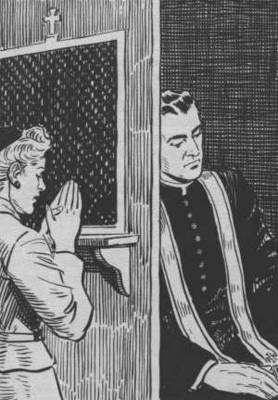
What I have learned the most since then is that "come as you are" is for all of us, not just those who have done (or are doing) the more obvious or sins.

For a church really to be open for all to "come as they are," even those stable within the church must have the benefit of being allowed to come as a wounded person, finding medicine for their wounds, forgiveness for their sins.

The best and easiest way for this to happen is sacramental confession, where you confess your sins to a priest who absolves those sins.

One of the surest signs of an unhealthy Catholic parish is an empty confessional; not because the people are more or less sinful, but because it indicates that the most regular church-goers are not ready to recognize their own short-comings - they are not prepared to come as they are.  How can we expect others to come as they are we do not?

Rosaries and Freedom of Worship

Yet, it is important that recognize that not everyone is ready or willing to receive such medicine.  Not everyone arrives ready to confess their sins (and consequently not ready to receive Christ, physically through communion, or otherwise.)  Even these people need medicine, perhaps more so than those who are in line for confession.
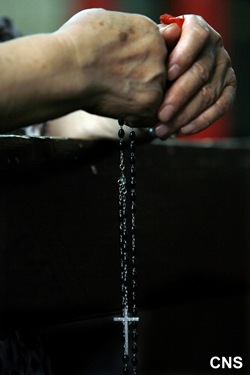

Whether people have come prepared to receive Christ or not, I would say one of the most helpful things a church can do is to allow people to focus on God and pray in the way they are best disposed to do.  I think one of the biggest obstacles we place create in worship is uniformity in worship.  When you walk into a church and everyone else stands and sits at the right time, says all the right responses, is swaying their hands in the air during the music, or hugging everyone around them at some point in the service, it likewise creates pressure for everyone to be a good, joyful Christian.

Christian joy is wonderful, and necessary, but the bottom line is that not all those wounded in battle will enter the field hospital bubbling over with joy; and if they aren't, they shouldn't feel that they have to pretend they are. (Just like those who are should feel free to show it.)

In recent decades, much has been said about people praying the rosary during Mass - for the most part, the practice has been condemned; people shouldn't be distracted from paying attention and participating.  Yet, while the rosary is certainly not the ideal form of participation, it is most certainly one good example from Catholic worship of an easy way for people to focus on God and worship him on a day that for ever reason their mind might otherwise be distracted and wandering.

It's not about defining some sort of requirements; quite the contrary, I would say that the best situation would see a bit of everything - during a hymn, for example, some people may be singing loudly, others re-reading the Gospel reading, others on their knees praying quietly, etc.  It allows all (regulars or not) to come as they are and worship as they need.

(I imagine this picture is from the
outside of the churching looking in)
 
Come as You Are

When I walked through the doors of Our Lady of Guadalupe parish in Playa del Carmen several years ago, I was impressed that while words from the pulpit were not minced or spared when it came to sins, so many sinners came willingly as they were.  The confessional always had a line up that lasted through the first half of the mass.  Even those arriving late would go to kneel in front of the altar, light a candle and say a prayer before going to confession or joining the service.  All those sinners, I could see, were welcomed and taken care of. 

What I didn't realize at the time is that the part most appealing to me, what ultimately drew me closer, wasn't that others could come as they were, but that I could come as I was (and as I still am) - as a sinner, wounded in battle and in need of medicine.

Friday, October 4, 2013

How Many Extraordinary Ministers of the Eucharist Does a Catholic Parish Need?


Notice: only 2 Extraordinary Ministers for a huge parish
How many Extraordinary Ministers of the Eucharist does a Catholic parish need?

The short answer is, in most small to medium parishes, none.

I've been to medium sized parishes in the Mexican countryside where those partaking would rather line up out of the door and have mass go overtime overlapping with the beginning of the next mass (creating the kind of disorganized chaos that is a part of normal life in Mexico anyway) than receive the Eucharist from anyone but the priest.

These same parishes also offer communion under both species by means of intinction (dipping the Body of Christ into the Precious Blood), making it impossible to rush through in any way because of the special care required (and probably offering yet another reason not to have anyone but the priest delivering.)
Even the elderly man using the walker prefers to approach the altar

My wife and I are reminded of this every time we go back to Mexico.  While in Playa del Carmen, there are Extraordinary Ministers, and they do not practice intinction, our home parish here (Our Lady of Guadalupe) demonstrates the point as well.

We estimate that an any given Sunday Mass there are probably between 1000 and 1500 people present (and there are 5 Sunday Masses.)  And how many Extraordinary ministers are there?

2.

The priest is in the middle in front of the altar, and the other 2 (usually the leading nun, and a deacon) are at the front of the side aisles.  No one goes to the back of the church.  Everyone approaches the altar.

I have been to parishes in Canada that have less than 1/10 of that mass attendance.  Yet they have 2 or 3 extraordinary ministers.  One goes to the back of the (very small) church.  I'm not sure why that is considered to be necessary.

The Precious Blood and Body of Christ
(In Mexico there is also no row by row.  It's less organized but it removes the pressure that everyone should go up.  When you do row by row, there's always the chance of that awkward moment when someone ready to go up for communion waits for that person next to them kneeling and praying to go up, and the person coming out of the row behind them also waits for them.  It draws unnecessary attention to the person who doesn't go up for communion, and - in some cases - may pressure them to simply go up.  But that's a side point.)

Mexican Catholicism isn't by any means perfect.  It has its flaws - some of them glaring.  But there are certainly good points we could pick up from them.

Sunday, March 24, 2013

On Liturgical Beauty and the Mass of the Poor

These days, many people are talking about a more austere style of Mass as opposed to the style richer in the highly developed traditions of the Roman Church.  While I have my opinion on this distinction, I am highly unqualified to speak about the topic.  There is a related distinction which I am equally unqualified to discuss, but in which I have personal experience to share.  This distinction is "Mass for the poor" as the not-poor express it vs. how the poor express it.


Catholicism in Mexico
First of all, I do believe that if the poor really had their way, Roman Catholic Masses would be very beautiful. However, that is a different subject.  What I can say about my experience in Mexico is that, in that country, when middle-class attempt to have a "Mass for the common people" it looks and feels very different from a "Mass for the common people" which is actually attended by the poorest people.

A Middle-Class Mass

While in Mexico, it is impossible to say one parish is solely middle and upper class, since people of most classes will be mixed in most parishes, there are definite tendencies and there are definitely parishes which the poor, by their own account, say are parishes for the "rich" (which to them, includes the middle class) and are not for them.  Therefore, they avoid going to those parishes. (The poor in Mexico are usually quite accepting of the placement of their class and feel little desire to break class boundaries.  In my experience it is more the middle class which has taken up this battle.)

Ironically, it seems to me, that it is mostly these very parishes - the ones which the poor see as "beyond their class" - that make the greatest effort to have Masses for the people, include "indigenous" elements and decorate their churches in a way that is more distinctly "Mexican" (meaning not traditional) and "personal, warm and friendly" often featuring expressive art in current contemporary styles, as well as a distinctive stylized theme of lettering and symbols.  Sacred images tend to be rare.  The music tends to have a contemporary folky style.  While I can not claim to be doing anything but speculating, it seems to be these parishes that are striving for a more "indigenous Mexican expression of the Faith."

What's most striking to me is that you can see that a good deal of money, time and effort are invested into making this happen.
Catholicism in Mexico
The Poor Mass
Just so you know, I'm not going to be heaping  praise on the virtues of the poor here; their music tends to be very bad, and on the whole, their parish churches visually reflect the poverty of people.  However, what I will be praising is their authenticity.  Let me describe one parish I attended daily for almost a month.

It's name, perhaps somewhat significantly, is San Francisco de Asis.  It is a typical structure of the poorer neighbourhoods of Mexico City, built of concrete blocks, which are finished inside and out with fairly unappealing colours of paint and imitation stones.  The roof is fiberglass.  Inside the church, simple shelves screwed onto the walls hold statues of saints, which would have been unusually nice, had the paint not been flaking off of them. (I remember St. Francis and St. Charbel, whose shelf was piled high with the ribbons which people use to make requests of him.)  The altar, cloths, tabernacle and other items of high importance all looked like mismatched combinations of rejected items from other parishes.

I remember waking up at my in-laws apartment (around the corner,) getting my 2 young sons dressed, and hurrying out the door as the 8 am bells rang from the church.  There are enough parishes in the surrounding communities, all of which ring their bells every time they have Mass, that it would have been a beautiful moment of sound, had the traffic on the main road, which was backed up and almost at stand-still since about an hour earlier, with it's noisy engines, loud buses and blaring horns, not drowned out any church bell that wasn't within two blocks.

The people arrived on foot.  Since it was a weekday morning, most were elderly ladies clearly belonging to the impoverished neighbourhood surrounding the church.  It was about a third full.  The priest offered a very simple but "clean" mass.  There was no choir.  No organ, no piano, no guitar.  All singing - including the prayers such as the gloria and hymns - was lead by the elderly ladies, especially by a group about five pews back from the front.

I remember their singing.  It was neither traditional nor was it "folky" or "indigenous." In artistic aesthetic terms, it would be hard to call it "beautiful" or "creative" or "expressive."  Their old voices crackled in off key notes.  Were they the same songs that are sung in the nicer parishes?  Perhaps.  They sounded so different I couldn't tell. Yet their voices had something in them that I don't remember hearing in the more carefully crafted "popular" Masses - a sort of passion and adoration.

One day of the week, after Mass, the priest would present a relic of St. Francis.  Almost all present lined up in front of his shrine to kiss the relic.

Something about Mass at this parish touched me.  While there is no doubt that the Mass was greatly lacking in beauty and talent, the people were not striving to "express themselves" or their culture.  They were, quite on the contrary, striving for something more beautiful than what they could attain.

That in itself was very beautiful.

Beauty like this cannot be planned through a liturgy team, finances, art, creativity, self-expression or any sort of intellectual idea of "appeal to the masses."  It is also something that could not be imitated.

I would love it if every day of my life, I were near a Mass in a traditionally decorated church with gold and beautiful paintings, with bells, incense, and awe-inspiring chant rising to its high ceilings.  However, that option lacking, a Mass like the one I just described is probably where I have found the greatest beauty.


I could (and I intend to) write more about this parish, but for today's point, this will be enough.

Wednesday, March 13, 2013

Habemus Papam!

At about 2:08 - an hour ago - a pope was elected by the cardinals in Rome, and white smoke came out of the chimney of the Sistine Chapel.

Any minute now, the new pope should be introduced, and we will find out first who he is, and then his papal name!  It looks like the door on the balcony of St. Peter's Basilica has been opened slightly, and they say there has been movement seen inside.  I will post as soon as I know.

Monday, March 4, 2013

What Are Your Favourite Places in the World? One of Mine is in Valladolid …

One my favourite places that I've been too is probably fairly unremarkable.  There are no stores, cafes, art, music or anything else.  What makes it appealing to me is the fact that it's a quiet plaza in a colonial residential neighbourhood in an unknown town.  There is a view of an old monastery.

Recently a co-worker who visited there recently sent me some pictures of this very place:


 I remember sitting on the benches there, eating lunch with my oldest son when we visited for New Years 2012, and relaxing in the shade another time before than.  I always forget to bring my camera. Good thing other people don't!

This is the view of the monastery:


I believe it still functions as a monastery.  They have daily Mass in the chapel at least.  When the bells ring out breaking the quiet which generally permeates the calm community, it is simply beautiful.

The place is beautiful; the pleasure is so simple.

For more pictures and of my last visit to Valladolid, see Valladolid, A Mayan Colonial Town.  For a great description of a very different side of Valladolid, see A Visit to Valladolid, Colonial Yucatán: Parte Uno. (Besides this quiet corner of beauty, the writer captures the essence of what I like about Valladolid.)

Tuesday, September 18, 2012

Baptism of Our Twins

This Sunday, our baby twins, who will be 2 months old in 2 days, were baptized!  Here are some pictures:
Grandma getting the babies dressed

The blessing of the water.

The annointing with oil.

The sermon

The baptism itself

Closer view of the baptism

Welcoming of babies into the Church


 After the baptism, the priest gave my wife the blessing for mothers of newborns, known as "churching":

Here's picture of the church's beautiful high altar.  It's a beautiful little church building in the countryside:

Finally, our celebration afterwards. Fortunately, the weather was beautiful, so we enjoyed lunch outside, at our house:

Wednesday, February 29, 2012

Mexico City - Some Scenery from Tacubaya

One of the things I love about Mexico City is the presence of random scenery, sometimes not coinciding with the typical image we have of this city, even for those who know it.  Considering it's the second largest city in the world, and both the most beautiful and ugliest city I've seen (within a kilometer or so of each other), both exciting and boring, monotonous and ever-changing, it's no surprise that there is no "rule" about what kind of interesting scenes you'll find at any given moment.  As a complete side note that I feel like sharing, with a probable population of approx. 400,000 gringos it's the largest community of Americans outside of the USA.

That having been said, the three pictures I'm sharing today are fairly typical to the city, and rather un-random.  But they caught my attention for different reasons.  So here they are:

A former church-turned-museum - the Borough Office for Benito Juarez (near Tacubaya, at Parque Lira)
This is a very common scene in Mexico - an abandoned old church that his been restored far better than many that remain in actual use; the reason is that they have been converted to museums, giving all levels of government, private foundations, artists and the public a vested interest in restoring them.  This particular church was built in 1906, consecrated by a representative of the great Pope St. Pius X.  It was used to serve an adjoining community home - for street kids, I believe - a building which is now a city office.  When the home went out of use some 40 years ago, the church went out of use with it, and was soon turned into a museum.

I found out this information at the demand of my 4-year-old son, who was insistent on knowing why there was no mass being held, and why the church was filled with colourful sculptures of dragons from Mexican folklore instead of saints.  After asking the lady at the desk, and passing the story on to my son, he began to sob loudly.  When he finally calmed down enough to talk, he asked me if we could go find the priest (meaning the one responsible for this church building) and give him money so he could turn it back into a church and have mass there again.

I see this as an "old" church, but in relative terms, it's very new, and served as church building for a brief 60-70 years.  It reminds me of the time when I was visiting a village near my wife's grandpa's farm; when I asked him about the "old church" on the town square, he corrected me and told me that the church wasn't old; he remembered seeing the completion of the church as a child, meaning it was no more than 80 years old - a very recent innovation in the village.


A crucifix with rosaries in a bus
This is actually a fairly mild example of bus decoration; drivers will include anything from crucifixes and saints, to poster girls, and sometimes even both side by side.  I've seen a few buses with statues of Saint Death.  This driver had only the crucifix and rosaries.  Rosaries on the rear-view mirrors of taxis and other cars are pretty commonplace.  I can't speak for this driver, or make generalizations, but I know a number of people who will show many outward signs of Catholic faith like this, but are fairly uninterested in mass and even anti-clerical.  My brother-in-law, for example, will cross himself when he sees a church building or sacred image, or when he hears of that someone has died, and he commonly asks people to pray for him (to God or to the Virgin Mary), but my wife can't remember once that he's attended mass.  He doesn't think much of priests or pastors either - and even less of other churches.  So, he's definitely not atheist, and most certainly couldn't count as Protestant, but does he count as a Catholic?  I think he would say so, and I think, in some sense, I would agree.  But it falls outside of our usual northern paradigm where its not likely that someone who has stopped attending church would continue showing outward signs of religion, with strong dedication.


The Coca-Cola Building (or "Ermita") in Tacubaya

This building is a famous landmark in the heart of Tacubaya. I don't know if there used to be more buildings like this one, but from what I've seen, it's unique in Mexico City - I haven't seen any others of this style.  It was build in 1925 (from what I gathered from a quick google search) and is, as I like to point out to my wife, the "Future of the Past." When they build it, I'm sure they thought it was what the future would look like - a future that, of course, never arrived.  If I understand correctly, the name "Ermita" comes from a previous building on the site, which was a small chapel. ("Ermita" means "Hermitage." - see EDIFICIO ERMITA # 23 ANALOGO or GALERÍA FOTOGRÁFICA | El México de Ayer; both are in Spanish, but they have neat historic pictures of Mexico City even if can't read the descriptions.)

I think the back is a theater, or was a theater, at least.  Right across the road from this building is the only store where I've bought running shoes since I've lived in Mexico; they have great prices on New Balance.  I save my running-shoe shopping for my annual visits to the city.

Tuesday, January 24, 2012

Why is the Virgin Mary so Important?

"a woman clothed with the sun, with the moon under her feet"
Many people look at  Mexican culture or more generally Catholic and other Christian traditions and wonder why the Virgin Mary is so important.  While I know there are a number of angles to take on this issue (tradition, her recognition as "Mother of God" in the third Ecumenical Council, etc.), during the fall of 2011, I heard one of the priests at my parish in Playa del Carmen (Father Patrick) address this issue from the point of view of the Bible.

Before pointing out Father Patrick's presentation of Mary's broader presence in the Bible, I'll briefly outline what I had heard before.  Many people will consider the presence of Mary in the Bible to be limited to the Gospels, specifically the annunciation and birth of Christ  (Luke 1:26-2:20, paralleled only partly in Mat. 1:18-25,) the wedding at Cana (John 2:1-11), and the death of Christ (John 19:25-27).  These events are rich with meaning and importance in themselves.

In the Christmas story in Luke we see Mary as a humble servant of God, receiving one of the most important tasks/roles given to a mere human, and give the Church some of its best known prayers.  In the wedding at Cana, generally considered to be Christ's first miracle, we see this miracle take place following the simple command of Mary to the servants, "Do whatever he tells you," - the same command that (through obedience) has given the Church so many miracles since then.  Just before his death, Christ tells Mary that the disciple "whom he loved" (assumed to be St. John, the writer of the gospel) is now his son, and tells this same disciple that Mary is now his mother.  The disciple, according to tradition, represents the apostles as a group; since the bishops of the Church inherit the role of the apostles, Mary, for the first time (400 years before its formal declaration at the Council at Ephesus), is declared by Christ's own words to be the Mother of the Church.  A brief reference to her after the death of Christ (Acts 1:14) shows her to be among the most devout.

One blogger pointed out that Mary quite probably played an important role in the writing of the Gospels; according to this blogger, she would have been the only living source for the stories of the annunciation and birth of Christ, as well as details of the temple visit (Luke 2:41-52).

Just from what is obviously about Mary in the Gospels, she holds a place of importance in the Scriptures.  Yet, from what the priest pointed out, this role is emphasized even more in the Scriptures as a whole, from the beginning to the end.  He drew attention to the following (this is my rendering, as close as possible; there may be deviations from what he actually said):


  • Mary is the third human mentioned in the Bible: 
"I will put enmity between you and the woman,     and between your offspring and hers;     he will strike your head,     and you will strike his heel." (Gen. 3:15)

While the woman and her offspring refer to Eve and mankind, it's more specifically a prophesy of Mary (the woman) and Christ (her offspring) who strikes the head of the the serpent (i.e. Satan,) making Mary not only the third person mentioned, but directly linking her to the most important event in the history of mankind from the very beginning of the Scriptures.

  • Mary is one of the last humans mentioned in the Bible, in the Apocalypse of John:
    "1 A great portent appeared in heaven: a woman clothed with the sun, with the moon under her feet, and on her head a crown of twelve stars. 2 She was pregnant and was crying out in birth pangs, in the agony of giving birth. 3 Then another portent appeared in heaven: a great red dragon, with seven heads and ten horns, and seven diadems on his heads. 4 His tail swept down a third of the stars of heaven and threw them to the earth. Then the dragon stood before the woman who was about to bear a child, so that he might devour her child as soon as it was born. 5 And she gave birth to a son, a male child, who is to rule all the nations with a rod of iron. But her child was snatched away and taken to God and to his throne; 6 and the woman fled into the wilderness, where she has a place prepared by God, so that there she can be nourished for one thousand two hundred sixty days." (Rev. 12:1-6)

    The image of the woman "clothed with the sun with the moon under her feet, and on her head a crown of twelve stars" is the way in which Mary appeared to the native Mexican, Juan Diego, shortly after the Spanish Conquest, giving Mexico the image of Our Lady of Guadalupe, permanently imprinted on his cloak, which is still kept in her Basilica to this day (in Mexico City.)  If I remember correctly, since Mary as the Mother of the Church, her plight at the end (v. 6) represents the Church awaiting Christ. (I'm not sure if I remember this specific point correctly.)

     
  • Finally, there are several instances where the prophets mention Mary, including:  
    Therefore the Lord himself will give you a sign. Look, the young woman is with child and shall bear a son, and shall name him Immanuel." (Isaiah 7:14)


    These are the instances which the priest mentioned, but I've realized there are more. Of course, all of this depends on interpretation. I pointed out to a friend of mine recently, while some Christians read the Bible and see Jesus, speaking in tongues and the rapture, others read the Bible and see Jesus and then Mary (of course in both cases among many other things.)  I suspect that the second is the older.  In any case, to understand a culture and faith of people who honour Mary, it's important to understand her presence throughout the scriptures, and the

Wednesday, December 21, 2011

“This Church Has Air Conditioning!”

Church Air Conditioned
Reposted from “Imagine,” my blog about religion that I cancelled this summer.
I assume that if your church has an space for announcements below it’s name sign outside of the church, this space should be reserved for one of the most important messages that your church has to offer the public.

I’ve seen everything from offers of eternal life, to threats of eternal damnation, to communal welcome messages, to verses of scriptural consolation.  The one that caught my attention the most was a church that I saw a couple of weeks ago with the following message in big, bold letters, outshining even the name and denomination of the church:

“This Church Has Air Conditioning!”

So has this particular church simply thrown in the towel - have they given up on the idea that they have truth to offer?  Or do they truly feel that the most powerful point they can offer the community is a comfortable climate?  Is it perhaps a kind of bait, and when unsuspecting people enter to enjoy their climate-controlled worship, they’ll hit them with the big one?

Physical comfort seems to be one of the key items of attention in church growth these days.  I remember hearing the principal of church growth set forth in my childhood church that once a church reached 70% spatial capacity, it would need to expand, open new service times, or start new branches; at 70%, new people would simply stop coming, or current members would leave due to the lack of elbow room.

While I suspected the integrity of this theory all along, I rejected it flatly as an invalid formula for true church growth when I saw a church that had 5 Lord’s Day services packed to the brim with people standing up, and even standing on the steps and yard outside the church where speakers had been installed.  The church is located in a hot climate and has very little “comfort” except for the large open windows and high ceilings; definitely no air conditioning.  A branch church is currently under construction, and it seems it will be packed full the moment it opens.  I have also heard of another church group which had very poorly designed buildings with low ceilings and bad ventilation which was experiencing similar problems; the churches were simply over-full despite lack of comfort and rapid opening of new church buildings. Also no air conditioning, and well over 100% full.

Conclusion; while I certainly have nothing against air conditioning and elbow space, neither have anything to do with church growth. 

I hope that the the air conditioning invitation I saw was simply excitement over a newly installed feature, and would soon be replaced with a more meaningful message.  Unfortunately, it wouldn’t surprise me if this was really the most important item they felt they could offer their community.

Thursday, December 8, 2011

How do You Show Reverence?

Kneeling woman with kids.I while back I think I posted about the difference between how we northerners tend to see morals (prohibitions) and how Mexicans tend to see morals (positive actions.)  (I can’t find the post now – maybe it’s just something I told someone.  If I find it, I’ll share the link.)


A closely related idea is how we see reverence. I recently saw a review of a movie (“The Greatest Miracle”) which attempts to depict the spiritual events which take place in the Mass.  The writer took issue with the fact that in the movie, the characters were getting up and moving around the church during mass, even approaching the sanctuary.  The movie takes place in Mexico, and I realized that this issue was actually connected to the fact in Mexico, people have a different concept of reverence.  The following are some comments I made about the review:


While Canadians who arrive late for Mass I think would try to sneak into the back pews unnoticed, I’ve seen Mexicans arrive very late DURING MASS and walk right up to the steps leading to the altar to genuflect and cross themselves before sitting down. (During the movie, the angel actually complains about a family that arrives late.)  They also get up and move around during Mass more readily.  I think there are two factors involved in this.  One is that Mexicans have slightly different idea of reverence; Mexicans can go to great lengths to show outward signs of reverence (crossing themselves, genuflecting, bowing, fully participating in the appropriate prayers), but not feel they are being irreverent by changing places in the church during Mass. In fact, if you just finished confession, you will always be moving to your “normal” spot, and (in my experience) this happens every Mass when 2 priests are available. … Mexican morality (and reverence) is more heavily based on active outward signs (bowing, etc.) more freely expressed, not only the prescribed time, while we Anglophones tend to focus on prohibitions (you shouldn’t get up or make noise during mass, you shouldn’t show up late, etc.) I suspect a balance of the two is necessary (I’m too new to Catholicism to say if either approach is more correct than the other), but I’ve seen enough of Canadian and Mexican culture to know that this factor is definitely related to how each culture views “reverence.”


The second factor of people moving around is that in Mexico Catholicism is the default religion.  In the U.S., Canada and many other places, Catholics are a minority - a large minority, but for all but 2 days of the year, the only people who show up for Mass are the more devout Catholics.  This means these devout few will be more dedicated to showing reverence and respect through silence and staying still.  In Mexico, since it’s the communal religion, anyone and everyone - devout or not, sometimes even non-Catholic - shows up for mass.  This means that you’ll have non-devout people in the Mass who may not understand or value reverence.  So why do they go then?  Because it’s the only place where you go to experience God more closely.  Some people think they have to go, even though they are not devout.  In many parts of Mexican culture, it’s almost just automatic.  It’s what you do.  So while you have some devout and reverent people who don’t feel it’s irreverent to move about, there are also plenty of non-devout Catholics who simply don’t know better or care much about reverence.


Closely related is that I’ve seen people in Mexico who just happen to be wandering by, or feel down on life, and stop in for a prayer - during Mass or not.  Sometimes they stay for the whole Mass, other times they leave when they finish their own prayer.  In fact, this is the whole context of the movie; it’s just that the story conveniently has the three main characters show up just as mass is beginning.  If you imagine a real culture (like Mexico) where people will tend to go to the church as a refuge in times of personal turmoil, it’s not always going to work out so “neatly” that they show up just on time for mass.


Just to be clear, I agree with our northern ideas about reverence.  Also it’s not that every Mass in Mexico has noisy distractions and lots of people moving around (depending on the specific community, there are churches that wouldn’t have this at all), but what I saw in the movie looked “normal” in the context of Mexico, and I think it helps us to understand why they made the movie that way.


So, how do you think reverence is shown most appropriately?  Silence/prohibitions?  Outward signs and visible affection? Both?  Or maybe not at all?

Monday, September 19, 2011

Local History Expert – A Homeless Man in Halifax

Halifax - Little Dutch ChurchAlthough in some sense they may be less reliable in accuracy sometimes, local, home-grown, self-made history experts are far more interesting than than the official ones.

I had a chance to experience such an expert in Halifax.  While my brother and I, along with our families, were walking down the street in Halifax past the historic church building known as the “Little Dutch Church” (pictured) and chatting about why this Anglican Church had been built for Lutheran German immigrants, a homeless man walking by overheard us, and took it upon himself to jump in the conversation and share what he knew.

Yes, the church was Anglican, he confirmed, even though the parish members were German immigrants.  The round church building just a block or two away (St. George’s) was also Anglican.  He knew about their history; he had slept in both churches in the past.  The one we were looking at – the “Little Dutch Church” – had been the scene of some archaeological controversy as well; some excavation under the building had unearthed some bones, which were recorded by archaeologists and then re-buried (see Little Dutch Church - Reburial Noticepicture.)

These stories were told with the enthusiasm and eagerness of someone who simply wanted to share what he knew, and had no agenda, purpose, format or guideline in doing so.

We never learned the significance of the bones since at that point we reached the soup kitchen where the man was headed.