Showing posts with label Natural Lifestyle Culture. Show all posts

Thursday, May 23, 2013

May is Time to Start Another Garden!

For my family, gardening has progressed from accidental tomato and papaya plants, to our beautiful bougainvilleas and mini rose bush in Playa del Carmen,
to last year's sunflowers here in Canada, and this year to a shared garden and a more complete house-side garden (instead of the usual flower gardens.)

Our elderly neighbour, who can no longer plant her garden alone, as asked me to help her plant and care for her garden, and has offered us the share the vegetables.  Her garden includes:
  • tomatoes
  • green, red and yellow peppers
  • potatoes
  • onions
  • radishes
 and a few other items I can't remember right now.  Here are some pictures:


In the same flower garden where we planted the sunflowers last year, I planted various items since they all have space between them:
  • tomatoes
  • sunflowers (which will be tall and rise above the rest)
  • string beans (between the tomato plants)
  • marigolds (in a well-spaced line right in front)
  • cilantro (between the marigolds)
  • more potatoes (around the more shaded side of the house)
I don't know if I've crowded too much in, but we'll see.  It's our first experiment.  Weeding won't be a problem since it's all accessible from the front of the flower garden.  The kids helped to plant it again, and were very excited.

Unfortunately, I didn't get pictures of the kids helping, but I'll get pictures of them at harvest time.  Here are some pictures I took of the visible plants later in the evening:


These are the packages from the cilantro and string bean seeds:


I'm looking forward to enjoying fresh vegetables in August and September!

Thursday, May 16, 2013

If You Decide to Go Missing in Latin America, Please Tell Your Family

Thinking about going missing in Latin America?  Please read these tips first.

If one young couple in Peru had followed them, they would've spared their family the pain of thinking they had been abducted or murdered.

Jamie and Garret - Adventurous (but inconsiderate) Young Couple
The Story of Two Young Adventurers
As the story goes, which fortunately has a happy ending, Garrett Hand and Jamie Neal of California were on a biking trip in Peru when their family suspected something horrible had happened to them.  Why?

They had been:
  • updated their trip regularly on Facebook
  • withdrawing money from a U.S. bank account
  • making phone calls home

Suddenly, out of the blue, without forewarning or explanation, all of this stopped.  They had taken a several-week-long boat ride on the Amazon, where there was no internet, phone or bank machine, and not told anyone.  Their family and friends, for obvious reasons, noticed and were concerned.

Tip #1 We Live on the Internet
If you are the kind of person who uses FB every day, or withdraws money from your mom's bank account a couple of times a week (from foreign ATMs) please remember that the way we use technology now, in the minds of most people has a direct correspondence to how they perceive reality:

If you stop using your technological forms of rapid international communication, people will assume that something (bad) has happened to you.

And this is with good reason; people who live in and breath the web and such items don't stop using them unless something drastic happens.

Of course, there's always the chance that something good happened to you (such as discovering that there are real trees outside and that they are more beautiful than the pictures on FB or even this blog,) but people don't consider that a normal possibility.

This is not a modern phenomenon.  In the days before the wide-spread use of the internet (let's say when I was a child, back in the 80's) if you went to a bar for a beer every day, or called your sister every Thursday, people would've been just as worried if suddenly those habits broke off without warning.

Humans are concerned drastic and sudden change of other people's behaviour - again, usually with good reason.

Tip #2 Do Disconnect.
I sympathize entirely with this young couple.  I love to disconnect and - better yet - go places where you can't connect.  If it serves no other purpose, it at least gives you a fresh perspective to share when you re-connect.  But most of all it's a simple reminder that the online world is a part of (and imitation of) the real world, and not the other way around.  (More and more people are forgetting this.)

So, yes take a boat down an isolated part of the Amazon River (as this couple did) or go hiking in mountain villages where electricity is still state-of-the-art technology.  It's good for you.

Tip #3 But, for Goodness' Sake, Tell People
(I would say "For God's Sake" but God knows where  you are, so I wouldn't worry much about that side of it.  It's more for the sake of being good to people who love you.)

Tell people, post a message on FB, call your mother (big #1) and say - "Look, I'm going out on the river" (or into the mountains, etc.) "and I may not be in touch for a few weeks.  I should re-appear in [place name] in [x] to [x+1] weeks." Give a range of weeks so they're not scared when you fail to call home after 9:34 AM on day 16.

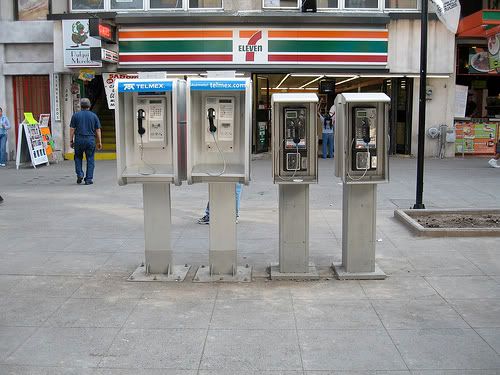
"Pay Phones" - an ancient form of communication, operated by coins
Yes, it's more adventurous just to get on the boat and go - it's leaving in 5 minutes, so you don't time to connect to the internet; but, really, you're taking years off your mother's life in worry.  There's another boat. Even if it's 2 days later, you can wait.  After all, isn't that the point of getting lost in rural Latin America? Time doesn't matter any more?

Tip #4 Do What You Promised
If the end the time limit you told people was 5 weeks, make sure you make contact within 5 weeks.

Yes, I know you just met the jungle tribeswoman that you're going to leave your girlfriend for and get married in an ancient ritual, but still ... first go to the nearest town with a phone and call your mother.  That way she can cry about it (joy of hearing from you, sadness of loosing her baby to a unknown woman from strange and foreign land, who will probably treat him cruelly) and pass the phone to your dad who can say mean things to you to bring back to your senses.

Trust me.  It's helpful.

Tip #5 Practice Disconnecting Ahead of Time
If you're going to isolated places where it's likely you'll be disconnected, practice doing it before it's necessary.  Try only posting FB updates once a week for a while.

I know the social media age demands daily updates, and even that is considered limited.  But again - why are you going to rural Latin America?

Sometimes it's nice to put it up as a whole story.  Sometimes it's  nice if reality trumps social media; you write only part of the story, because you just have so many other wonderful things to do.

This also helps people feel less shock when you disconnect for 4 weeks.  (But you still need to tell them ...)

Conclusion
Well, I guess that's everything.  Who knows if Garrett and Jamie will read this, and it might not be any use if they do.  Maybe they've learned their lesson, or maybe they've already decided not to go missing anymore.

But for the rest of you young, adventurous travellers who live on the internet at all other points of your life, please be sensitive to that fact when you escape for a short time.

(Oh, and I might ad tip #6: if you are passed puberty, try to convince your mother not to see you as her "baby" any more.  Besides the fact that it's not terribly manly, it will save her a bit of worrying if she sees you as a man instead of as a little boy.  It's a tough one.  For the record, I'm not saying this was the case with Garret or Jamie, but I just know so many examples.)

(And a final note, don't take anything in this blog post to be actual facts about Garret and Jamie. Besides the fact that I just quickly skimmed through two articles about them, I also wrote a good deal of the top of my head.  If you want to know about their story, please read the linked news story, or Google search their names.)

Friday, April 26, 2013

Why Are "Catholic lawmakers hostile to abortion even when more moderate on other social issues?"

Before I say anything, I want you to click on the link below.  I want you to look at the green number that appears at the top of the page.  First see how many millions are listed there, then notice how quickly that number is going up?

http://www.worldometers.info/abortions/


When I opened the page it at 13,336,610.  It goes up by about 3 every second.

A law recently passed in Kansas limiting abortions
These are statistics for clinical murder.

The counter shows how many human beings are being murdered around the world every second - not total of murders, but only those murdered clinically, in a nice, safe, clean sterile setting that makes these murders seem like a "medical procedure."  This clean, clinical murder is called "abortion."

The total is the number of abortions that have taken place this year - since January. That's less than 4 months.  In less than 4 months, well over 13 million babies have been intentionally murdered in clinics.

That means that in less than 2 months, there were over 6 million clinically murdered babies.

According to the same webpage, the WHO reports that there are between 40 and 50 million abortions per year. That means that in less than 2 years, there are more than 75 million clinically murdered humans.

a precursor to abortionists
Why 75 Million Murders?

Why do I highlight the numbers 6 million and 75 million?  Well, about 80 years ago, a man took over the parliament of a prominent and very advanced European country.  He proceeded to start a program that led to and arranged for the clinical and systematic cold-blooded murder of over 6 million innocent people.  This program also lead to the deaths of 75 million people in the war which most people would consider the worst catastrophe in human history.

This man is an icon of evil; his actions and the way of thinking that led to those actions are unquestionably condemned by all reasonable humans.

Yet, the same number of cold, systematic, clinical murders that he committed in about 6 years was committed in the first two months of this year in the name of "choice" and "rights."

Of course, we're comparing planned, clinical murders in a handful of nations to those in the whole world .  So to make the comparison more fair, let's compare only to the U.S.  According to the WHO, there are about 3000 abortions a day in that country. That means there are 6 million every 5.5 years.  That means in the U.S. alone, abortion is outdoing the holocaust in a lesser period of time.

The same total number of people that died in horrendous 6-year war that evil man started have been murdered in abortions in only the past 2 years.  Both these numbers are world-wide.

A monster, because he made abortion look as dirty as it really is
The Holocaust of Our Progressive World

World War II and especially Hitler's Holocaust were horrible atrocities which should have never happened.  The numbers above show that abortion is an even greater atrocity - at least by 3x.

Abortion is the Holocaust of our modern, progressive, middle-class world.

Like the Holocaust, comfort, ease and - most importantly - the fear of shame or public humiliation for speaking out against it, make us quite us quite content to allow it to carry on quietly out of sight in safe, sterile clinics where it won't make us feel bad or guilty.

Unlike Hitler's atrocities, which eventually brought almost every other super-power nation against it, there is only one single nation in the world that has taken a decisive stand against abortion (Chile).  All other either endorse it as a "fundamental right" (increasingly more common) or turn a blind eye to it.

Many people are upset by what happened with Dr. Gosnell.  A few people are upset because he was murdering babies.  Most people are upset only because he wasn't as clean and clinically sterile as he should've been and - worst of all - that he let his filthiness spill out into the public eye to make us uncomfortable.

Like the brainwashed middle-class of central Europe in WWII, we are willing to turn a blind eye for the sake of comfort - we just want to be sure that it's kept comfortably clean and out of our sight.

Alberto Giubilini, advocate of "after-birth abortions"
The Final Solution

Post-birth abortion is not only a monster looming in the future used as a scare tactic by pro-lifers.  It is a common and accepted practice - even if it has not yet been given official legal approval.

It is already common practice for babies born live after botched abortions to be (a) left to die or (b) killed by the same techniques used in abortions.  This not a freak abuse limited to monsters like Gosnell.  In Canada, the government has reports of this happening to almost 500 babies in 10 years.  These are only the reported cases.  (In Canada, there is no legal requirement to report an abortion.)

Planned Parenthood practices both techniques (a and b) mentioned above.

The academic groundwork to justify "post-birth abortions" legally has already been laid by "credible" academics in influential places.  The justification is that a baby can be killed by the same techniques used in abortions “when circumstances occur after birth such that they would have justified abortion."  They use the term "after-birth abortion" rather than "infanticide" "to emphasize that the moral status of the individual killed is comparable with that of a fetus … rather than to that of a child."

(see http://articles.washingtonpost.com/2013-04-08/opinions/38362423_1_viable-babies-abortion-survivor-planned-parenthood)

Marc Thiessen - a critic of "post-birth abortion"
Basically, killing a baby just after birth can be justified by the exact same arguments used in favour of abortion. And these academics are right; there's no reasonable way you can justify that a baby is a conscious human being 1 minute after the leaving the mother completely if you did not recognize that status 2 minutes earlier when part of her was still inside her mother.

Currently, there are scientists studying the question whether a 2-month-old baby is a conscious human or not - and even a 5-month-old.  People should be paying much more attention to these studies, because if the "scientific consensus" answers the above question with "no" then we will soon be having academics, and then doctors and judges, talking about something like "pre-consciousness abortion" to describe a process for clinically murdering babies that are several months old.

Unlike the case with pre-birth abortions, for "post-birth abortions" we don't even need renegade doctors who want to be heroes. Planned Parenthood is already doing that quietly, behind the scenes, on public money and with public approval (given through silence.)  All it will take to implement this "final solution" is a couple of Supreme Court judges who want their names to be recorded in history as the fearless leaders of justice who overturned their nation's laws for the sake of "progress."


Saving a Mother's Live?

And the big question - how many abortions are procured to save a mother's life? This is after all, the end-all wildcard pro-choice argument that makes all pro-lifers shut up and be entirely ashamed of ever even thinking that abortion should be banned.

Reasons for abortions
In a U.K.study, 0.006% were in direct response to save a mother's life (i.e. she was dying and the abortion saved her), and another 0.37% were due to risk of the mother's life (i.e. it was unsure if she would've died or not, but the risk was high.)

That means, of the 13 million babies clinically murdered since January, probably only 78,000 - worldwide - were in direct response to the immediate threat of death for the mother.

Abortion is not right in any situation, but the point here is legal abortion has nothing to do with saving mothers' lives. 99.994% of abortions are carried purely for a matter of personal preference or convenience, justified on the assumption that the baby is not in fact a human.  This lends itself very nicely to post-birth abortion arguments.

(*U.S. stats will list 2.8% as "maternal health concerns." This does NOT indicate danger or even risk of death, but "health" in a far broader context. "Danger of death" does not show up on stats - I'm assuming because the cases are so rare.)


Me, holding my babies minutes after they were  born.
They were humans then, just as they were 8.5 months
before, at the moment of conception.
Some More Stats
  • Worldwide, there are 125,000 abortions per day - that's the entire population of Waterloo, ON, or Playa del Carmen, MX, murdered every day
  • In the US there are over 3000 abortions every day - that's the population of the township I live in
  • That's a total of about 20% of all babies in the U.S.
  • In Canada, there is one abortion for every 3 live births; that's 25% of all babies

So ...

I couldn't name a worst atrocity than this one. Go back to that counter again - http://www.worldometers.info/abortions/. Every time that number turns over, imagine a person in nice clean clinic, having surgical scissor being jammed up through her neck into her brain, or having her spinal cord severed, or being burned in chemicals or cut to pieces alive - of course, in each case this person is nicely sedated and muffled to ensure that other people in the room don't feel uncomfortable about the process - they might see her squirm a little, but doctors and scientists can reassure us that that's just an non-conscious reflex. Pleasant thought, isn't it?

Back to the Main Question

Why, then, is that "Catholic lawmakers in particular are often hostile to abortion rights even when they are more moderate on other social issues"?  Tara Culp-Ressler at ThinkProgress.org points out this fact as though it's absurd, some sort of silly contradiction.

I hope the numbers and comparison I shared above answer this questions satisfactorily. Abortion is not simply another "social issue."

Monday, April 22, 2013

I Don't Celebrate Earth Day - and This is Why


Earth Day - With Earth above humans
There is a whole bunch of new holidays that governments and international organizations have put into place that I simply couldn't care less about, one way or another.

Earth Day  is not one of these.  While I care a good deal about nature and the environment, I specifically choose NOT to celebrate Earth Day.  Why?

What is Earth Day?

Earth Day is a celebration of environmentalism.  The idea is to highlight and inspire people to start good ecological habits, do something to care for the environment or promote environmentalism, etc.  And as far as these actions themselves are concerned, I agree with them and believe they are good.

The Problem with Environmentalism

However, the problem I have with Earth Day is that its purpose is to promote environmentalism.  Environmentalism has problematic current within it - and I would say it's a strong one, although it runs below the surface in many cases - to place the environment and earth above and beyond humans themselves.

In extreme cases, the point is obvious. For example, I once read somewhere that fanatical environmentalists would rather procure an abortion than cut down a tree. Once I told a truly fanatical environmentalist (vegan and obsessed with animal rights to the extreme) about the death of a person; his answer was, "Good, another meat-eater dead."

Those are extreme cases and not worth dwelling on. But even in fairly non-fanatical environmentalism, I believe this same basic problem defines some basic assumptions and it is seen as normal that the care of nature should take precedence over the quality of life of humans.  The earth and protecting basically becomes an end.

This basic error is the reason I don't celebrate Earth Day.

Healthy Care for Nature

In a healthier view of caring for nature, it is a means rather than an end in itself.  We care for nature primarily because it is good for us.  Destroying nature will have (and has had) horrible consequences on the quality of human life.

His Holiness Benedict XVI, an open advocate of
protecting nature as a means, not an end.
However, since the purpose of caring for nature is to improve human life, we must also be prepared to use and adapt nature responsibly for that purpose when it is available.

Now, some people who celebrate Earth Day will probably object at this point and say that they agree with me. "You can believe that and still celebrate your view of caring for the Earth."

No, in fact, I can't. And this leads me to my last point.

No Room for God

Earth Day does not include God. It does not recognize Him, name Him or acknowledge Him.

"But can't I say that caring for God's creation is praising Him?"

You sure can, but that's not what Earth Day is about.  If it were, then somewhere, on all the pages of the official organizers of Earth Day, we would see the words "God's Creation."

Thus, it not only promotes a movement that puts nature above humans, but one that puts God's Creation above God.  This is, in fact, the root of the previous problem.  God created the universe to glorify Him.  He specifically created the Earth to be subservient to human beings, His children.  He created it to glorify Him, and part of this is to serve us.  We are given care of the Earth, together with use of it and command of it.

Now, if you take God out of the picture (as all Earth Day write-ups do)  then the reason for making care for nature a subordinate means to improve human life is greatly weakened and lines are blurred.  It is no longer necessary to make this distinction clear.

"I'll celebrate Earth Day to praise God, but you can do it to worship the earth and wish death upon meat-eating humans if you like; as long as we plant some trees together ..." Not a healthy message to put out there.

There are many, many Christians who care for the environment. Some of the most enthusiastic people I have known have been devout Christians.  So why is God excluded from Earth Day, then? As far as I can guess, the organizers wouldn't want to distract people of the matter of highest importance (environment) from one that to them is of secondary importance (God.)  They mention the improvement of quality of human life in passing, but not as a main point; they know they can safely mention it without risking removing the Environment as the end, the #1 item.

Replacing the Importance of Pascha (Easter)

On another point, I'm also distrustful of this holiday displacing Easter.  Easter, (or, by its correct name, Pascha) is the greatest celebration of the Christian year.  It is the celebration of the Resurrection of Christ, the most important event in history, the defeat of death and the victory of Christ bring us eternal life.

But isn't Easter is only 2 days - or 3 if you want to count Good Friday?

In the Western tradition, which includes most Christians I know, Paschatide (or "Easter Season") includes the 50 days after Easter - which makes sense since it is the most important festivity of the year. Earth Day almost always falls after Easter, so right in the middle of these 50 days of joyous celebration.  Easter is, in fact, a feast of renewal, of springtime; from what I've read, early Christian writings connected the renewal of nature in spring to the Passover, to the Resurrection, and even to the Creation.

I wouldn't begrudge Earth Day one simple day the 50 of Paschatide, but as the website for Earth Day Canada points out, "In Canada, Earth Day has grown into Earth Week and even Earth Month to accommodate the profusion of events and projects" (http://www.earthday.ca/pub/about/history.php.) So, now people are taking a full 30 days of Easter's 50 to devote an environmentalist cause that specifically excludes the mention of God?

I prefer to celebrate the Resurrection of Christ.

If Earth Day were to give due place to God and even mankind over nature, I would also not hesitate to mix the two holidays.  But I cannot justify mixing the holiday which has been the most important celebration of God's mercy since Israel left Egypt with a month-long celebration that excludes Him altogether.

Caring for nature - our gift from God to care for and use
I'm not anti-fanatical

So, now, just for the record, I'm not a fanatic against Earth Day.  I wouldn't look down on a family or individual for participating.  I`m sure many many people participate with best of intentions - even best of Christian intentions, participating with the purpose of glorifying God and serving the betterment of human life.  I did not discourage my son from participating in the school events or being excited about it.  I only took time to sit down and talk to him and make sure he know why we celebrate and protect the Earth.  I was sure that first God and then humans held their proper place.

My family recycles, saves water, reduces garbage, reuses containers, shops local (as often as our budget allows us) and uses cloth bags, among other such items. But we don't do it to serve the Environment as a end in itself.  We do it primarily because the Earth is God's creation, and secondarily because humans will be able to live better as a result.

If I knew Christians who celebrated Earth Day, I would express my doubts about this day, but I won't go on any crusade against it.  It's not important enough - at least not yet. (If I live to see an "Earth Day Easter Celebration," that might change.  In 2057, the Western Easter is on April 22.)

Sunday, August 26, 2012

No More Facebook (for now ...)

I've made a decision to cancel my Facebook account for a while.  I've been told that even if you deactivate, the minute you try to sign in again, it just reactivates everything the way it was before.  So, to make it a little harder for me to "get back into it," I'm also going to de-connect all of my friends; at least I'll have to start from 0 when I come back in.

(If you are a Facebook Friend, don't take it personally when I "cancel" our Facebook connection - I'm doing it to everyone.)

It's almost certain that this won't be permanent, but I do want it to be long enough to get myself out of the habit and un-addicted.

This evening, as I was viewing Facebook, I smelled the smoke of a backyard campfire coming in through an open window.  Why wasn't I at a campfire? Facebook.

I have about 1000 things to do that would be better ways of spending time than Facebook.  Some are big things, like family or religion.  Others are little things, like this blog.  I want to replace some of my screen-connections with real face-to-face connections.  When I am online, I want it to be something more productive.

There are things I hate about Facebook, like the adictive-ness, and the compulsion I've started feeling that sharing something on this public bulletin board actually makes some difference in reality. Sorry to say so, but I can't stand those ridiculous pictures people put up with the one-liner commentaries on life, politics, religion, or cats. And of course, those discussions we let ourselves get into are just so silly.  By far the worst, is the time I waste.

There are good things I like about it too.  I love seeing pictures of nieces and nephews or my friends.  It's nice to find out soon when something wonderful happens, easily offer some consolation to someone going through a hard time or simply be up-to-date with where people are and what they're doing. People have also shared many great articles on Facebook.  It's been a good way to re-connect with people I may not have otherwise found again. When I do get back onto Facebook sometime in the future, I look forward to enjoying these items again.

These are the things I first started using Facebook for. I started using it more, on a daily basis, to publicize this blog.  Ironically, it started eating away at my blogging time, little by little; now I'm on FB several times a day, but I write a blog post less than once a month.  Maybe I can start posting again regularly without FB.

Let's see if this little experiment works.

Thursday, May 3, 2012

Prosperity and Abundance

In a previous post, I wrote that I don’t believe that poverty in its truest sense exists in most places I’ve been to; even the poorest place I’ve been, where $500 dollars is a massive fortune, the people have never gone a day of their life without more than enough food, the clothing they need and a house to live in.  They have very little, but they are lacking nothing.

This doesn’t mean that true poverty doesn’t exist; it simply means that it in our comfortable world of prosperity and abundance, we have a skewed definition of poverty. Many of us have more than enough food every day of our lives, and money to spend on all sorts of extra items that are in now way necessary to live on, yet we consider ourselves poor or low income.

The village where we live in Canada has a large number of Mennonites arriving from Mexico; many live on incomes much lower than Canadians consider “necessary” with families much larger than Canadians consider sane.  Some church charities have noticed the situation and taken steps to help out.  For example, one day of the week, there is a sewing circle in a church basement here; one of the charities goes to a local grocery store and picks up all the fruit and vegetables that the store can no longer sell.  About 90% of these are still good, and only very few have gone bad.  The people who take these pick out some of the fruit, but leave pretty much all the vegetables and even some of the less popular fruit.  If there were anyone truly living in poverty, I’d suspect after everyone had picked out their favourites, they would pick it up the whole box and take it home to feed their needy family.  But no one does.

I am not complaining about or criticizing abundance, I’m only saying that we are so surrounded by abundance, that we don’t even realize it.  We begin to think that abundance is poverty.

Personally, I’m thankful for some of the benefits that overabundance brings.  Besides regular thrift shops which sell excellent used stuff for cheap prices, there’s a shop nearby called the “Twooney Barn.” It’s basically a thrift shop where you pay whatever you want for things.  You can also exchange furniture, clothing and a bunch of other items.  When you’re done with things, you simply take them back if they’re still good.  My wife went there for the first time today and completed the few things we still need for our new apartment here in Canada.  It helps keep the budget in check.  Places like that wouldn’t be possible without a culture of overabundance.  I’m thankful for and to the people who have too many things and are willing to give away some of those things, despite the fact that they are in perfectly good condition, so people like us can buy them at whatever price we see fit.

So, yes, I’m thankful that we live in a place of abundance and prosperity.  It only surprises me when people don’t realize how abundant and prosperous life really is.  Realizing this would help us do more for those who truly are poor.

Wednesday, February 29, 2012

Why I'm Not Vegetarian


First of all, I need to start of by saying this is not an anti-vegetarian rant. In many ways, I sympathize with and practice vegetarianism, (depending on how you define vegetarianism - I point I'll get to below.)  I eat very little meat.  My family buys and eats small portions of meat once a week, and we're happy with that.  We would probably be just as happy if we ate no meat at all.  For lent, we are eating no meat (except on Sundays if the occasion arises, which it usually does with our very carnivorous friends and family.)  Lent is hardly a change or challenge.  During normal weeks, we don't miss it or even think of it if we miss our weekly trip to the butcher.  So why don't I just take that easy step and make myself vegetarian?  Here are my reasons.

Vegetarianism is a means not an end.  In its proper context, practicing vegetarianism at times, most of the time or even all the time is a means to accomplish something else - health, religious devotion, saving money, economic improvement, protesting animal abuse, etc.  In their proper context, I consider all of these valid; I would definitely say some of these goals are more important than others, but all have some degree of validity.  But when we define vegetarianism as a practice which is a means to accomplish another goal, it means that there is no such thing as a "vegetarian."  Both a monk and an animal rights activist may practice vegetarianism, but it would absolutely incorrect to lump both together under the category of "vegetarian."  Their reasons have nothing to do with each other, and their manner of living and focus in life are entirely different.

Vegetarianism is something you can do sometimes, and not at others. This definition of vegetarianism (a means to accomplish other ends) is the definition I support. Depending on the purpose, I sympathize with and practice vegetarianism.  This definition allows someone to practice vegetarianism 95% of the time, then eat meat at the family Christmas dinner without feeling they've "lost their (meat) virginity," so to speak; it allows people to practice vegetarianism during religious fasting, and enjoy eating meat again when the feast day comes.

The label "vegetarian" makes vegetarianism an end rather than a means.  I would say most if not all vegetarians start off with something like I described above; they abstain from meat for a specific purpose which is an end more important than the practice itself.  Yet, I  feel that often once people make the leap and finally to call themselves "vegetarian," (note: this is not giving up meat altogether, but actually taking on the label) the relation of means vs. end gets turns on  its head.  Vegetarianism is now the end, and the purpose, and all the other ends (religion, health, animal rights, economy) suddenly become the means to justify being Vegetarian.  A vegetarian trying to convince someone else to become vegetarian (a situation that couldn't happen in the above definition) will give a long list of justifications - "Take your pick," is the message, "so long as you become vegetarian, it doesn't matter what your reason is."

Vegetarian purity. Once someone calls himself "vegetarian," he is committing himself to NOT eating meat pretty much at all costs.  I've seen vegetarians have a whole household running around trying to change the food so they can eat it. If a "vegetarian" eats meat once, they've committed a grave error on a moral level. They're left with the moral conflict of whether they will continue to be vegetarian or give in to their failure and abandon their cause.  Being vegetarian, if you're not careful, can become like a religion in itself.

I probably don't have to say that I'm not a fan of this kind of vegetarianism. Besides the fact that I still haven't heard a compelling reason to give up meat completely (to eat less or even little meat, yes, but to eat no meat, no,) I've never liked the idea of putting my hosts to all sorts of trouble to accommodate my preference.  The most important point is, I see vegetarianism as a means to accomplish more important goals.

I will continue to practice vegetarianism as often as it's necessary or reasonable to do so.  I'll continue practicing vegetarianism many days of my life because meat costs too much; I'll continue practicing vegetarianism during religious fasts to focus on God and give more to others.  On the other hand, for now, I'll continue eating meat when my family feels like it, to celebrate feast days and (usually) when I'm at another person's house and they offer me meat. But even if one day I stop eating meat altogether, I still won't be "vegetarian," because it will still be a means to accomplish another end, and not an end in itself.

Friday, July 8, 2011

Our Daily Bike Ride – Part II – Leisure vs. Practicality

Riding Bike on a Trail in Waterloo RegionI’m happy that we’ve started the habit of our daily bike ride here.  It’s not only good exercise, but excellent family time.  I’ve always loved biking, and I’ve always used a bike whenever I’ve lived in a place where it’s possible.  I’ve noticed that my bike usage has changed.

When I lived in Playa del Carmen (as in Toronto several years before), I rode a bike for transportation; it was a practical tool.Daily Bike Ride  Sometimes I used it for personal exercise in the morning.  Now, as during my teenaged years, I ride my book for pleasure.  I go out with my dad, my wife, my three-year-old, and the two girls of the family we share a house with; it’s a big happy family/community bike ride. (My mother very kindly stays at home to take care of the baby.)

The bike rides are wonderful and I’m glad we’re in a place where we can enjoy them.

Wednesday, March 2, 2011

Cloth Diapers - Advantages and Disadvantages

The "Fancy" Cloth Diapers - The folded diaper cloth is inserted into the decorated liner
While we used only disposable diapers with our first baby (who's now 3) we've used almost only cloth diapers with our most recent baby.  Throughout North America, including Mexico, there seems to be a small but growing trend to go back to cloth diapers, along with breast-feeding, etc.  The good news is that this makes cloth diapers more available   The bad news is that as soon as something becomes associated with a "natural" or "organic" lifestyle, it becomes more expensive.  The better news, however, is that even with more expensive cloth diapers, it's still much cheaper than even discount disposable diapers.

Our baby wearing one of these nice cloth diapers
When we tell people we are using cloth diapers, we get varying reactions, including, "Are you crazy?  What's the point of making so much work for yourself?", "That's neat, but it's just too much work for me", and, very rarely, "Wow, we're doing that, too."  Both of our mothers were very enthusiastic about the idea, but kind of shook their heads at the fancy and expensive cloth diapers we ordered over the internet; they both thought it would work just as well to use traditional diaper cloth and the nylon shorts.

We are now using both traditional cloth diapers (composed of a cloth, safety pins, and nylon liner shorts) and our collection of "fancy" diapers; the truth is at first the traditional cloth diapers were all we wanted, but we couldn't find the nylon shorts anywhere (diaper cloth is easy enough to find at any fabric store.)  So, we looked on the internet and ordered some nice hand-made cloth diapers with colourful designs.  My parents live in a Mennonite community in Canada, so finding the nylon shorts was easy enough.  My mother sent some to us by mail, and they work great.

Generally speaking, the following are the advantages of cloth diapers, from what we have found:

  • They reduce garbage considerably
  • They are much better for the baby's skin (they're made of cotton.)  With our second baby, we haven't had a single diaper rash, even living in a hot, humid climate.  With our first, living in a cool, fresh climate (Mexico City) he had rashes quite often using disposable diapers.
  • They are cheap.  For the nicer designed ones, a package of 12, which is usually meets our needs with a daily wash cycle, we spent about $200 dollars; even cheap disposable diapers run up close to $100 per month, so in three months that money and more has been saved back.  The price of the detergent (which is a very simple detergent) is negligible, and since the daily wash load of diapers fits into the "small" or "medium" setting on the machine, our water bill hasn't risen noticeably.
  • They look nice (our "fancy" internet diapers.)
 The disadvantages are:

  • They need to be washed every day. But once you're in the rhythm of this, it's five minutes in the morning to start the machine, and another 20 minutes to hang them and fold them.
  • "Solids" need to rinsed out.  But this is usually only one diaper a day.  It's also just a matter of a quick rinse; the machine does the real work.  As my mother-in-law says, "It's just milk, anyway."
  • You need to carry the dirty diapers with you when your out and about.  The cloth diapers we bought over the internet close up very nicely and don't let odours out.  The biggest problem is the bulk of carrying them.  We still haven't tried the traditional cloth diapers, but we'll probably just save those for at home.
  • They take a little longer to put on.  The fancy ones from the internet go on just as quickly as disposables, but take a few minutes to prepare (inserting the diaper cloth into the decorated liners), which my wife usually does ahead of time.  The traditional ones are only slow when you first start, and once you get the hang of it are almost as fast as the other ones.
  • If you're using the traditional ones, they need to be changed immediately.  The fancy ones have an extra liner and help keep moisture away from the skin a little longer.  In any case, it's best for the baby's skin to change any diaper (even disposables) immediately, so this really shouldn't be an issue.
The components of a traditional clothe diaper - cloth, safety pins, and nylon liner "shorts"

As you notice, I have a "but" for every disadvantage.  The truth of the matter is, my wife and I are NOT super fanatics for "natural" trends; we try to do a little, but will give something up quite readily if it doesn't look like it's worth the trouble (I'm not proud of this, it's just to put this into perspective.)  Cloth diapers are much easier to use than most people imagine.

In terms of the environmental point, some people will argue that the water used is as bad or worse than the garbage generated by the disposable diapers. This is especially true here on the Yucatan Peninsula, where otherwise correctly treated and disposed waste water still damages the coral reef.  However, besides the huge factor that it's still better for the baby's skin, the water used for washing is equal to about 2 flushes of the toilet, or for what many people is a standard shower.  While waste water and clean water usage is a real issue, it should be addressed in terms of rain water collection and alternative treatment and disposal methods, since even without washing diapers, it's still just as big of an issue.  It should not be used as an excuse not to use cloth diapers.
Our baby using a traditional cloth diaper.

(I know some people who consider themselves people who "care about nature" but don't recycle, don't use alternative products and don't use in any other environment-friendly activity in their lifestyle, since for everyone of them, they've found a opinion that feels that the alternative is worse than the normal main-stream practice.  So, care for environment seems to mean, for these people, doing everything like we are now, and discouraging any alternatives.  I see this as a cop-out to avoid saying that they just can't be bothered. I'm less concerned when people say they just feel they're too busy, or don't care much; at least they're being honest, and those problems can be addressed by making things easier.)


Back to the main point, we're fans of cloth diaper use (both fancy and traditional), and we would recommend it to anyone who is wondering.  Our baby's skin is better, we're saving money, we're doing one more little thing to reduce garbage, and our effort has been minimal.  I would only recommend that anyone interested who has never changed a cloth diaper before use the fancier ones, to start at least. The nylon shorts for the traditional ones are harder to find these days, and if you prepare the the fancy ones ahead of time, they're really easy to change.  Since they come with neat designs and look really nice, it's also easier to get excited about them; motivation is important since our modern lifestyle makes it hard to "get into" something like this.  (The novelty wears off after a few times of washing the "solids" out, but excitement can give the routine a nice and necessary boost at the beginning.)
Our diapers drying inside (after washing!) on a rainy day - we don't have a dryer.

Saturday, February 19, 2011

Cold or Alergies? Here's a Good, Semi-Natural Treatment

An Effective, Semi-Natural Cold or Allergy Treatment
For the past  2 months, I've had an ongoing cold or allergies; the funny thing is that since I've moved to Playa del Carmen, a nice sunny, warm beachfront town, both have been noticeably worse than either in central Mexico or in Canada.  And, on top of that, my allergies seem surprisingly similar to a cold.  The very few times I've gone to the doctor, it's always turned out to be allergies, even though EVERYTHING about it feels like a cold.

This morning my 3-year-old son woke me up at 6:30, and I had a runny nose, I was sneezing and had a headache, and I had to blow my nose every 3 minutes.  10 minutes later, the baby was crying and wanted to eat.  (Saturday is my wife's only precious sleep-in day during the whole week, so it's out of the question to take that away from her.)

I felt like closing myself into a dark, quiet room to just forget about the world.  I thought about heading to the drugstore for allergy medicine, but then I decided to try our alternative approach first.  The last time my family came from Canada, my dad had given us a bottle of tea tree oil as a natural treatment for ticks on our dog. (Ticks are very, very common here in the jungle, and all dogs get them if they are not treated.  Most people use a horrible chemical that cannot be used by pregnant or breastfeeding women, or anyone under the age of 19.  The tea tree oil actually works very, very well - better than the chemical.)

A few months ago, reading the natural health booklet that came with it, I realized that it had lots of uses, including treating the common cold. I found it also works for allergies.  So, this morning, this is how I treated my allergies/cold or whatever it is:

  • Tea Tree Oil - I heated a pot of water until it was steaming very well, and added 10 drops of tea tree oil.  I place a towel over my head and leaned over the steaming pot inhaling the vapor of the oil.  The relief in my nose was almost instant.
  • Hot Tea -  I used Tetley Orange Pekoe tea, but I would normally us an herbal tea - we've run out.  I prepared it while I was heating the water, so I could enjoy it immediately after the tea tree oil.
  • Paracetamol - I took one tablet to help with the headache.  The only not natural part of my treatment.  This is still much better than going to the doctor here; most doctors (although most certainly not all) in Mexico tend to way over medicate; I'm highly suspicious an hesitant when it comes to over-medication.  We've found 2 doctors who are very conservative about medicine, and give treatments (which include only small amounts of medicine if any) whic, as we suspected, are usually much more successful.  I also believe in generics, most of the time.  Tylenol costs about 10 times as much, and does the same thing.

I probably could have done without the paracetamol, but on the whole the treatment was successful.  Afterwards, I just felt a little sleepy, but otherwise fine.  The rest of the morning was a very relaxing, comfortable Saturday morning.

To read more about my experience with healthcare and medicine in Mexico, read: