Tuesday, December 25, 2012

A Mexican Chistmas Celebration (Posada) in Ontario's Countryside


Now that Christmas time is here, I finally have some time to write again, as well as some nice events to write about.

First and foremost, one of the most exciting events to celebrate the coming of Christmas was a Mexican Posada. In Mexico, the tradition is that during the 9 days leading up to Christmas, neighbours and extended families will gather to act out the story of Joseph and Mary looking for an inn in Bethlehem, followed by a celebration with food, hot drinks and piñatas. The celebration is called a Posada, which is the Spanish word for “inn.”

In our village here Ontario, we celebrated a Posada on Sunday, Dec. 16.  The priest at our parish first proposed the idea of holding this celebration here a few weeks before.

He had heard about these events, and had been excited to hold one; when he found out that my wife is Mexican, he thought it was an excellent opportunity to bring this rich Mexican tradition to Ontario's countryside!  Several people from our parish and from the rest of the community worked together to organize certain parts of the event.  The priest played the key roll of bringing the various people together and covering some of the central details, for which we're very thankful!


In the Mexican fashion, the first part of the celebration was held outside; starting at the main intersection, people carried candles and sung Christmas carols walking about 4 blocks to the parish.  In Mexico, a couple of people are usually designated to hold little figures of Joseph and Mary (usually the ones from a household nativity scene.)  However, the community went all out, and Mary, (a roll taken by a local teen) arived on horse-back, being led by her brother who took the role of Joseph.

Arriving at the church, following the Mexican tradition, Joseph and Mary (and the rest of the crowd) was greeted by a less-than-welcoming Innkeeper.  After a back and forth dialogue in which the Innkeeper even threatened to give Joseph a beating (translated from the original Mexican songs), the Innkeeper finally realized that Joseph’s wife was Mary, the Mother of Jesus, and gave them a warm welcome, inviting them and the crowd inside for food and drink.

The celebration followed in the church basement. My parents provided Mexican food ("gordas" and a type of enchiladas), with additional snacks provided by some ladies from the church.  There were also plenty of candies, cake and coffee to go around!

The atmosphere was festive and everyone present had a good time!  At one point, a woman stood up and led the group in song.

After dinner and desert, 3 large piñatas were brought out and smashed by blind-folded children holding a broom handle.  My family and I had prepared the pinatas; this was a bit of an adventure in itself since it was our first go a making them.

They turned out well and looked good, but I had used the wrong kind of string; at the time of breaking them, 2 of them fell to the ground at the first hit!  Since one of them didn't break, I tossed it up into the air, and one kid swung at it like a baseball.  Candies flew everywhere and the kids were excited.


Despite drizzly weather, the turn out for the event was considerable; our priest had expected about 30 people, and prepared food for about 50, thinking the left overs could be sent home.  My wife and I suspected that this would overkill, and would've been quite happy to see 25 people.


However, approximately 95 people were counted at the mealtime, and most of these had joined the procession and carol singing!  When the group arrived at the church, extra tables had to be set up, almost filling the space available.  Fortunately, the food was enough to go around, and there were even some leftovers.  The priest and some others said something about the story of the fish and loaves.

Members of St. Mary’s Parish, neighbours from Linwood, residents of St. Clements and even an entire table of visitors from Toronto were among those attending the event. (Both Catholics and non-Catholics joined in.)

Leaving the event, many people commented on looking forward to repeating the Posada next year.  With the excellent turn-out and the festive spirit of all who attended, we're definitely planning to repeat the Posada in years to come, making plans to accommodate a larger group!

My family followed up on this event with a little Posada just at our own home with only a handful of people, on Christmas Eve.  It seems that a fairly wide-spread Catholic practice is to leave the manger empty in Nativity Scenes until Christmas Eve, when the Baby Jesus is placed in the manger.  The Mexican version of this tradition combines it with the last Posada on the night of Dec. 24.


As Mexican families will do, three people were outside holding the figures of Mary, Joseph and Jesus; when they were allowed in by the "innkeeper" (those of us inside), the entire family gathered around the nativity scene and the person holding the figure of Jesus (my oldest son in this case) placed him in the manger as we sang Christmas carols!  This final Posada usually comes after the Christmas Eve Mass and "kicks off" the Christmas celebrations (dining, music, dancing, etc.) which, in Mexico, can last till dawn.

I'll write about our household Christmas celebrations another day.

Friday, November 9, 2012

Random Acts of Kindness Day - Planned Randomness & Official Charity

Today I went to the grocery store, and there were some people there from a community foundation who gave me a free copy of the local newspaper - The Waterloo Region Record.  Today, they informed me, was "Random Act of Kindness Day."  (My wife is currently enjoying the newspaper.)

There was one item I couldn't find, so I went to the grocery store down the road.  More people from the same group were there and offered me another newspaper.  I kindly thanked them and told them I had already received one.  They then offered me a coupon for a free coffee and some tickets for free access to the local pool and skate rink. I thankfully accepted both, and went to pick up my free coffee.

The acts were nice gestures and I am thankful for the free things they gave me.  However, at one point it did occur to me - how random are these acts of kindness if a group has planned and organized them, with sponsors and all?

Of course, the whole point was to generate truly random acts of kindness, simply using this planned activity to bring attention to the idea on this one day.  On the cards and book marks that they gave with the free gifts, there is a request for the person who receives it to offer a (small) random act of kindness with someone else on the same day - saying hello, opening a door, etc.

I did my few little random acts of kindness today.  But really they were things I do just about every day anyway - and things that people do for me.

So, was this planned event by this foundation necessary or useful?  Did someone out there today start a personal habit or "domino effect" of random kindness because of it?  I'd hope so, considering the time, effort and money they and others spent on it.

In relation to this, there are two conclusions I have come to:

  1. "Planned randomness" is only useful it inspires true randomness.  This may also be said of official charity, which is most useful if it inspires personal charity on a local, person to person level.
  2. If a good thing is happening, no matter how over-planned it may seem, let it be.  It is a good thing after all.  I felt good to get that free coffee.  My wife is enjoying the newspaper.  Hopefully this winter I'll get a chance to go skating with my sons.  It may not be the ideal way acts of charity should happen, but it is still in the end a good thing.
Do a random act of kindness for someone today.  A real one. Something above and beyond what you would normally do.  This will accomplish 2 things; it will eliminate the need for events like this one and at the same time it will make the people planning and carrying out this event happy to see such things are happening more.

Saturday, October 13, 2012

Our Lady of Guadalupe Parish Church, Playa del Carmen


Our Lady of Guadalupe Parish, Playa del Carmen
The parish where I first saw joining the Catholic Church a real, feasible action was the parish church of Our Lady of Guadalupe, Playa del Carmen (Paroquia de Nuestra Senora de Guadalupe.)  This church (both the building and the people) holds a special place in my heart.  It was (and still is) like a home along the journey.  Perhaps it could be compared to Rivendell somewhat; it's not the destination of the journey, nor is it Paradise or even the most important place in the journey, but it has offered me a place and time of rest, consolation and safety along an otherwise perilous road.

Nestled in the middle of Playa del Carmen's first (and least reputable) slum, its off-white steeple with stain-glassed windows rises above half-built concrete homes with fiberglass roofs, haphazard stores, taco carts and greasy little restaurants where thick smoke pours out of the chimneys from the chicken roasters.

The building itself is beautiful.  This is not because of the contrast to the slum around it; in fact, it would probably be more beautiful standing by itself or in a large spacious yard so you could actually see the whole thing.  But the surrounding neighbourhood is part of the church, as the church is part of it.  Many of the people who worship there live in these homes and the parish offers (to all who seek it) care, education, teaching in the Faith, blessings and the Sacraments of the Church.  The old Irish priest who started the parish about 20 years ago is respected and called "Father" by everyone I know of.  My point is; the parish and the community are inseparable.


Likewise, the building and the beautiful things which have happened there are closely bound to each other.

I think the building would be described as a neo-mission style. (Excuse the out-of-focus images; I'm getting used to using a completely manual lense.)

The Sanctuary

The main image, below the crucifix, is the Virgin of Guadalupe (patroness of the parish, and, of course, Mother of the Church), the Virgin Mary as she appeared to a native at the time of the Spanish Conquest. On each side of the image of the Virgin, you will see:


Christ as a Child with St. Joseph (the patron of our family.)

St. Juan Diego, the native Mexican to whom the Virgin Mary appeared.
 For nearly 2 decades the church was without windows.  Now, little by little, stained glass is being installed:

The steeple, looking south.
The 8 windows in the steeple and the two windows below it depict the story of the Virgin of Guadalupe appearing to St. Juan Diego.  The large one in the picture above shows the Virgin Mary giving the saint roses.  The bishop had been doubting that these appearances actually happened, so the Virgin Mary gave the roses as a sign to be brought to the bishop; at that time roses didn't exist in the area where the appearance took place (Mexico City), so the only explanation could be a miracle.

St. Juan Diego, showing the roses to the doubters. (Below the steeple, south)
Archangel Michael (north side, next to the sanctuary)

This is newest stained glass image, installed this summer, entitled, "Who is like God?"  The words of the Archangel Michael as he casts Satan from Heaven, who had claimed to be like God. (The anguished face of Satan is hidden behind the woman singing in the choir.  But you can see his wings.)

East end, opposite the sanctuary
This image is also dear to our family; St. Joseph, Christ and the Virgin Mary as the Holy Family.

The lower row of windows throughout the nave of the church still do not have glass; however, the upper row of 12 windows (6 on each side) offers some of the titles of the Virgin Mary.  My favourite is this one:

 "Refuge of Sinners" 
One of the Stations of the Cross

One of the confessionals (There's one on each side, near the back entrance.  Confession is heard during Mass.)

A view from the main entrance, looking towards the sanctuary.

The main entrance.
 The tables in the foreground are where homeless people, low-income workers eat during the week.

Side entrance (north side)
West end of the building.

Another image of the face of the Virgin of Guadalupe can be seen above the windows of the church offices.  The blue tarp is the area where people eat breakfast after Mass. (It's redundant and pointless to call it "socializing" or "fellowship;" for Mexicans every time you eat it's socializing and fellowship!)

This area is actually the plaza which serves primarily as the patio for the parish school, of which I didn't take pictures.  The school will need a post in itself.

Wednesday, October 10, 2012

Sunflowers

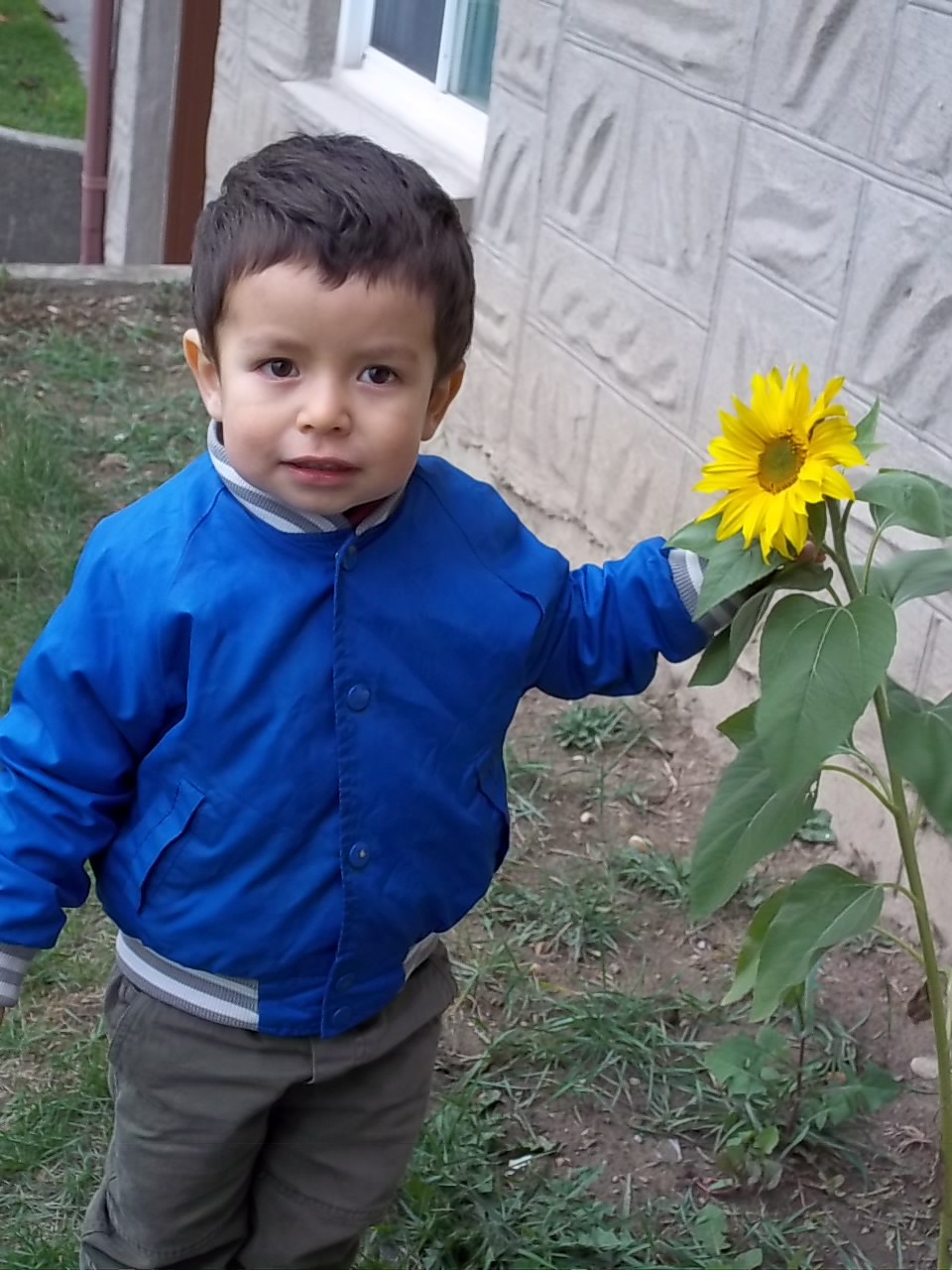
During June, my sons and I planted some sunflower seeds in the flower garden beside the house.  We planted 12 seeds.  We planted them late (I think May is ideal) and it was a very dry summer.  However, with nightly watering and the daily careful watching of my 4-year-old, two finally sprouted.  Both grew up and finally, last week while I was here in Mexico, the flowers opened.  My wife sent me pictures.

First, this is us planting them in June:

Now, three months later, here are my two sons, each with the sunflower that they claimed as their own (well, really the older one dictated which one belonged to whom, but they're both happy:)


Monday, October 8, 2012

Thanksgiving in Canada

Unfortunately, I wasn't in Canada to celebrate Thanksgiving this year; fortunately, my wife "shared" the dinner with me by means of pictures.  Looks delicious:

Table set

Some of the Family
(By the look of these first two pictures - looks like bacon and eggs - I'm not sure if it was breakfast, or the first part of the dinner.  In any case, I wish I were there ...)

Main course


If this is what I think it is, it's a "cooked salad" - some of the veggies are cooked, others are raw, with peanuts and grapes; I'm not sure if this a Mexican thing or my wife's creation, but it ends being pretty good.


Happy Thanksgiving to all!

Saturday, October 6, 2012

Another Beer, with a Mexican Snack ...

Tonight's Mix:

Leon Beer
The dark "Munich-style" beer I mentioned in yesterday's post. (see Mexican Beers - 2 of My Favorites.)

Chicharron
This is fried pork skin, that is dry kind of like chips.  As unappetizing as the description usually sounds, it's delicious.  Not the healthiest thing in the world, but tasty.

Valentina Sauce
This is a favourite Mexican sauce, good for just about everything from eggs to popcorn, french fries to pizza (if you're Mexican, that is.)  Tonight it's going on the chicharron.

Not a bad Mexican snack.  The beer is my favorite part.

The unusual part of the mix is Leonard Cohen.  Not very Mexican.

By the way, I go the chip for my camera (well, actually for my wife's camera; I don't own cameras.  If I do, she expropriates them.)  So, today I have a better picture.  Tomorrow I'll have more pictures of the city and other stuff, once again.

Friday, October 5, 2012

Mexican Beers - 2 of My Favorites

I don't have a whole to do on weekend evenings these days.  I'm in Mexico, without my family.  I've forgotten what it's like to be alone and go out and do stuff.  I feel like I should be changing a diaper, or doing the laundry. (Come to think of it, I do need to do the laundry.  Funny how I forget about that when I'm alone.)

In order to save money, I've limited myself to visiting some old acquaintances here (who also seem to stay at home with nothing to do), or, in the case of this evening, buy some beer to take home and drink it while reading (and writing) blogs.

Today, while reading some good pages, I've been enjoying two of my favourties: Leon, and - probably tied as my favourite Mexican beer - Negra Modelo.  The other favourite is Noche Buena, which is a special Bock beer sold only at Christmas time; the name means "Christmas Eve" and "Poinsettia," which is the logo of the brand.  Unfortunately, it's still much too early to find Noche Buena.

All of these are dark beers, which tend to be my preference.  However, a good Mexican light-coloured beer is Pacifico, which was originally a contribution from German (or more correctly, German Bohemian) immigrants in the north-west of the country (specifically Mazatlan) who also gave Mexico it's famous Banda music; this music - even in it's countryfied, popified versions - still carries the tradition of the triple beat (ump-pa-pa), the accordion and bass which are so characteristic of the famous Polka brought by the unMexican immigrants.

For most of us, it's rather strange to make any connection between German and Mexican cultures; the seem to be rather polar opposites in so many ways; but there it is, real and unmistakeable - both in the beer and the music.  (Incidentally, my own Germanic roots have come through Mexico.)

The German taste for strength, flavour and distinction combine well with the Mexican taste for easy smoothness and a happy life. (Yes, that's my description of Noche Buena, and applies to Pacifico as well; it could also be a description of parts of my life.)

Cheers!  Prost! and Salud!

(P.S. Still no memory card for the camera; but I remembered that my laptop can take pictures too!  The only problem is it's not convenient for taking pictures in the street.  The memory card will come tomorrow.)